by Paul Cudenec, who reads the article here
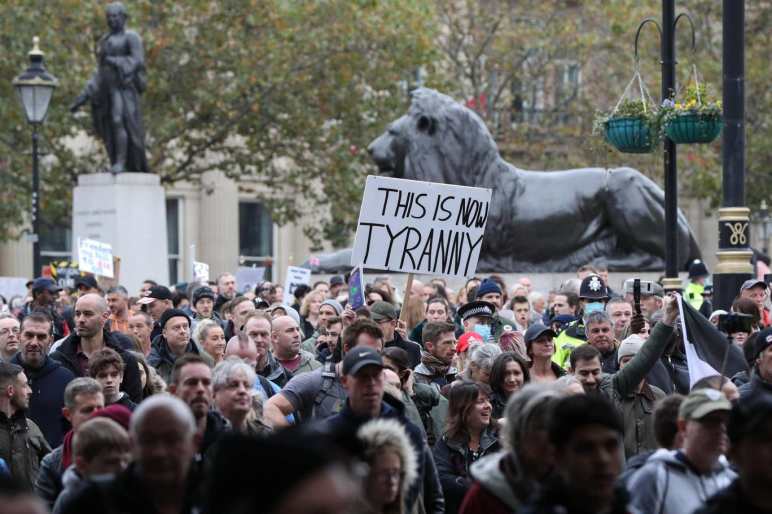
Every time that I strike a somewhat fiery note in my writing, as I did recently with ‘Our revolt will be raw‘, [1] a couple of people always seem to step forward to pour cold water on my joyful rage.
Probably the most infuriating kind of response is that which declares that there is absolutely no way we can ever bring down the global mafia so there is no point in even thinking about it.
Now, I can well understand why somebody might feel that the mafia has so much wealth and weaponry, and the population is so domesticated, docile and dumbed-down, that a successful uprising is not on the cards – I sometimes nurse the same thought myself, on bad days.
But why on earth would you feel the need to publicly trumpet this defeatist opinion, particularly in response to an article trying to persuade people to find the courage to resist our vile overlords?
Even if the possibility of a victorious rebellion is minimal (which I don’t accept is the case), it remains a possibility of some kind.
To try to convince would-be rebels that their resistance is utterly futile is to attempt to close down that possibility. This is a serious own goal for any authentic, but pessimistic, opponent of the system – it amounts to a potentially self-fulfilling prophecy acting in the interests of the ruling cabal against the people.

Another objection to a revolutionary outlook is that historical revolutions have proved to be false-flag operations aimed at placing power in the hands of the global mafia.
But we are no longer in 1789 or 1917 and power in our societies is already firmly in the hands of that mafia – today, any revolution against contemporary power would necessarily be a revolution against the mafia!
A spin-off argument of this kind is that we should not take to the streets in righteous anger at the endless excesses and crimes of the ruling racketeers, “because this is what they want us to do”.
This is, of course, a complete inversion of the truth – that is the very last thing they wish to happen.
Because sometimes public disorder has been deliberately instigated to advance state agendas, we are meant to believe that this will always necessarily be the case, under any circumstances.
Those who maintain that the authorities need outbreaks of disorder so as to have the excuse to clamp down on our civil liberties seem to have forgotten that those in power are already accelerating their assault on our freedom and trying to shunt us into their digital concentration camps.
Any resistance that breaks out today is quite clearly a response to that totalitarianism and not the cause of it or the pretext for it.

A third kind of objection to fighting talk comes from those whose spirituality is centred around passivity and non-action.
To them, it is terribly negative to try to throw off the assailant who is trying to throttle you to death, the positive response presumably being to allow yourself to be killed with a beatific and self-satisfied smile on your purple face.
I wrote about this question in a chapter of my book Nature, Essence & Anarchy – which came out 10 years ago, in the autumn of 2016 – entitled ‘When negative is positive’. [2]
There I explain that the desire to destroy an existing social order, an outlook typical of anarchists, is based on a positive mindset.
If you believe, as I do, that humans have a natural potential to live in co-operation in free organic communities, but that this potential is being cruelly denied by a state dictatorship, “then it is not a ‘negative’ thing to want to smash that dictatorial society to pieces”. [3]
I write that some people manage to repress the disgust they feel at the evils of modern society – in particular, now, at the increasingly obvious evils of the globalist cabal.
But other individuals, who unfortunately are currently in the minority, refuse to suppress their natural revulsion at the grim society they live in.
Instead, in the words of the anarchist psychoanalyst Otto Gross, they are infused with “the revolutionary instinct of humankind” which “refuses to adapt to that which is inferior”. [4]
I add: “Note that there is a two-fold action involved in this process – the revolutionary is calling on both the particular inner strength of their own individuality and, at the same time, the universal human revolutionary instinct.
“Ultimately, these cannot be separated – the revolutionary instinct of the species depends on the strength of certain individuals to express it. It is only through the individual that it becomes physically active.
“This is why anarchists, in theory and in practice, always insist as much on the freedom of the individual as on the social welfare of the community”. [5]
“Hatred for contemporary society and rebellion against it are born of an unconscious awareness that this is not how things are supposed to be…
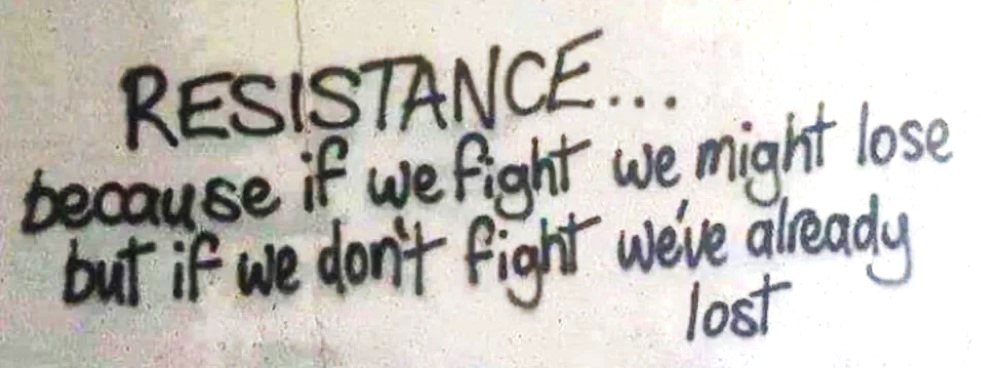
“Negativity would be to adapt to our surrounds, to compromise, to surrender to all that we know deep down to be wrong. Positivity is to be found in resistance, in struggle”. [6]

[1] Paul Cudenec, ‘Our revolt will be raw’, The Acorn 112, https://winteroak.org.uk/2026/08/21/the-acorn-112/
[2] Paul Cudenec, Nature, Essence & Anarchy (Sussex: Winter Oak, 2016), pp. 41-57, https://winteroak.org.uk/wp-content/uploads/2021/05/nature-essence-anarchy-w-1.pdf All subsequent page references are to that work, unless otherwise stated.
[3] p. 43.
[4] Otto Gross, Psychanalyse et Révolution: Essais, trans. by Jeanne Étoré (Paris: Éditions du Sandre, 2011), p. 147, cit. p. 50. See also https://orgrad.wordpress.com/a-z-of-thinkers/otto-gross/.
[5] p. 50. I obviously wrote this before Covid! See 2020’s ‘Anarchists against freedom’ for an update. https://winteroak.org.uk/2020/04/26/anarchists-against-freedom/
[6] p. 53.


I hear this too from spiritual circles and it is clearly a way to feel morally superior while keeping your head under the sand and not ruffling your feathers. To even pay attention to the evil is giving it power, they say, and it’s a very insidious belief, because there is some logic to it. In the immediate, here and now, you give it power because it’s now something that’s in your head, causing you to at least consider it, if not to take action, that’s true.
But what about the long-term goal of triumphing over it? How does that get done? I’ve not heard from them how that is achieved by doing nothing and ignoring it and passively waiting for it to go away. But this is absolutelythe mindset of spiritual and religious types around here.
LikeLiked by 1 person
I suspect that this passivity has been deliberately nurtured on a long-term basis.
LikeLiked by 3 people
To those who listen closely to Angus Dalgleish and host Jimmy Dore and come out the other side of their profoundly important discussion, and do not feel full, legitimate righteous indignation: Please seek medical attention immediately … because by this indication of apathy in the face of incalculable, historic criminality, you are already dead.
LikeLiked by 1 person