by Paul Cudenec, who reads the article here
We live in a society that generally lacks a spiritual dimension – everything revolves around money, possessions and power, with so-called “religions” often nothing more than systems of rules imposed on us by self-appointed authorities.
While we cannot go back to a time when that was not so, we can certainly go forward to a future that has restored that spiritual element and in order to do so we can draw inspiration from history.
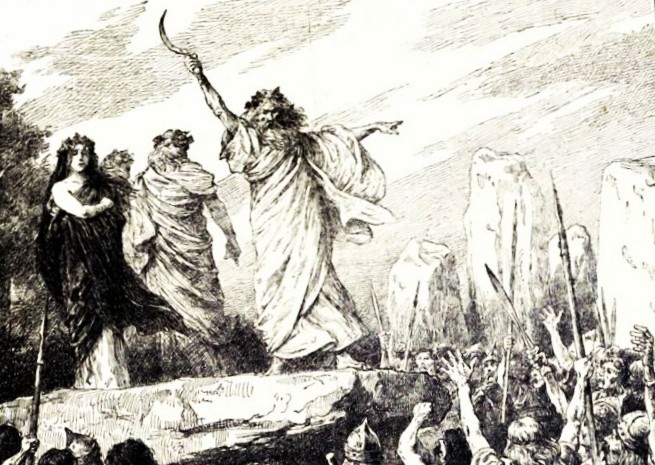
One such positive example is the Celtic civilization that flourished in Europe in the centuries before and just after the advent of Christianity.
Much fascinating light is shed on this culture by Jean Markale in his 1985 book Le druidisme: traditions et dieux des Celtes (‘Druidism: the Celts’ traditions and gods’).
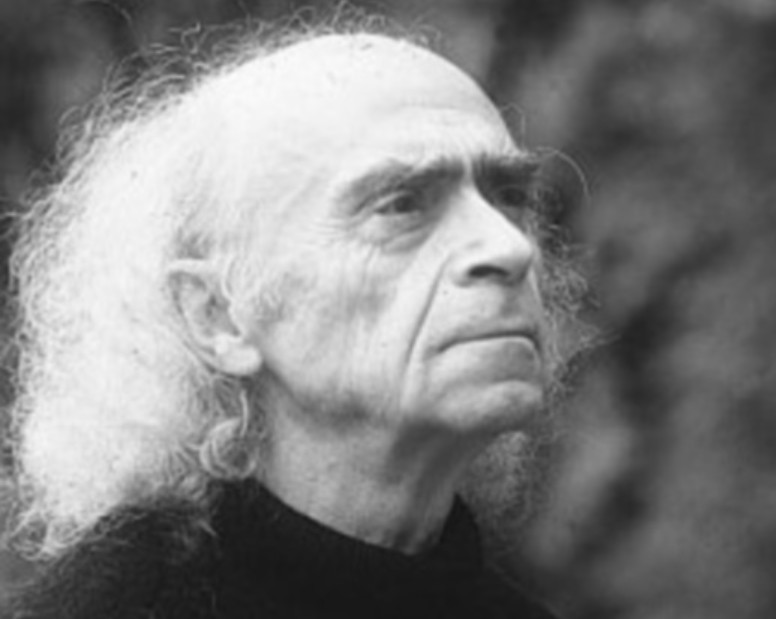
Markale (1928-2008) worked with André Breton and the surrealists from 1949 onwards and participated in that poetic and artistic movement’s enthusiastic exploration of ancient Celtic culture. [1]
Having pursued an academic career in Paris, he left his job, went to live in Brittany and devoted the rest of his life to studying the Celts, penning a vast number of books on the subject right up to his death at the age of 80.
He writes: “In a sense, druidism is the totality of the religious, intellectual, artistic, social and scientific thinking of the Celts, before they converted to the Christian religion”. [2]
Markale says the world of the Celts stretched from Bohemia to Britain and Ireland, from the plain of the River Po in northern Italy to the mouths of the river Rhine in what is now the Netherlands, with extensions in eastern Europe and current-day Turkey.
Celtic civilization first appeared, in a recognisable form, around the fifth century BC and lasted for hundreds of years. On the continent it gradually disappeared, swallowed up by the Gallo-Roman synthesis after the conquest of Gaul (France) by Julius Caesar fifty years before the birth of Jesus Christ.
“In Britain, it lasted until the sixth century AD. Driven back by the Angles and the Saxons it still lives on today, to a certain extent, in Wales and Brittany” – the same is obviously true for Scotland and Cornwall. Markale adds: “In Ireland, despite the vicissitudes of history, it never stopped existing”. [3]
He says Celtic culture was an oral tradition, passed on from generation to generation, belonging to a society based on animal husbandry, then agriculture, and advanced metalworking. [4]
Some of what we know about the Celts comes from contemporary Roman and Greek sources, some from the writing of early Irish Christians and some can be extrapolated from myth and folklore, although the druids themselves seem to have been lost to the authentic collective memory – never being mentioned in folk songs, for instance [5] – only to be reinvented by imaginative modern minds.
Classical writers described druids as philosophers, mages, bards, priests, doctors and theologians [6] and they are also known to have issued prophecies, dispensed justice, [7] acted as ambassadors, declared war and brought peace. [8]
Markale notes: “The Greeks were astonished that barbarians could possess a philosophical and religious tradition of high intellectual and even spiritual quality”. [9]
Unlike the Brahmans in India, druids were not a closed class: someone from any background could join, if they were willing and able to undergo the long and intense training, [10] which seems to have lasted for 20 years. [11]
The author says the word ‘druid’, regarded by some as referring to the trees with which they were closely associated, means ‘very seeing’ or ‘very knowing’ – placing them firmly within what John Lamb Lash regards as a broader gnostic tradition. [12]
There was a supranational structure to the druidic culture, involving regular conventions of chief druids from far and wide.

Julius Caesar records: “These assemble at a fixed period of the year in a consecrated place in the territories of the Carnutes, which is reckoned the central region of the whole of Gaul.
“Hither all, who have disputes, assemble from every part, and submit to their decrees and determinations. This institution is supposed to have been devised in Britain, and to have been brought over from it into Gaul; and now those who desire to gain a more accurate knowledge of that system generally proceed thither for the purpose of studying it”. [13]
Markale notes that the British of the time shared the same origins as the Gauls and probably spoke a more or less identical Celtic language.
He adds: “The Irish tradition says that druidism came from the ‘islands at the north of the world’ and describes future druids and young people going to Scotland (or some other part of Great Britain) to be initiated”. [14]
“It was there that the hero Cú Chulainn went to undertake his education and he was not the only one. What we do not know is whether there was one single druidic centre and, if so, where it was located.
“Several hypothesises have been advanced, in particular concerning Bangor in north Wales: the word Bangor means ‘college’ or ‘assembly’…
“It is possible that it could have been the island of Mona, the mysterious Ynys Môn of Welsh tradition, now also known as Anglesey: in 58 AD there was huge druidic establishment there, according to the account of Tacitus (Annales, XIV, 19-30), which was attacked and destroyed by the Roman army of Gaius Suetonius Paulinus at the time of the general revolt in Britain”. [15]

It was British support of their fellow Celts’ resistance to the Roman Empire in Gaul, along with the fact that Britain was the spiritual home of what the Romans regarded as a dangerous way of thinking, that led Caesar to invade the island, says Markale. [16]
The spiritual aspect to Celtic civilization represented by the druids was a crucial counter-balance to purely worldly power.
Dio Chrystostome, a Greek writer in the first century AD, explains: “The Celts had as priests those known as druids: they were experts in divination and in all other sciences; without them the king was not allowed to act or to make a decision, to the extent that in reality, it was they who were in command, kings being merely the servants and ministers of their will”. [17]
Markale adds: “Even if the king appeared as the pivot of society, the druid was in a certain way his ‘conscience’. The king is nothing without the druid”. [17] “The king was the emanation of the second class, that of the warriors, but the druid belonged to the first class, the priestly class”. [18]
He sees reflections of this king-druid couple across Indo-European mythology, such as with Tyr (god of war, law and justice) and Odin (god of magical and sacred power) or the Indian gods Mitra (maintenance of order) and Varuna (magical aspects). [19]
Within Celtic folklore there was also the pairing of the magician/druid Merlin with King Uther Pendragon and then with King Arthur.
The druidic role is to provide the king with spiritual or divine legitimacy by magical means such as the sword that young Arthur famously pulls from Merlin’s stone.
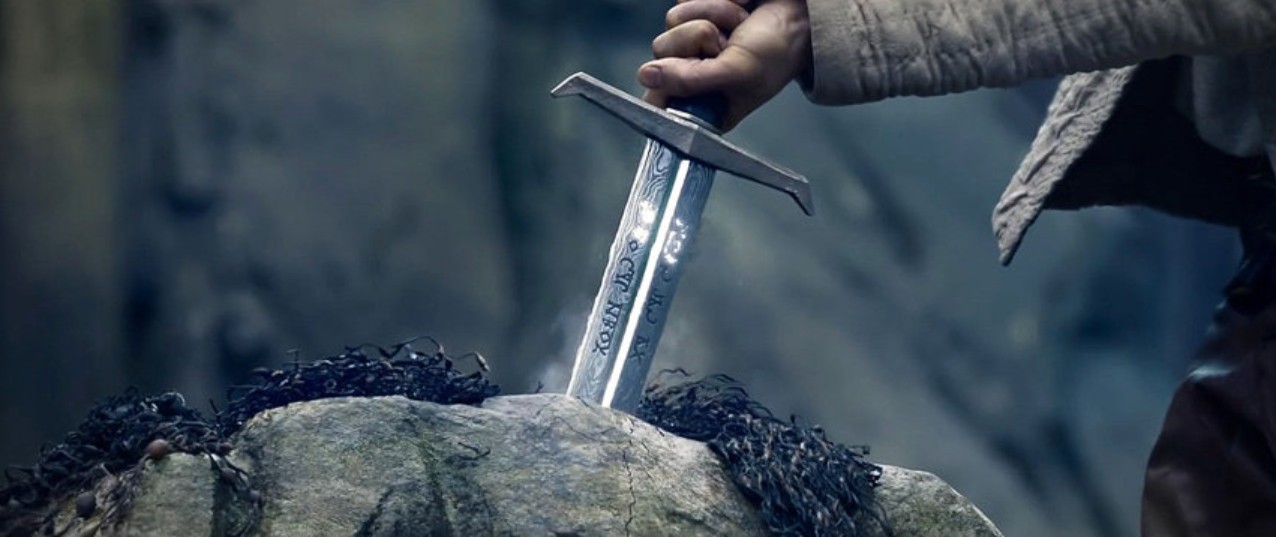
It is also Merlin who has Arthur bring together the Knights of the Round Table and who is behind their famous quest for the Holy Grail, says Markale. “The kingdom starts to collapse the day that Merlin disappears. Arthur-Mitra cannot validly reign without Merlin-Varuna”. [20]
He draws attention to the surprising number of gessa, prohibitions, imposed on the Celts’ kings, and later on other leaders.
The prohibitions always concerned kings or certain warriors, but never druids. Julius Caesar tells us that the vergobret (magistrate) of the Aedui tribe of central Gaul, was not allowed to leave his own people’s land. [21]
In Ireland, Conaire the Great was not allowed to kill birds or pass the town of Tara by the south or the plain of Breg by the north, or sleep in a house where, after sunset, the light inside was visible from the outside. He was told that no theft should take place under his reign and he should not break up any quarrels between two of his servants.
Explains Markale: “All went well for a certain time. Ireland prospered because its king respected all his gessa. But one day he broke up a fight between his two foster brothers. Having broken one prohibition, he went on to break all the others, one after the other, which led him to his death…
“It is perfectly reasonable that it should be the king, more than others, who endures the weight and the threat of numerous prohibitions. Otherwise, he would not be king”. [22]
The Celts recognised a number of more and less important gods and goddesses, although Markale insists this should not be interpreted as polytheism since they believed in an overall Cosmic Whole – more on that in the next article.
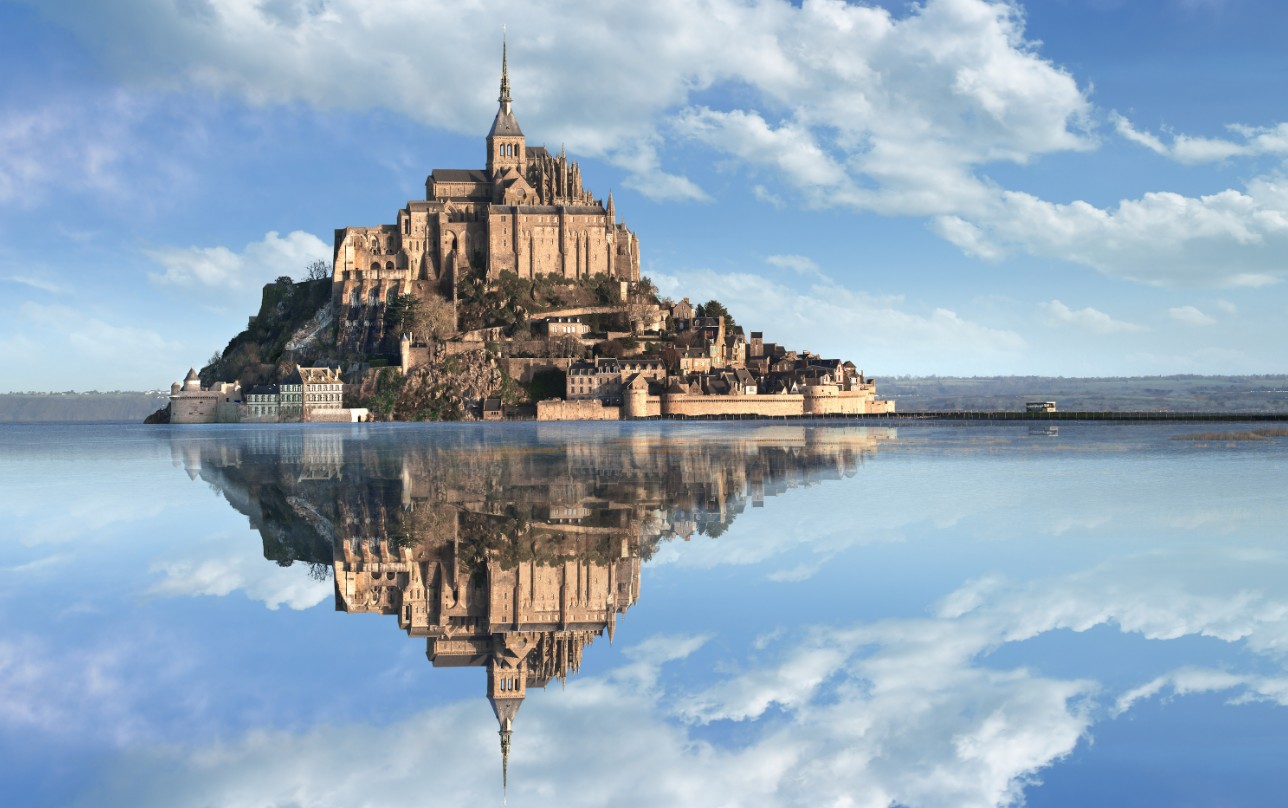
Belenus was the god after whom was named the feast of Beltane (see below) as well as a sacred island in Normandy once called Tum-Belen or Tombelaine (Belenus’s mound) and now known as Mont St Michel – the name Tombelaine was transferred to a nearby smaller island. Markale says: “The replacement of the ‘shining’ god by Michael, the archangel of light, is surely not a chance affair”. [23]
The god Lugh gave his name both to the Irish festival of Lughnasadh (see below) and to the French city of Lyons, explains Markale. [24] “Lyons was a sort of sacred city for the independent Gauls. A legend relayed by the Pseudo-Plutarch tells that it was founded on a spot designated by a family of crows. And the crow was Lugh’s symbolic animal”. [25]
The author compares him with another Indo-European god – Odin, also known as Wotan and Woden. “Like Odin, Lugh is superior to all the gods, although neither is the primordial god. Like Odin, Lugh is the supreme chief of the army of gods fighting the giants. Like Odin, Lugh possesses a magic lance. Like Odin, Lugh makes war not only in a heroic fashion, but also in a magical way. Like Odin, Lugh has an affinity with the crow. Like Odin, runemaster and protector of poets, Lugh is a master-poet and musician. Finally, while Odin is one-eyed, Lugh is the grandson of a one-eyed man and to operate his magic during a battle he closes one eye. That adds up to a lot of similarities”. [26]
While Lugh’s importance was in the number of functions he held, the Dagda was a powerful and superior warrior god who also presided over life and death. [27]
Markale sees the Dagda as being incarnated in François Rabelais’s Gargantua, who was not so much a literary creation as a borrowing from folk culture.
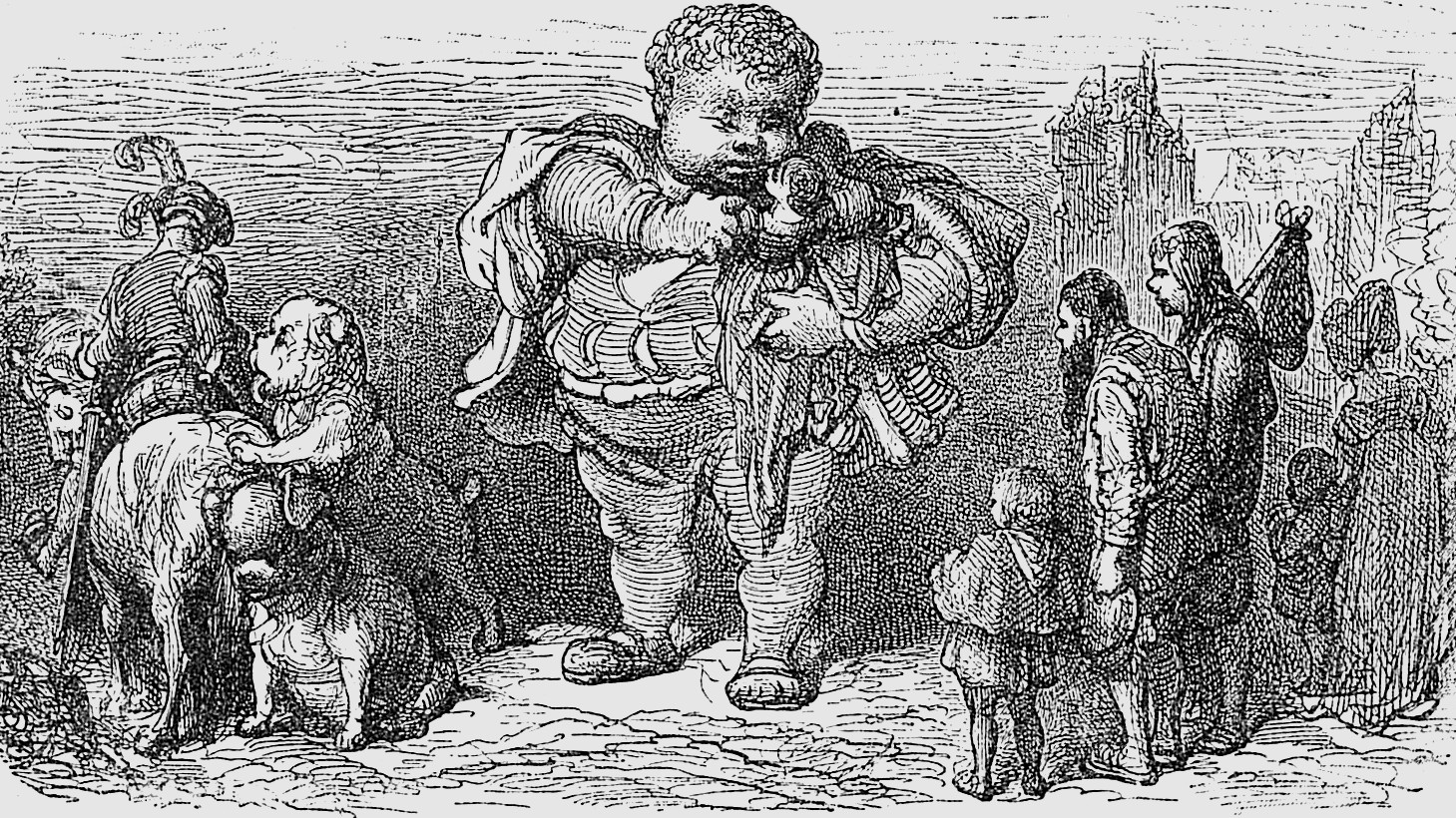
“Through his giant size, his appetite and his sexuality, Gargantua is certainly of the same nature as the Dagda and the anonymous 1532 account from Lyons entitled The Great and Invaluable Chronicles of the Great and Enormous Giant Gargantua, which links Gargantua to the Arthurian legend (Gargantua’s parents having been magically created by Merlin), does not contradict this opinion”. [28]
Brigid is a member of the legendary Tuatha Dé Danann (‘people of the goddess Danu’), [29] being the daughter of the Dagda and the goddess of poetry, wisdom and healing.
Markale writes: “Certain Irish texts count three different Brigids, which proves that she is a goddess with three faces, that’s to say a triple goddess. She definitely presided over the feast of Imbolc, February 1, (see below) and it is on that same day that the Irish honour Saint Brigid of Kildare, who for Christians seems to have replaced the pagan goddess. In fact, the Irish have made Saint Brigid a great patron saint, just below Saint Patrick in importance. It is not by chance”. [30]
He says her importance to the Celts sheds light on the role of women in Celtic society. “While women probably did not occupy a place at the top of the druidic hierarchy, it is certain that they could be prophetesses and poets”. [31]
Her warrior aspect also points to a reality in Celtic culture as a whole: “Certain Gallic coins, notably of the Baiocasses in Normandy, show us images of armed naked women, hair in disarray and apparently running into battle like furies”. [32]
On the other side of the English Channel there was Boudica, warrior queen of the Celtic Iceni tribe, who led the (failed) British uprising against Roman imperialism around 60 AD. [33]
The gods and goddesses were particularly honoured at certain points in the calendar, explains Markale. “We know that the big Celtic feasts took place four times a year, forty days after a solstice or an equinox, on the first of November, February, May and August”. [34]
He adds that the Celtic year was divided into two, rather than four, seasons – just Winter and Summer.
In the same way as feast days began with the night before, so did the New Year begin with the advent of Winter, at the festival of Samhain on November 1 [35] – the night leading to this day was of course what we now celebrate as Hallowe’en. Markale writes: “Effectively, on that day the community of the living and the community of the dead met up”. [36]
“The day before, all the fires of Ireland had to be put out. This was evidently the sign that the year was dying. It was reborn at the moment when the druids lit a new fire”.
“The festival consisted of an assembly of all the men and women constituting the community. They discussed political, economic and religious matters”. [37]
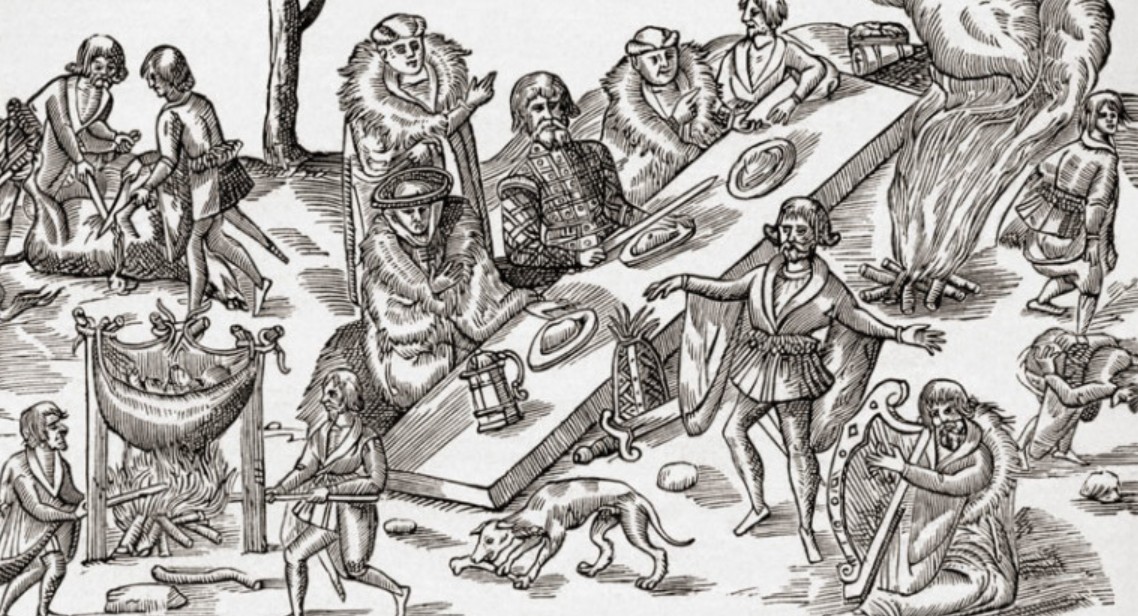
They ate the flesh of pigs, which was supposed to bring immortality, and drank copious amounts of alcoholic drinks, producing “drunkenness, in other words the trance thanks to which one can go beyond apparent reality and see the supernatural”. [38]
“For Greek and Roman writers, Celts already had a reputation for being passionate lovers of fermented drinks. Drunkenness is an oft-occurring theme in the epics, especially in Irish accounts.
“Gods and heroes compete in their unquenchable thirst for alcohol, in the form of beer, wine or mead. A religious festival never went by without a serious drinking session”. [39]
Three months later, on February 1, came Imbolc, which marked the mid-point of the Celtic Winter. Markale explains that this event was recuperated by Christianity as Candlemas (February 2).
“Fire was exalted here, but also lustral water. It was a feast of purification, a meaning which Candlemas still holds. But we are very badly informed on the components of Imbolc, all the pagan references having been swept away by Christians embarrassed by the problem of the goddess Brigid who reappeared in the guise of Abbess Brigid of Kildare [c. 451-525 AD], whose feast day was February 1. This festival did not involve the warrior class or the king: it was perhaps more intimate, more local”. [40]
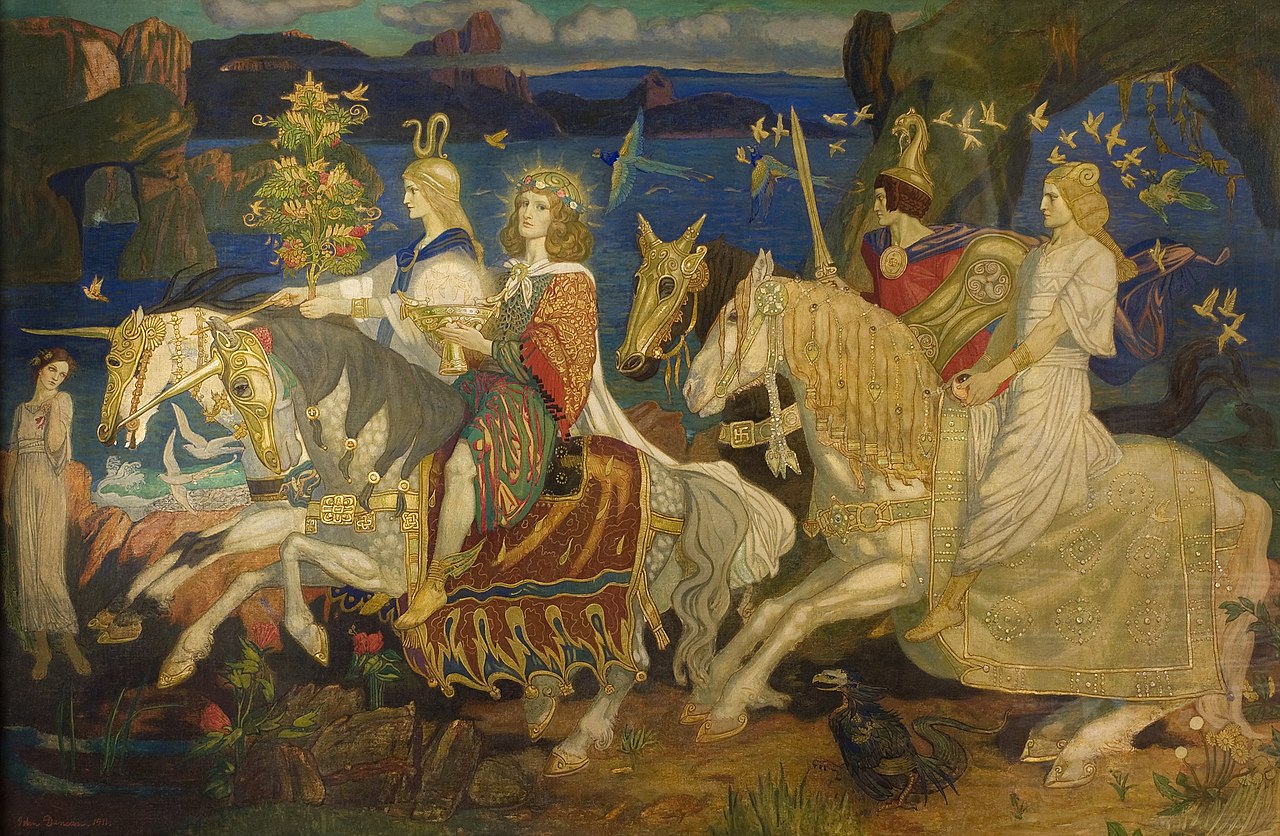
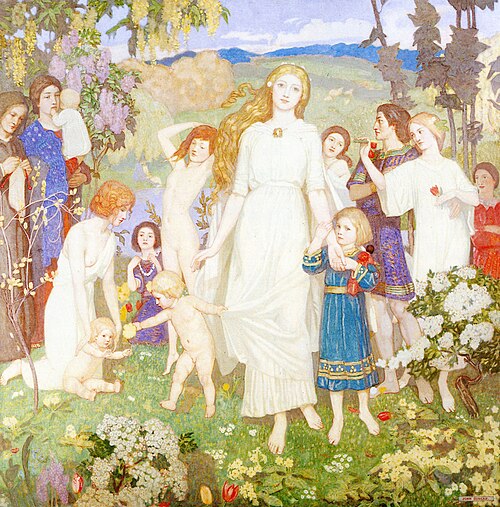
Beltane, aka May Day, was an important festival for the Celts. The Tuatha Dé Danann (pictured) are said to have arrived in Ireland on May 1 [41] and the feast is named after the “shining” god Belenus. Markale explains that this was the feast of fire, which was regarded as the transformation of cosmic energy. [42]
“It is the end of Winter and the start of Summer. Hence the fire rituals, particularly abundant, and the sacralisation of the growing vegetation… The festival of Beltane was an opening to life and light, an introduction into the daytime universe, whereas Samhain marked the passage into the night-time world, which in Brittany is still called ‘the dark months'”. [43]
Lughnasadh, named after Lugh, was said to have been established on August 1 by the god himself, in memory of his foster mother, the goddess Tailtiu, symbol of Mother Ireland, states Markale.
“It seems that Lughnasadh was above all a royal festival… The king, at this time of the year, was supposed to be in possession of his maximal power”. [44]
He stresses the utmost importance of these events to Celtic society: “The festivals, like the rites, involved everybody. Those who did not take part excluded themselves from the community. If, for one reason or another, a festival was not celebrated (which must have been very rare), the balance of society, and thus of the world, was put at risk.
“The festivals, like the rites, were operations of a magical or religious kind (or both) which established harmonious relationships between beings and things, between humans and gods, between visible forces and invisible forces”. [45]
“In Celtic society there was no distinction between the sacred and the profane. They were, like the druid and the king, two faces of one single reality”. [46]
“Druidism was certainly one of the greatest and most exhilarating adventures of the human spirit, trying to reconcile the irreconcilable: the individual and the collective, God and creation, Good and Evil, Day and Night, the Past and the Future and Life and Death”. [47]
In the second article in this series of five, we will be looking at where some Celtic beliefs came from and where some of them led.
Also in this series:
Through nature we can touch the divine
Life: a sacred and heroic mission
[1] https://fr.wikipedia.org/wiki/Jean_Markale
[2] Jean Markale, Le druidisme: traditions et dieux des Celtes, (Paris: Payot, 1985), p. 10. All translations are my own and all subsequent page references are to this work.
[3] pp. 14-15.
[4] p. 15.
[5] p. 23.
[6] pp. 19-20.
[7] p. 53, p. 16.
[8] p. 43.
[9] p. 19.
[10] p. 17.
[11] p. 48.
[12] p. 164 & p. 25, see Paul Cudenec, Our Sacred World, https://winteroak.org.uk/wp-content/uploads/2026/04/our-sacred-worldonline-2.pdf
[13] Julius Caesar, Commentarii De Bello Gallico, IV XIII, https://www.gutenberg.org/cache/epub/10657/pg10657-images.html
[14] p. 33.
[15] p. 34.
[16] Ibid.
[17] Dio Chrystostome, Oratio XLIX, cit. p. 38.
[17] p. 38.
[18] p. 39.
[19] pp. 40-41.
[20] p. 42.
[21] p. 216.
[22] pp. 216-17.
[23] pp. 99-100.
[24] p. 82.
[25] p. 88.
[26] p. 90.
[27] p. 117.
[28] pp. 122-23.
[29] p. 70.
[30] p. 132-33.
[31] p. 54.
[32] p. 137.
[33] https://en.wikipedia.org/wiki/Boudica
[34] p. 88.
[35] p. 162.
[36] p. 200.
[37] pp. 199-200.
[38] Ibid.
[39] p. 231.
[40] p. 201.
[41] p. 73.
[42] p. 186.
[43] p. 201.
[44] p. 203.
[45] pp. 203-04.
[46] p. 42.
[47] p. 282.


Good one !
I’ve arrived at a similar conclusion – money has replaced morality – nowhere is this more evident then our so called political misrepresentations especially the effing conservatives.
I’m no longer trying to earn money.
A series of events made me change my lifestyle, one, technically i’m homeless initially I was evicted now this is by choice I’m not to give to provide to many details but I live in little old truck parked up in the hills and I do volunteer work with animal rescue and forest regeneration and for that I receive a little tax free income as opposed to generating taxes which are bound to be wasted on the wrong projects such as nuclear submarines if you get my drift.
That’s what I wanted to share today.
Thanks for a wonderful podcast, looking forward to the next.
F
LikeLiked by 1 person
Cheers
LikeLike