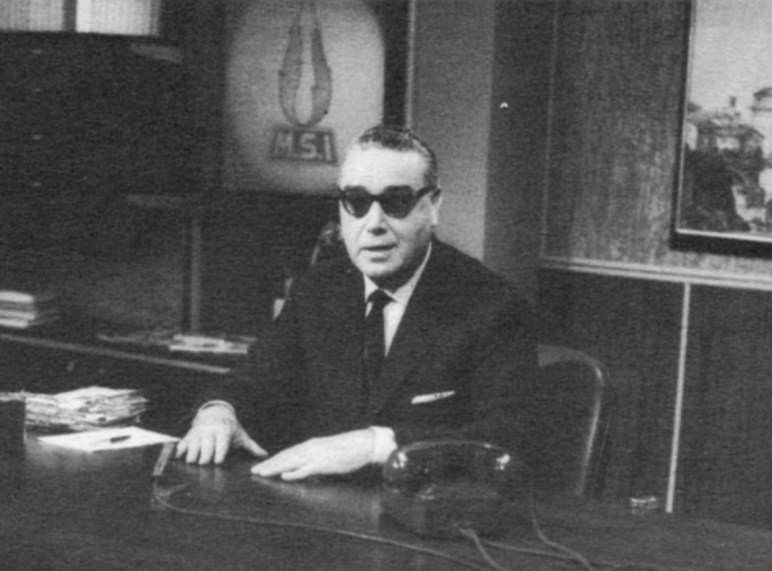
by Paul Cudenec, who reads the article here
I have stressed on many occasions that the key to understanding fascism is its closeness to industrialism: for all its talk of “tradition” and “family” it has invariably served as a totalitarian tool for the imposition of “modernisation” and technocratic control.
French historian Henri Michel says: “Without funding from industrialists and big landowners, fascism would not have succeeded. It duly showed its gratitude to its protectors, turning a blind eye to the illicit profits from the First World War, reducing inheritance taxes and abolishing price and rent controls”. [1]
He adds that “it coincided with Italy’s passage from an agrarian economy to an industrial economy” and introduced “the idea of a governmental guarantee of economic development”. [2]
This factor remained evident right from the start of the neofascist movement which began as soon as the old regime ended.
Anti-fascist Eugenio Reale complained to comrade Gaetano Salvemini that the purging of fascists from public office “became impossible from the third day, when the big industrialists appeared on the scene, those who had made hundreds of millions [of lire] serving the Germans, presenting certificates of civic virtue, provided to them by all kinds of committees, and perhaps even the odd partisan membership card in exchange for a few million”. [3]
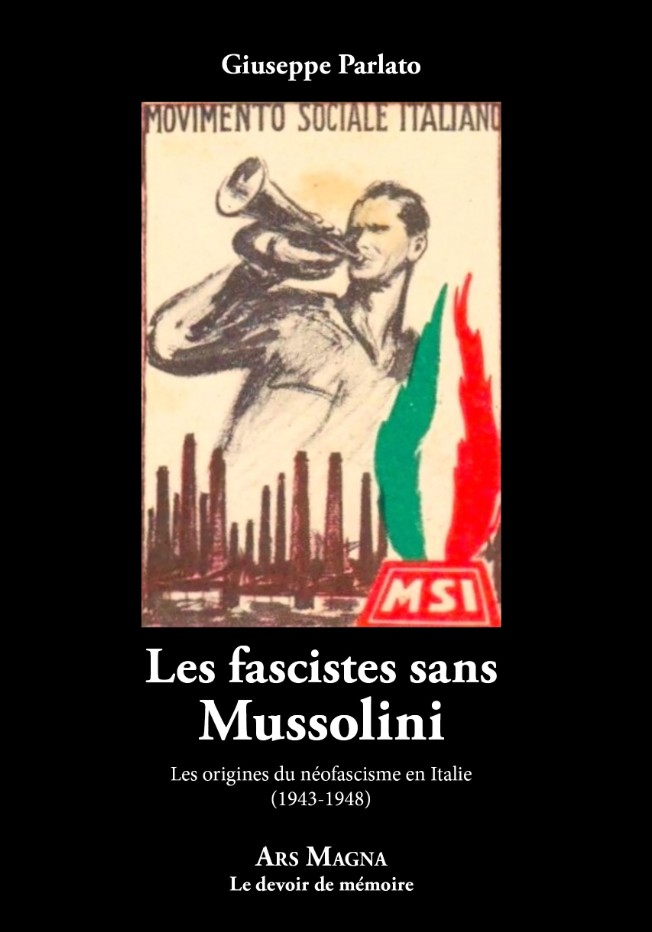
Giuseppe Parlato says in his account of the beginnings of neofascism: “In January 1945, an American source indicated that the fascists were particularly organised in the liberated territories. In Rome, in addition to the presence of the leaders of the regime, the situation was promising for neofascism on account of massive financial flows coming from several industrialists”. [4]
He adds that Romolo Vaselli, “one of the biggest representatives of the construction industry in Rome” – particularly involved in roadbuilding – was a generous contributor to the neofascist Movimento Sociale Italiano (MSI), as was the fascist industrialist Giovanni Armenise. [5]
Underground anti-communist activities were, according to a police informer, financed by the Milan industrialist Enrico Falck [6] and after the assassination of the neofascist Franco De Agazio in 1947, his journal Meridiano d’Italia (which, as I reported, [7] published articles by John F. Dulles and George C. Marshall) is said to have been jointly owned by his widow and another Milan industrialist by the name of Zucca. [8]
Parlato also names chocolate industrialist Stefano Pernigotti and Franco Marinotti of synthetic fibres business SNIA Viscosa as providing funds for neofascists. [9]
The MSI’s Arturo Michelini (pictured at the top of this article) “maintained good relations with the economic world, solidly assisted by Giovanni Orgera, who had been part of the ‘North section’ of the Bank of Italy under the RSI [Benito Mussolini’s Repubblica Sociale Italiana]”, and was in contact with the underground neofascist group Onore, [10] which was, as we saw, [11] linked to Allied intelligence.
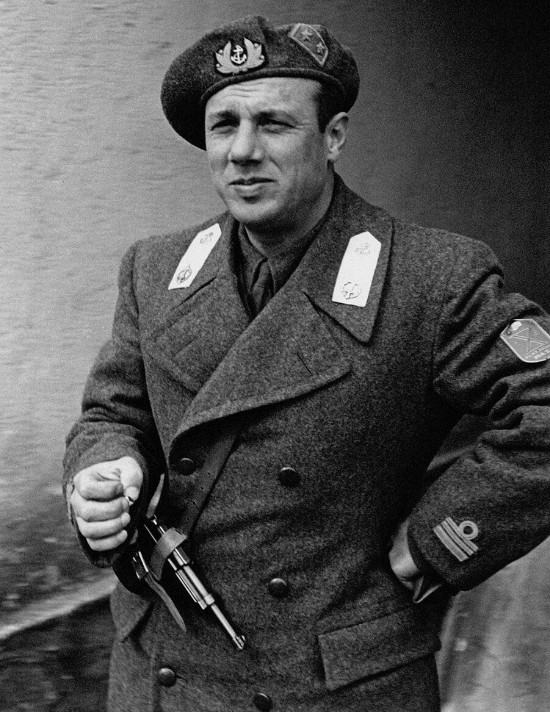
Parlato says of the forces commanded by Valerio Borghese (pictured), the fascist “Black Prince” whom I have previously described: “Close to the industrial world of the North, the Decima was charged with defending the premises of Fiat and other businesses in Lombardy”. [12]
A key role was also played by neofascist Umberto Salvarezza, who enjoyed close links with the world of industry, the Vatican and British intelligence. [13]
The MSI’s Giorgio Pini, who had been close to Mussolini, was in secret contact with Jacques Guiglia of Confindustria, the General Confederation of Italian Industry.
Parlato says: “Guiglia and [Bruno] Puccioni had contacts in American circles – in the media as well as in the secret services – which had been forged in the last days of the war and consolidated in the following months”. [14]
He explains that Guiglia had fought in Africa and had been held prisoner by the Allies. On his release “he was sent to Italy to work with SIM [Italian military intelligence], specifically in the sector of the economic-political group, which was concerned with the economic reconstruction of the country: this enabled him to come into contact with the American secret services.
“After the war he joined Confindustria, where he worked directly with its president Angelo Costa, as head of the press office. In 1946 he invited Pini to work with a journal connected to this industrialist organisation, La Gazzetta del Lavoratore, whose aim was to steer the world of work in an anti-communist direction.

“In 1970, Guiglia acted as an intermediary between the circles close to Borghese’s [aborted] coup d’état and the American services”. [15] “We are talking here about very ‘particular’ representatives of neofascism, hardly visible, who acted in a very reserved manner. They carried out their activity with a lot of caution”. [16]
Earlier this year I wrote an article about Mussolini’s support for Zionism: he met several of its leaders, one of whom, Nahum Goldmann, reported that the fascist dictator told him “I am a Zionist and I will help you to create a Jewish state”. [17]
I explained that Mussolini was close to the Zionist Vladimir Jabotinsky, creator of the terrorist Betar movement, and helped him set up a naval training school in Italy.
Wikipedia tells us: “The academy trained cadets from all over Europe, Palestine and South Africa and produced some of the future commanders of the Israeli Navy”. [18]
These connections did not end with Mussolini’s death and in 1946 neofascist Nino Buttazzoni and other former navy men from Decima MAS were approached on behalf of the Zionist entity which was about to create the state of Israel.
The negotiating was carried out by Admiral Agostino Calosi, who had met with Ada Sereni, coordinator of the Mossad Le’aliyah Bet (Institute for illegal immigration) which was seeking to hasten Jewish settlement in Palestine, still under British control at the time. [19]
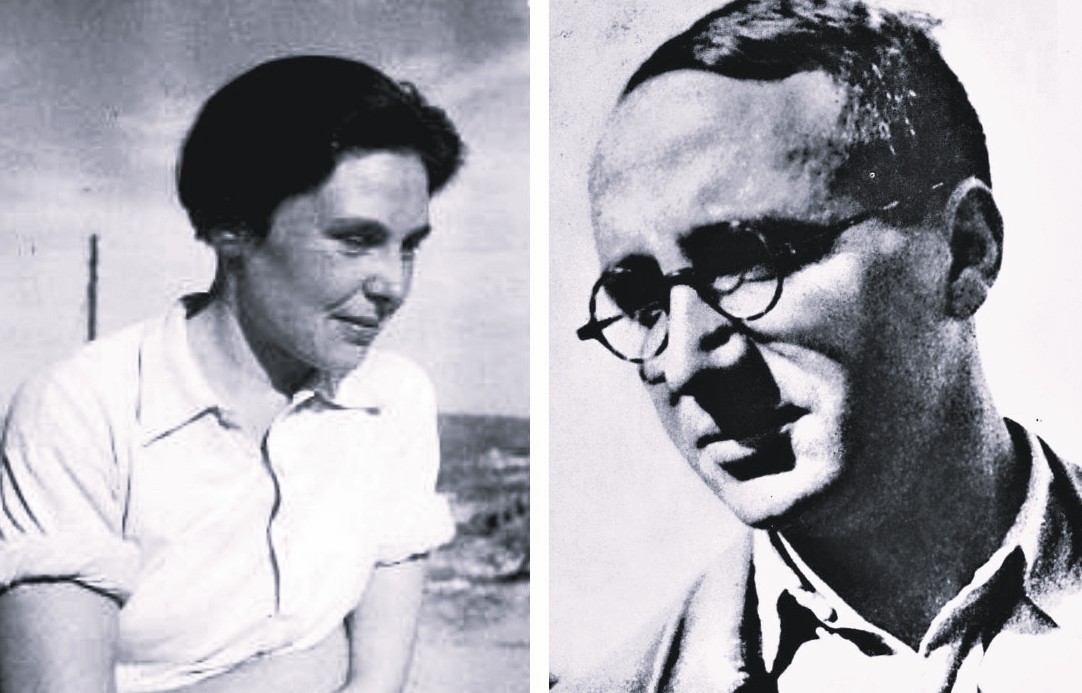
She was, in fact, the widow of Enzo Sereni (the couple are pictured above), an Italian Zionist who once told the anti-fascist activist Max Ascoli that “Hitler’s anti-semitism might yet lead to the salvation of the Jews” [20] and argued at the Zionist Congress in Luzerne in 1935 that there was no shame in using the persecution of the Jews in Germany to push the Zionist project in Palestine: “That is how our sages and leaders of old have taught us… to make use of the catastrophes of the Jewish population in the Diaspora for upbuilding”. [21]
Parlato says Admiral Calosi was also looking for men able to train “Jewish military formations from Palestine who were present on Italian soil, following the Allied invasion of Italy, by teaching them assault techniques”. [22]
“The Israelis were particularly interested by the Decima, which had become famous thanks to its engagements with the British during the Second World War and was made up of men considered among the best commandos. Calosi’s assurances were enough for the Jewish organisation: there was further confirmation from Angleton, who had excellent relations with Borghese and his soldiers” [23] – this was, of course, James J. Angleton of the OSS, forerunner of the CIA.
A few months later, at the start of 1948, Calosi was used to approach another Decima man, Fiorenzo Capriotti, and ask him to train the new Israeli navy.
He accepted, “quickly became a highly appreciated military adviser” and was one of those behind the sinking of the Egyptian navy’s sloop El Emir Farouk at Gaza in 1948. [24]
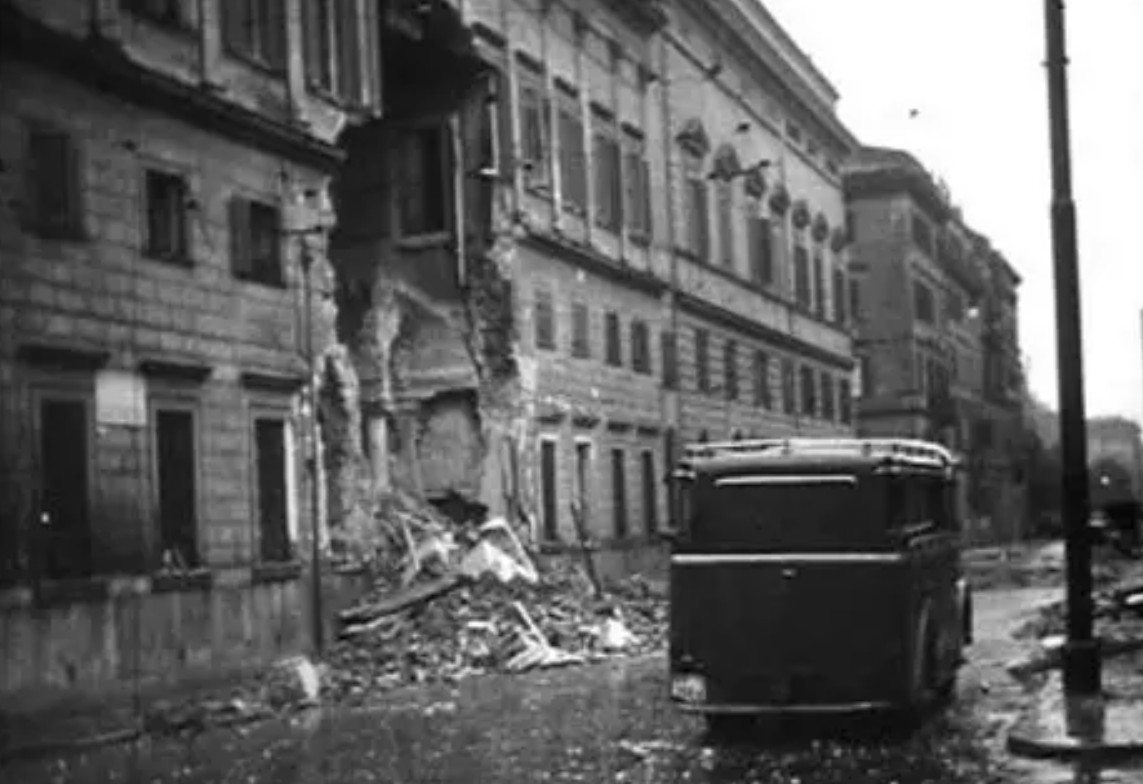
Parlato also writes about the neofascist involvement in the bombing of the British embassy in Rome in October 1946 (pictured).
This is generally attributed to the Zionist terrorist group Irgun Zvai Leumi, although at the time neofascists close to the MSI tried to make political capital out of it by blaming communists.
But more light has since been shed on the affair through the testimony of witnesses including neofascist Pino Romualdi’s daughter, Marina.
It appears that although Irgun indeed carried out the terrorist attack, the explosives were provided to them by the Italian neofascists of FAR (Fasci di Azione Rivoluzionaria).
Romualdi had apparently been in contact with a person calling himself “Jabotinksi”, after the now-dead Zionist leader, to whom he had supplied the explosives from a fascist stash. [25]
Parlato adds: “Curiously, when Mario Tedeschi [a neofascist] recalled a series of modest attacks carried out by FAR in Rome at the start of 1947, he stressed that their method of action was similar to that of Irgun”. [26]
An Italian blog article about the bombing of the British embassy states: “In 2007 it became known through the statements of Alfredo Mantica, a former member of the neo-fascist Movimento Sociale Italiano, and undersecretary of foreign affairs in Silvio Berlusconi’s government from 2008, that two veterans of the Fasci Italiani di Combattimento had supplied the explosives to the Zionist agents. They were Nettuno ‘Pino’ Romualdi (1913-1988) and Giovanni ‘Nino’ Buttazzoni (1912-2009), both founders of the MSI”. [27]
Buttazzoni told Parlato in a 2005 interview that his close friend and MSI colleague Bruno Puccioni was in contact with, among others, “Otto Skorzeny and his pro-American intelligence network”. [28]
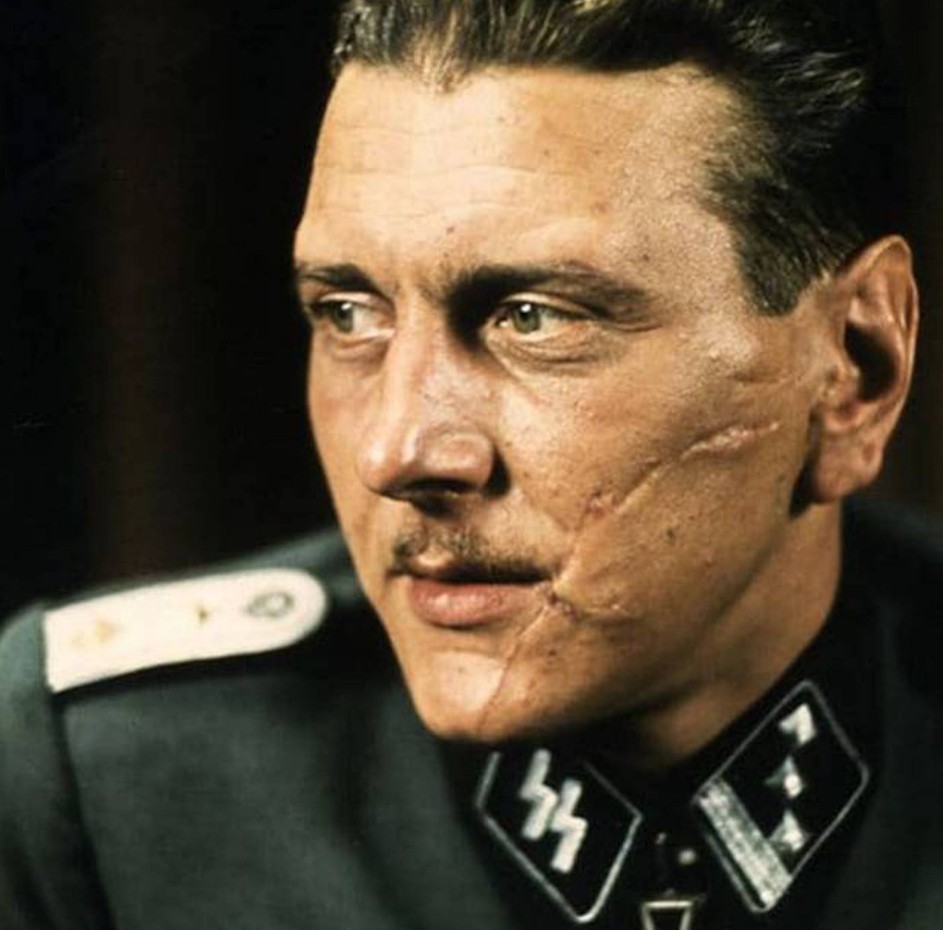
When I looked up Skorzeny on Wikipedia I discovered that “pro-American” does not tell his whole story, as it has now been confirmed that the Austrian-born SS officer went on to work for Israel’s Mossad. [29]
Did I ever mention that the Nazi regime was a Zionist golem?
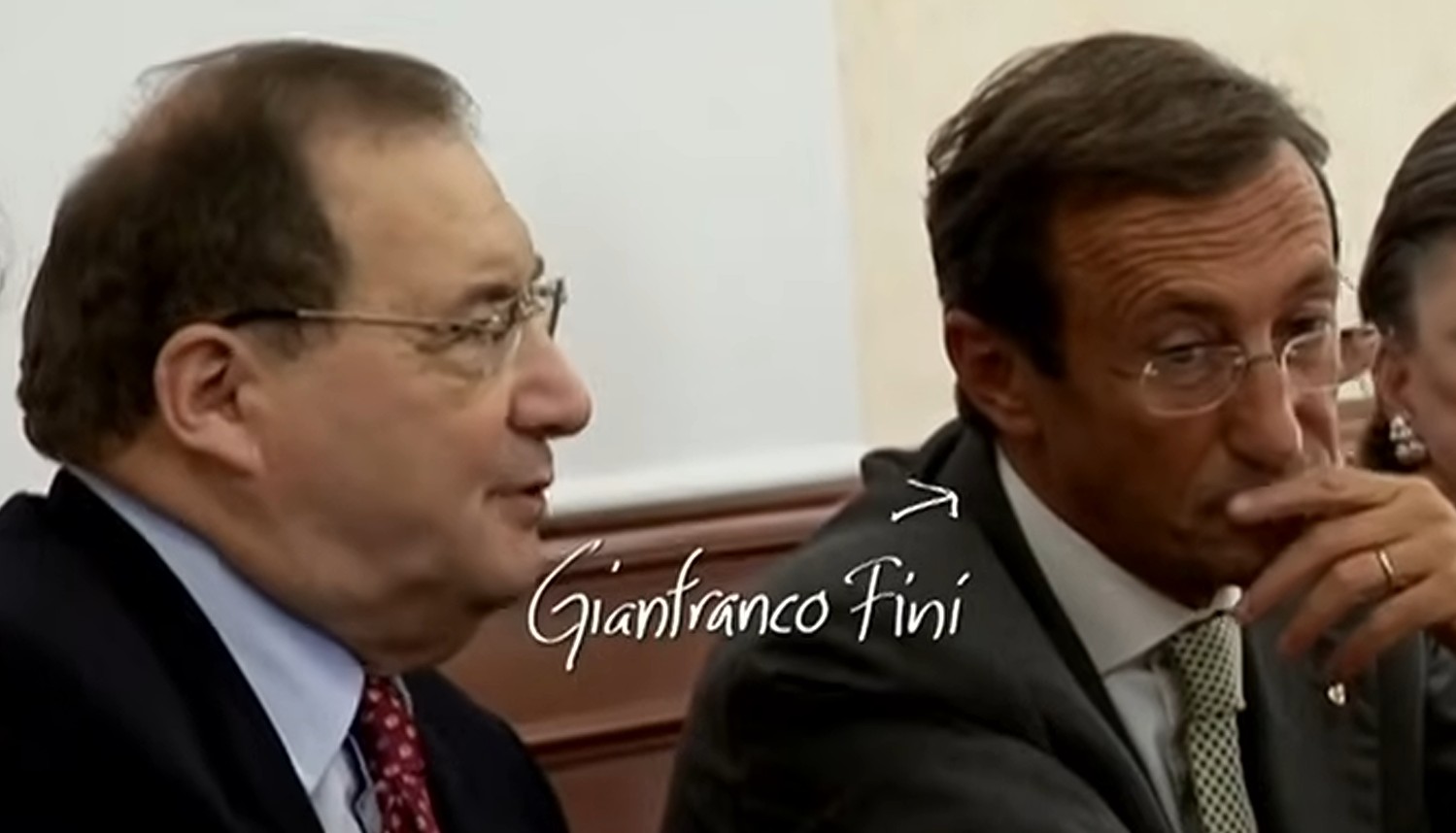
I would add by way of update that Israeli film-maker Yoav Shamir’s 2009 documentary Defamation shows the then head of the (ultra-Zionist) Anti-Defamation League, Abraham Foxman, at an event in Rome during which he was sitting next to none other than neofascist Gianfranco Fini, former head of the MSI. [30]
Parlato says the early connections with Zionism had gradually modified the outlook of Italian neofascists: “The MSI was never systematically anti-semitic, but the position adopted by this party in the 1960s was particularly striking with regard to Israeli nationalism, with the country regarded as the vanguard of the West”. [31]
He remarks that part of the interest for the neofascists in this collaboration with the zio-satanic imperialist mafia (ZIM), alongside a thirst for action and a particular hatred of the British, was the “more than honourable economic compensation” [32] involved and I suspect that corruption, rather than ideological conviction, lies at the core of the matter.
Whiffs of this emerge time and time again in his book. He outlines, for instance, a funding channel connecting the Vatican’s Roberto Ronca with Francis Spellman, cardinal of New York, and the aforementioned US intelligence chief Angleton, who had coordinated finances for Princess Pignatelli’s Movimento italiano femminile, which I mentioned in a previous piece, [33] as well as for Luigi Gedda’s “civic committees” and for the MSI. [34]
Handling this arrangement within the MSI was none other than Puccioni, so close to SS/Mossad man Skorzeny (pictured). [35]
Anyone trying to follow the corrupt activities of what is today known as the “Epstein class” will be rather suspicious of any talk about such people “helping orphans”.
And this was the case for me when I read that “in 1949, Cardinal Spellman sponsored an important initiative to help Italian war orphans, which planned to raise funds from the Italian community in Brazil. The organiser of this initiative was Countess Amalia Matarazzo, whose family was the point of reference for fascist refugees in Brazil”. [36]
We come back to neofascism’s industrial connections here, in fact: “The Matarazzos were a family of rich Italian emigrants in Brazil, where they had built up a great fortune through various different sectors: the mechanical industry, salt and sugar, printing, the chemical industry, maritime navigation and the textile industry”. [37]
Parlato further cites police files which refer to “enormous sums from Italy and abroad” put at the disposition of two particular neofascists immediately after the end of the war. [37]
One of these was Puccio Pucci, who had been an officer of Mussolini’s personal guard (Moschettieri) and president of the Italian National Olympic Committee. [38]
This last detail points directly to a ZIM connection, as will be understood by anyone who has read my 2024 piece ‘The Olympic agenda is profit and control’. [39]
As I mention there, a stalwart sponsor of the Olympic Games for the last century, even for the Nazi Olympics in Berlin in 1936, has been Coca-Cola, and I do not suppose it is a coincidence that Emilio Patrissi, who in 1947 founded the neofascist Movimento Nazionalista per la Democrazia Sociale, enjoyed such “excellent” links with certain American funders that they invited him to become Coca-Cola’s representative in Italy! [40]
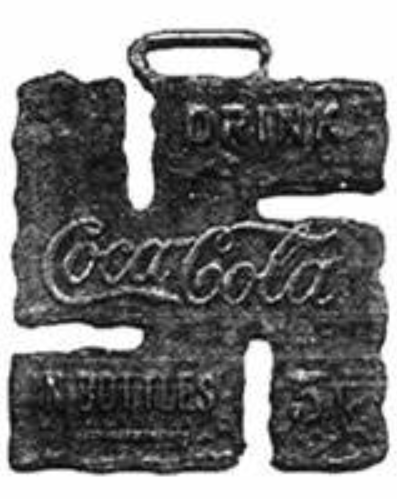
Further context is provided by a 2023 article which states that “Coca-Cola’s steadfast allegiance to Israel, demonstrated by its resistance to the Arab League boycott, has established its pivotal role as a significant trade ally, earning commendations from the Israeli Government Economic Mission for its unwavering dedication” [41] and by the fact that it is currently being boycotted by pro-Palestine campaigners because it “is implicated in Israeli war crimes”. [42]
Parlato notes that the flow of information provided by “anti-communists” to American intelligence incited “astronomical increases” in dark funds from Washington in the lucrative racket that was the Cold War. [43]
He comments: “The contacts that neofascists made with milieux more or less representing the American secret services, the ecclesiastical realm, the Masonic sectors, monarchist groups and representatives of the Israeli services did not lead to an internal division in the neofascist world.
“This is solely because these contacts were covered with a cloak of silence. If the membership had learned with what kind of people the neofascist leaders had negotiated, there would probably never have been an MSI”. [44]
What his book confirms is the reality that “fascism”, “communism” and “democracy” were and are fictional characters in the theatrical production called “history” or “politics”.
Behind the scenes lies something else entirely, whose very existence we are brainwashed, gaslit and intimidated into not seeing, let alone challenging.

In his book The Jewish Century Yuri Slezkine proudly describes a vertically-integrated “Jewish economy” that he says dominates the modern world. [45]
But what he writes about (Jewish domination of banking, industry, academia, politics, media and culture) is only the tip of the iceberg and lurking underneath is a vertically-integrated black economy – the world of money-laundering and extortion, of arms trafficking, drugs trafficking and child trafficking.
This is utterly entwined with the machineries of captured institutional power, including the deep state and its agents which infiltrate and sabotage all opposition to global mafia control.
Industrial pollution and exploitation; war and terrorism; reconstruction and modernisation; banking and bribery; prostitution, paedocriminality and blackmail; surveillance, censorship and media propaganda are all cogs in one vast diabolical machine.
If we are to free ourselves from the grip of this psychopathic supremacist entity – which aims to dominate and destroy our societies, cultures and peoples – we will have to be able to see clearly what we are up against and redefine our outlook accordingly.
We cannot afford to remain trapped in its false binary oppositions of “left” versus “right”, “communism” versus “anti-communism” or “fascism” versus “anti-fascism” – even “Zionism” versus “anti-Zionism” is a trap if we fail to see that judeo-supremacism is about much more than the state of Israel.
And then, once we understand what our enemy really is, we can resolve to dedicate our lives to overcoming it – for the sake of the decent majority of humankind and of the living world to which we all belong.

Previous articles in this series:
Neofascists and communists: a love-hate relationship
Divide and rule: the anti-communist psychosis
[1] Henri Michel; Les fascismes (Paris: Presses Universitaires de France, Que sais-je series, 1987), p. 36. All translations from French are my own.
[2] Michel, p. 40.
[3] Letter from E. Reale to Salvemini, September 24 1945, G. Salvemini, Lettere dall’America 1944-1946 (Bari: Laterza, 1967), pp. 175-78, cit. Giuseppe Parlato, Les fascistes sans Mussolini: Les origines du néofascisme en Italie (1943-1948), trans. Istvan Leszno, (Château-Thébaud: Ars Magna, 2025), first published in 2006 then 2012 as Fascisti senza Mussolini: le origini del neofascismo in Italia (1943-1948), p. 328.
[4] Parlato, p. 167.
[5] Parlato, p. 172, https://it.wikipedia.org/wiki/Romolo_Vaselli,
https://it.wikipedia.org/wiki/Giovanni_Armenise
[6] Parlato, p. 352.
[7] Paul Cudenec, ‘Divide and rule: the anti-communist psychosis’, https://winteroak.org.uk/2026/06/12/divide-and-rule-the-anti-communist-psychosis/
[8] Parlato, p. 451.
[9] Parlato, p. 486, https://it.wikipedia.org/wiki/SNIA
[10] Parlato, p. 288.
[11] Cudenec, ‘Divide and rule: the anti-communist psychosis’.
[12] Parlato, p. 142.
[13] Parlato, p. 175, pp. 178-79.
[14] Parlato, p. 393.
[15] Parlato, pp. 635-36.
[16] Parlato, p. 393.
[17] Paul Cudenec, ‘Benito Mussolini and the New World Order’,
https://winteroak.org.uk/2026/02/05/benito-mussolini-and-the-new-world-order/
[18] https://en.wikipedia.org/wiki/Betar_Naval_Academy
[19] A. Sereni, I clandestini del mare: l’emigrazione ebraica in terra d’Israele dal 1945 al 1948 (Milan: Mursia, 1973), pp. 113-14, cit. Parlato, p. 354.
[20] Ruth Bondy, The Emissary: A Life of Enzo Sereni (Boston: Little Brown & Co., 1977), p. 141, https://archive.org/details/emissarylifeofen00bond/page/n295/mode/2up?q=salvation, cit. https://nazismosionismo.blogspot.com/2012/03/capitulo-xxxiii-los-marinos-fascistas.html
[21] Kongresszeitung, official stenographic organ of the Zionist Congress, No 5, p. 9, cit. Paul Novick, Zionism Today (New York: The Jewish Buro of the Central Committee of the Communist Party of the USA, 1936), p. 5, https://www.marxists.org/subject//jewish/novick-zionism.pdf
[22] Parlato, p. 354.
[23] Parlato, p. 355.
[24] Parlato, p. 356.
[25] Parlato, pp. 358-59.
[26] M. Tedeschi, Fascisti dopo Mussolini (Rome: Arnia, 1950), later republished (Rome: Settino Sigillo, 1996), p. 133, cit. Parlato, p. 359.
[27] https://nazismosionismo.blogspot.com/2012/03/capitulo-xxxiii-los-marinos-fascistas.html
[28] Interview with N. Buttazzoni of March 28 2005, cit. Parlato, p. 672.
[29] https://en.wikipedia.org/wiki/Otto_Skorzeny#Recruitment_by_Mossad
[30] https://www.youtube.com/watch?v=CTAjc1OSrmY
[31] Parlato, pp. 356-57.
[32] Parlato, p. 356.
[33] Cudenec, ‘Divide and rule: the anti-communist psychosis’.
[34] Parlato, pp. 486-87.
[35] Parlato, p. 487.
[36] Archivio Centrale dello Stato, Rome, MIF Papers, b. 37, fasc. 10, cit. Parlato, p. 679.
[37] Parlato, p. 488.
[37] Parlato, pp. 131-32.
[38] Parlato, p. 126-27.
[39] Paul Cudenec, ‘The Olympic agenda is profit and control’,
https://winteroak.org.uk/2024/05/06/the-olympic-agenda-is-profit-and-control/
[40] Parlato, p. 422, https://olympics.com/en/paris-2024/committee/games-stakeholder/partners
[41] https://paketmu.com/is-the-coca-cola-company-supportive-of-israel-explained/
[42] https://bdsmovement.net/news/coca-cola-quenching-israel%E2%80%99s-genocidal-soldiers%E2%80%99-thirst
[43] Parlato, p. 368.
[44] Parlato, p. 410.
[45] Paul Cudenec, ‘Invisible imperialism’, https://winteroak.org.uk/2026/04/23/invisible-imperialism/


Seeing the scarred face image of criminally insane Nazi Otto Skorzeny caused me to recall the scarred face of actor Sean Penn (Colonel Steven J. Lockjaw) in the anti-Fascist Oscar-winning film One Battle After Another, written and directed by Paul Thomas Anderson, a loose adaptation of Thomas Pynchon’s 1990 novel Vineland.
English/writing academic lecturer Alexander Howard wrote an outstanding review:
(https://theconversation.com/thomas-pynchons-vineland-set-in-1984-is-translated-for-the-trump-era-in-one-battle-after-another-266063)
Perennial Nobel Prize contender Thomas Pynchon’s fourth novel, Vineland (1990) has been loosely adapted by Paul Thomas Anderson as a new film, One Battle After Another. The film is already considered an Oscar contender.
Vineland, at its core, is preoccupied with the fate of America in the age of mass media and creeping authoritarianism. Pynchon’s novel is largely set in 1984, the year president Ronald Reagan was reelected in a landslide – a time when the idealism and revolutionary impulses of the American left had withered.
That sense of defeat speaks directly to now. Anderson’s adaptation lands in a year defined by Donald Trump’s decisive 2024 election victory and a MAGA-driven backlash against diversity and inclusion, trans rights and climate action.
Anderson repurposes Pynchon for our present plight, plunging us into a familiar hellscape of immigration detention centres, white supremacist hideouts and so-called sanctuary cities. One of these cities is a central setting: engulfed in flames, thick with smoke and overrun by state-backed goons kitted out in combat gear – enforcers who seemingly answer to no one, itching to knock a semblance of sense into some “radical left” skulls.
Scenes from immigration raid protests in Los Angeles, June 2025, resembled Paul Thomas Anderson’s film. Caroline Brehman/AAP
Militarisation of American life
One review of the film points out how the escalation of immigration crackdowns and expansion of ICE under Trump’s second presidency “embodies the militarization of everyday American life” in a way that “feels, in a word, Pynchonian”.
The famously mysterious Pynchon’s last known paid job was a formative stint as a technical writer for Boeing. There, he was “a cog in the US war machine – closely involved in what was the most critical component of the military-industrial complex”, according to American Studies scholar Steven Weisenburger.
Thomas Pynchon. Wikimedia Commons
Over 100 pages of Pynchon’s Boeing prose survives, including detailed work on intercontinental ballistic missile systems. Tasked with translating the arcane dialect of rocket engineers into readable language for servicemen, Pynchon found himself writing at the very point when the Cuban Missile Crisis brought humanity to the brink of extinction.
This episode left him with a lifelong suspicion of the machinery of mass destruction and the technocratic rationalisations that sustain it.The Conversation is a news organization dedicated to facts and evidenceVineland: aftershocks of the 1960s
Vineland’s plot focuses on the fallout from the 1960s. It follows washed-up countercultural relic Zoyd Wheeler (Leonardo DiCaprio’s Bob Ferguson in the film) and his teenage daughter Prairie (Chase Infiniti’s Willa), as they navigate the legacy of past betrayals and try to avoid the vice-like grip of state power.
While he changes the names of the characters, Anderson’s film overflows with images and emblems of state repression. In a striking early shot, we see a vast steel wall in the desert, floodlit against the starless night sky. Anderson’s film demonstrates how the shortcomings and failures of past resistance are often replayed, almost note for note, in the present.
Making extensive use of flashbacks and featuring a dizzying array of major and minor characters, Vineland explores the lingering aftershocks of the 1960s and the way they continue to inform personal lives and public culture.
The pot-smoking, welfare-cheque-cashing Zoyd Wheeler is our guide. When we first meet him, Zoyd is scraping by on the margins of Reagan’s America, reminiscing about the old days and trying his best to bring up his daughter.
Looming over them is the absent figure of Frenesi Gates, Prairie’s mother and Zoyd’s former partner, whom they have not seen for years. (In the film, she is represented by the character Perfidia Beverley Hills, played by Teyana Taylor.) Once a member of a militant film-making collective (yes, you read that correctly), her camera trained on the frontlines of protest, Frenesi snitched on her comrades and crossed to the dark side.
Her defection is bound up with Brock Vond, a ruthless federal prosecutor, to whom she is disastrously and inexorably drawn. (Sean Penn’s Colonel Steven J. Lockjaw, a detention centre commander, inhabits this role in the film.) Vond is no mere antagonist: seemingly omnipotent, he stands in for Vineland’s vision of state power. Amoral and obsessive, he is the embodiment of a system that brooks no deviation from predetermined norms.
His pursuit of Frenesi is more than a personal fixation; it is an allegory for how the state seduces, compromises and ultimately devours its subjects. This toxic dynamic animates the action of the novel. Pynchon’s point is not simply that the state corrupted Frenesi, but that the left’s own shortcomings and blind spots made such corruption possible in the first place.
Sean Penn’s detention centre commander Colonel Steven J. Lockjaw replaces the novel’s ruthless federal prosecutor, Brock Vond. Warner Bros
In this sense, he is suggesting – correctly – that the seeds of the conservative ascendancy of the late 1970s and 80s were in fact sown in the failures of the radical movements that came before. It is an important, if bitter, pill to swallow – and we can identify comparisons with our own era.
MAGA’s rise has been abetted not only by right-wing mobilisation, but also by the left’s fragmentation: its internal conflicts weakening its ability to resist authoritarian drift in meaningful ways.
This, I think, is one of the reasons Vineland still matters today. Pynchon, to his credit, refuses readers the easy fiction of noble idealism set against the backdrop of a corrupt establishment. Instead, the novel collapses those binaries. Vineland reminds us radical energies can be turned against themselves – and that apparatuses of domination thrive on just such lapses.
In other words, the enduring power of the novel, which ends on a highly ambiguous note, has much to do with its unwillingness to let anyone – least of all those who once dreamed of revolution – off the hook. Pynchon, conflict and coercion
Pynchon’s reputation rests, to a degree, on work that turns distrust and paranoia into a form of cultural critique. That distrust is already present in his exuberant, globetrotting first novel, V (1963). One of Pynchon’s instantly recognisable signatures – his compendious, darkly comedic writing style – was already present.
His second novel, The Crying of Lot 49 (1966), was shorter and, on the face of it, more accessible. With its paranoid vision of secret postal networks and shadowy conspiracies, it resonated with readers shaken by the turbulence of their historical predicament.
Vietnam. The civil rights struggle. Wave after wave of political assassinations. These were at the forefront of public consciousness, deepening the nagging suspicion that hidden networks of power were shaping events in manners ordinary citizens could neither perceive nor determine.
https://images.theconversation.com/files/694236/original/file-20251003-56-4actgq.jpg?ixlib=rb-4.1.0&q=45&auto=format&w=754&fit=clip
State troopers break up a 1965 civil rights march using tear gas in Alabama. AAP
Published in 1973, Gravity’s Rainbow – a postmodern epic about war, rockets and metaphysics – confirmed Pynchon’s standing as one of the century’s most ambitious novelists. A vast World War II narrative, it centred on the German V-2 rocket as a symbol of technological domination.
For some critics, Vineland seemed like an unsatisfactory retreat from the encyclopaedic scale of Gravity’s Rainbow – into a more straightforward engagement with postwar American society.
But, in fact, it was pivotal in Pynchon’s career. Vineland turns from the manufactured cataclysms of mid-century conflict to more insidious forms of coercion. Personal freedom is drastically curtailed and social existence is managed at every level imaginable. Philosopher Theodor Adorno would describe this as the totally “administered world”.
Read more: Join the Counterforce: Thomas Pynchon’s postmodern epic Gravity’s Rainbow at 50
Numbed by slop
In Pynchon’s book, the radical upheavals of the 1960s and 1970s cast a long shadow, their energies sometimes tipping into outright political extremism. Yet by (the somewhat Orwellian) 1984, what remains is little more than a desiccated husk of ideological dissent.
It’s easily co-opted into the machinery of late capitalist society, numbed on a steady diet of televisual nothing piped into homes via a device known as the Tube. Meanwhile, an expansive security state relentlessly pursues anyone with the temerity to resist.
Today, instead of the Tube, we are bombarded with algorithmic feeds and AI-generated content, a continual flow of slop designed to pacify and distract us. At the same time, Trump’s return to office has brought renewed efforts to enforce censorship, restrict dissent and crack down on immigration: a 21st-century manifestation of the totalitarian reflex Pynchon outlined so presciently.
In a revealing moment late in Pynchon’s novel, we overhear old-timers somewhere in the background
The world Pynchon warned us about
Given the slow-motion catastrophe of contemporary life, these debates go a long way toward explaining the novel’s enduring relevance. Indeed, they could be lifted almost verbatim from today’s news headlines, where commentators continue to argue whether Trump represents a new sort of fascism or the culmination of an authoritarian tendency long embedded in the fabric of American political life.
One Battle After Another, approximately 20 years in the making, amplifies Pynchon’s concern with how power insinuates itself into every aspect of life. It presents us with a narrative about contemporary America that somehow feels both hyperbolic and, depressingly, only a small step removed from reality.
Unlike Pynchon, who had no problem referencing Reagan in Vineland, Anderson pointedly avoids naming Donald Trump.
Given the current political climate in America, it is probably a sensible choice. (One can only imagine the Truth Social tirade were Trump ever to sit through the film. If it happens, I’ll be online, waiting patiently, with a bag of popcorn and a few small beers.) Still, the event horizon of his second administration marks a gravitational pull too strong to ignore.
Welcome to the world Thomas Pynchon warned us about.
LikeLiked by 1 person