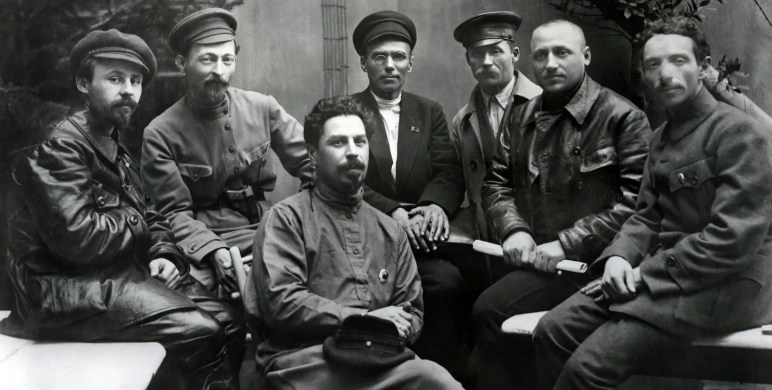
by Paul Cudenec, who reads the article here
Zionism and communism are, of course, not the same thing – indeed from one perspective they appear as polar opposites, with the latter rejecting Jewish identity, religion and nationalism in favour of a staunchly atheist universalist internationalism. However, poles that establish opposites also invariably reveal connections and, from another vantage point, the ideologies amount to two sides of the same ethno-cultural coin.
In his book The Jewish Century, which I recently discussed, [1] Yuri Slezkine cites the work of Lev Shternberg, explaining that this onetime revolutionary, terrorist, longtime Siberian exile, and the dean of Soviet anthropologists until his death in 1927, “came to see modern socialism as a specifically Jewish achievement”. [2] Moreover, Shternberg’s analysis confirms the way in which socialism/communism was used as a means to promote – amongst those who should have been most opposed to it! – the industrialism which is the principal tool through which judeo-supremacists have imposed their authoritarian system of dispossession and exploitation on Gentile populations worldwide.
And this manufactured outlook was, of course, closely bound to the “rationalist” and “scientific” worldview that had been relentlessly pushed by these circles at least since the Invisible College of early 17th century England. [3] Shternberg writes: “The first heralds of socialism in the nineteenth century were non-Jews, the Frenchmen Saint-Simon and Fourier. But that was utopian socialism… Finally, the time was ripe for the emergence of scientific socialism. It was then that the rationalist Jewish genius arrived on the scene in the shape of Karl Marx (pictured), who alone was capable of erecting the whole structure of the new teaching, from the foundation to the top, crowned by the grandiose monistic system of historical materialism.
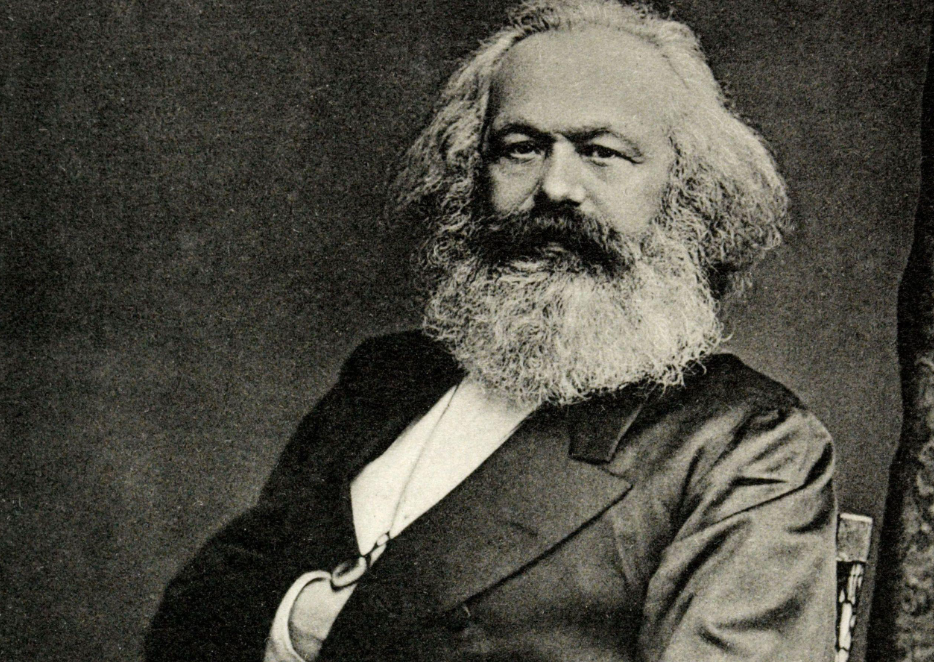
“But what is particularly striking about the Jewish socialists is a remarkable combination of rationalist thinking with social emotionalism and activism – the very psychic peculiarities of the Jewish type that we see so clearly in all the previous periods of Jewish history, especially in the prophets… Marx combined the genius of theoretical, almost mathematical, thinking with the fiery temperament of a fanatical fighter and the historical sense of a true prophet. The works of Marx are not only the new Bible of our time, but also a new kind of book of social predictions! Even now, the exegetics of Marx’s teachings and social predictions exceeds all the volumes of the Talmud”. [4]
Slezkine notes that the Marxist notion of redemption is “strikingly modern because it results from technological progress and has been prophesised scientifically”. [5] He describes the Marxists as those in Russia “who belonged to the rise of the Modern Age and praised the Jews for bringing it about… the only members of the Russian intelligentsia who despised the Russian peasant and the Russian intelligentsia as much as they despised ‘rotten’ liberalism”. [6]
Due to this insidious influence, idealists with revolutionary ideas – in Russia as elsewhere – were turned away from opposing the industrial capitalist system itself and tricked into supporting it in a different guise. Slezkine says: “The switch of allegiance in some (not all!) intelligentsia quarters from Populism to Marxism (beginning in the 1890s) involved a reallocation of redeemer status from the Russian peasant to the international proletariat. Urban collectivism and vertical cityscape replaced rural communalism and horizontal pastoral as the reflection of future perfection, and the angular male worker replaced the peasant girl (or the often feminized – ‘rotund’ – peasant man) as the intellectual’s corporal better half”. [7]

“For the Jewish rebels, the fall from grace of the Russian peasant opened up new opportunities. Marxism (especially of the Menshevik variety) proved popular… possibly because it seemed to allow for the inclusion of the ‘Jewish masses’ (none of whom qualified as peasants) among the saviors and the saved”. [8]
“Possible Jewish origins of important Communist rituals and styles (as well as words) were widely alleged by contemporaries, many of them Jewish, Communist or both. Ilya Ehrenburg, who was a certified fellow traveler when he published The Stormy Life of Lazik Roitshvanetz, caricatured early Soviet orthodoxy by making it seem indistinguishable from Talmudic exegesis. Both were built around the division of the world into ‘clean’ and ‘unclean’ spheres, and – as Lazik the Wandering Jew was meant to discover – both pursued purity by multiplying meaningless rules and by pretending to reconcile them to each other and to the unruly reality of human existence”. [9]
The blending of the idea of purity with a sense of superiority and correctness, which is common to judeo-supremacism and communism – and indeed to the “woke” ideology that is their bastard offspring [10] – is perfectly expressed when Ehrenburg has Lazik declare: “We have the chosen brains and we cannot soil them with insolent delusions”. [11]
Slezkine also looks at the findings of Jeff Schatz, whose study of the generation of Polish communists born around 1910 revealed that many of them “considered their Marxist education to have been primarily Jewish in style”. [12] Schatz himself explains: “The basic method was self-study, supplemented by tutoring by those more advanced. Thus, they read and discussed, and if they could not agree on the meaning of a text, or when issues proved too complicated, they asked for the help of an expert whose authoritative interpretation was, as a rule, accepted… Those who enjoyed the highest respect knew large portions of the classical texts almost by heart. In addition, those more advanced would frequently be able to quote from memory statistical data, for example, on the production of bread, sugar or steel before and after the October Revolution, to support their analyses and generalizations. ‘We behaved like yeshiva bokhers [Jewish religious students] and they like rabbis’, one respondent summed up”. [13]
Slezkine remarks that, in Marxism as in Judaism, true knowledge was to be found in sacred texts, and ‘consciousness’ depended, in part, on one’s “ability to reconcile their many prescriptions, predictions and prohibitions”. [14] And Schatz emphasises: “The texts of the classics were regarded with utmost veneration, as the highest authority in which all the questions that could possibly be asked were answered. The practical difficulty was to find the most suitable fragment of the texts and to interpret it correctly, so that the hidden answer would appear. In discussing such texts, as well as debating social or political questions, there was the characteristic hair-splitting quality of analysis that many respondents themselves today call ‘Talmudic'”. [15]
Not only was the dry and rigid style of Marxism similar to the Jewish religious approach, but the content also overlapped in certain ways, such as with its promise of what Slezkine calls “a redemption that was both specific and universal”. [16] He adds: “Proletarian free will and historical predestination (liberty and necessity) will merge in the act of apocalyptic revolt against History in order to produce communism, a state in which there is no alienation of labor and thus no ‘contradictions’, no injustice and no Time. This is collective salvation, in that the reconciliation with the world is achieved by the whole of humanity on Judgement day”. [17]
The connections between Jewishness and communism can be shown to be strong in many different countries. Istvan Déak writes: “The left-wing intellectuals did not simply ‘happen to be mostly Jews’ as some pious historiography would have us believe, but Jews created the left-wing intellectual movement in Germany'”. [18] And Slezkine adds: “Between the wars, Jews remained prominent in the Weimar Republic’s Social Democratic Party, especially as journalists, theorists, teachers, propagandists and parliamentarians. Indeed, most professional socialist intellectuals in Germany and Austria were of Jewish descent”. [19]
“In the United States in the same period, Jews (most of them immigrants from Eastern Europe) accounted for about 40 to 50 percent of Communist Party membership and at least a comparable proportion of the Party’s leaders, journalists, theorists, and organizers”. [20] “In Poland, ‘ethnic’ Jews composed the majority of the original Communist leadership”. In the 1930s, they made up only 22-26% of the party membership but most of the members of the Central Committee. [21]
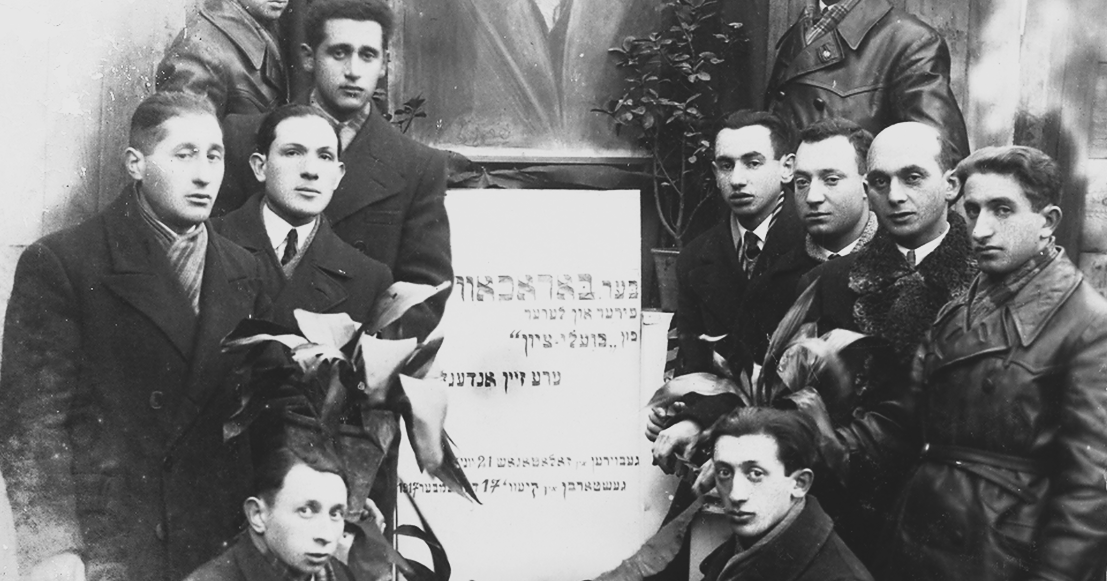
Furthermore a Polish “Social Democratic” group took part in the judeo-supremacist plan to undermine national sovereignties and build the infrastructures of the invisible imperialism we today call globalism, as I have previously noted. [22] In his book on the 1919 post-war peace talks, Nathan Feinberg credits the (pictured) Poale Zion organisation [23] with “awakening the interest of the ‘International’ in the Jewish question”. [24] He says its role was crucial “when one considers that socialist public opinion was an important factor during the peace negotiations”. [25]
But it was undoubtedly Russia that saw the firmest convergence of the communist and Jewish agendas. Slezkine observes: “The first Social Democratic party in the Russian Empire was the Jewish Bund (founded in 1897). The First Congress of the Russian Social Democratic Labor Party (RSDLP) was convened in 1898 in Minsk, at the initiative and under the protection of the Bund activists”. [26]
It is important to note that becoming communist did not imply a departure from the larger global Jewish fold. The author says that “the Jewish revolutionaries and educational networks – of people, books, money, and information – were similar to the traditional commercial ones. Sometimes they overlapped…” [27] As examples he cites the fact that the Fifth Congress of the aforementioned RSDLP was underwritten by American soap millionaire Joseph Fels and that Lenin’s return to Russia in 1917 was arranged by Alexander Helphand, aka Parvus (pictured), “himself both a revolutionary and a millionaire”. [28]
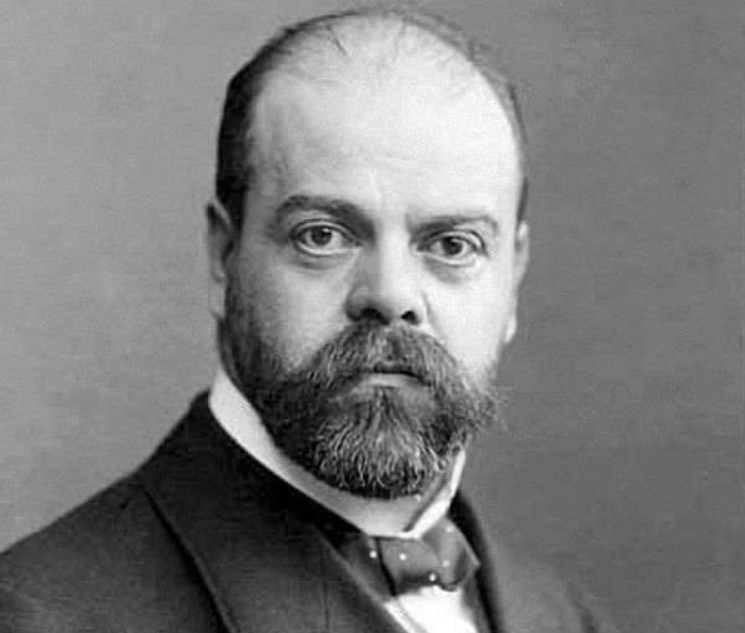
Slezkine insists that “there was no master plan behind this, needless to say…” [29] but here I have to disagree with him. As I showed in The False Red Flag (2024), the Bolshevik revolution was funded by judeo-supremacist financiers – notably the Rothschilds’ “Morgan” front in the USA – in pursuit of their own profit and power. [30]
Antony Sutton writes that “the betrayal of the Russian Revolution” – that is to say the brutal repression of the genuine freedom-seeking rebels – was the work of “the new powerbrokers of another corrupt political system… the ambitions of a few Wall Street financiers who, for their own purposes, could accept a centralized tsarist Russia or a centralized Marxist Russia but not a decentralized free Russia”. [31]
He muses about the apparent contradiction of somebody like George Foster Peabody, deputy chairman of the Federal Reserve Bank of New York, being an enthusiast for government ownership of railways and he argues: “Given the dominant political influence of Peabody and his fellow financiers in Washington, they could by government control of railroads more easily avoid the rigors of competition. Through political influence they could manipulate the police power of the state to achieve what they had been unable, or what was too costly, to achieve under private enterprise. In other words, the police power of the State was a means of maintaining a private monopoly… The idea of a centrally planned socialist Russia must have appealed to Peabody. Think of it – one gigantic State monopoly!” [32]
In 1922, the same year as they created their Gosbank central bank, the Bolsheviks formed their first international bank, known as the Ruskombank (Foreign Commercial Bank or the Bank of Foreign Commerce). It was headed by “Bolshevik Banker” Olof Aschberg (pictured) and on its board, alongside representatives of the Soviet Union, sat tsarist private bankers and representatives of German, Swedish and American banks. [33]
I write in The False Red Flag about the conflicting claims in the freedom movement as to whether globalism is essentially “capitalist” or “communist” in nature. And I remark: “Once we realise that communism in Russia was promoted and funded by the same mafia who are now behind the WEF [34] the fog of confusion quickly clears. As we have seen, the real aim behind installing communism in Russia was to impose, by means of its totalitarian central state, a massive wave of highly profitable industrial development”. [35] Indeed, Slezkine describes this as “the most intense industrializing drive ever attempted by any state and the most resolute assault on the Apollonian [ie Gentile] countryside ever undertaken by any urban civilization”. [36]
The significant Jewish involvement in Bolshevism was evident right from the start, he explains. “According to the Provisional Government’s commissar for the liquidation of tsarist political police abroad, S.G. Svatikov, at least 99 (62.3 percent) of the 159 political émigrés who returned to Russia through Germany in 1917 in ‘sealed trains’ were Jews”. [37] “For those [Jews] who wished to fight, there was but one army to join. The Red Army was the only force that stood earnestly and consistently against the Jewish pogroms and the only one led by a Jew. Trotsky (pictured) was not just a general or even a prophet: he was the living embodiment of redemptive violence, the sword of revolutionary justice, and – at the same time – Lev Davydovich Bronstein”. [38]

“The other Bolshevik leaders standing closest to Lenin during the civil war were G.E. Zinoviev (Ovsei-Gersh Aronovich Radomyslsky), L.B. Kamenev (Rosenfeld), and Ya. M. Sverdlov… there were many rebbes’ sons in the Red Army”. [39] It is easy to see why the counter-revolutionary Russian Whites saw Bolshevism as “a particularly contagious combination of old Mercurianism [ie Jewishness] and new urbanism as a form of foreign dominance”. [40]
The majority of Bolsheviks were not Jewish, explains historian Mikhail Beizer, but those of that particular background did have a rather high profile in the movement. “It may have seemed to the general population that the Jewish participation in Party and Soviet organs was even more substantial because Jewish names were constantly popping up in newspapers. Jews spoke relatively more often than others at rallies, conferences, and meetings of all kinds. Here, for example, is the agenda [minutes] of the Tenth City Conference of the Young Communist League (Komsomol), held in Petrograd on January 5th, 1920: Zinoviev made a speech on the current situation, Slosman read the report of the city Komsomol committee, Kagan spoke on political and organizational matters, Itkina greeted the delegates on behalf of female workers, and Zaks represented the central committee of the Komsomol”. [41]
Slezkine reports that “the Jews had a much higher proportion of elite members than any other ethnic group in the USSR” [42] and provides plenty of evidence to back this up. He notes that Lenin’s bodyguard and embalmer were both Jewish; [43] names the Jewish leaders of the secret police running the building of the White Sea Canal in 1931-34 with Gulag slave labour; [44] and says that Jews constituted the single largest group within the “leading cadres” of the secret police in general. [45]
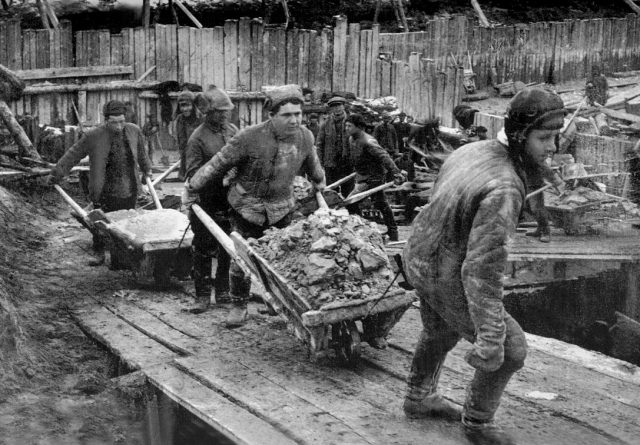
“The Gulag, or Main Labor Camp Administration, was headed by ethnic Jews from 1930, when it was formed, until late November 1938, when the Great Terror was mostly over”. [46] Jews formed “the backbone of the new Soviet bureaucracy”, [47] he says, and also dominated professions such as dentistry and pharmacy, while being severely overrepresented in the law, journalism, medicine, science and academia.
They were presumably also severely underrepresented in the grim factories that converted Russian lives into vast profits for the global industrial mafia!
Slezkine states: “It was at the very top of the Moscow and Leningrad elite that the Jewish presence was particularly strong and – by definition – visible”. [48] He also describes how Lenin’s New Economic Policy (NEP) in 1921 “created enough opportunities for entrepreneurial creativity to lure some émigré businessmen back to Russia”. [49] He reveals that, although Jews formed only 6.5 percent of the city’s population, “in 1924 in Moscow, Jewish ‘Nepmen’ owned 75.4 percent of all drugstores, 54.6 percent of all fabric stores, 48.6 percent of all jewelry stores, 39.4 percent of all dry goods stores, 36 percent of all lumber warehouses, 26.3 percent of all shoe stores, 19.4 percent of all furniture stores, 17.7 percent of all tobacco shops, and 14.5 percent of all clothing stores. The new ‘Soviet bourgeoisie’ was Jewish to a very considerable extent”. [50]
“Relatively free access to public education, coupled with the destruction of the prerevolutionary Russian elite and the relentless official discrimination against their children, created unprecedented opportunities (by any standard anywhere) for Jewish immigrants to Soviet cities”. [51]
Jewish influence was likewise strong in Bolshevik propaganda and culture (which were more or less the same thing). Says Slezkine: “Natan Altman, who had begun his artistic career by experimenting with Jewish themes, became the leader of ‘Lenin’s Plan for Monumental Propaganda’, the founder of artistic ‘Leninania’ (Lenin iconography), and the designer of the first Soviet flag, state emblems, official seals, and postage stamps. In 1918, he was put in charge of an enormous festival marking the first anniversary of the October Revolution in Petrograd. Fourteen kilometres (8.7 miles) of canvas and enormous red, green and orange cubist panels were used to decorate – and reconceptualize – the city’s main square in front of the Winter Palace”. [52]
He adds: “The revolutionary rebirth was accompanied by revolutionary renamings, which reflected the degree of Jewish prominence”. [53] For example, Petrograd’s Vladimir Square and Vladimir Avenue were named after Semen Nakhimson and the new Communist Workers’ University (along with various streets and the city of Elisavetgrad) was named after Zinoviev. “The royal residences Pavlovsk and Gatchina became Slutsk and Trotsk, respectively. Vera (Berta) Slutskaia had been the secretary of the Vasileostrovsky District Party Committee”. [53]
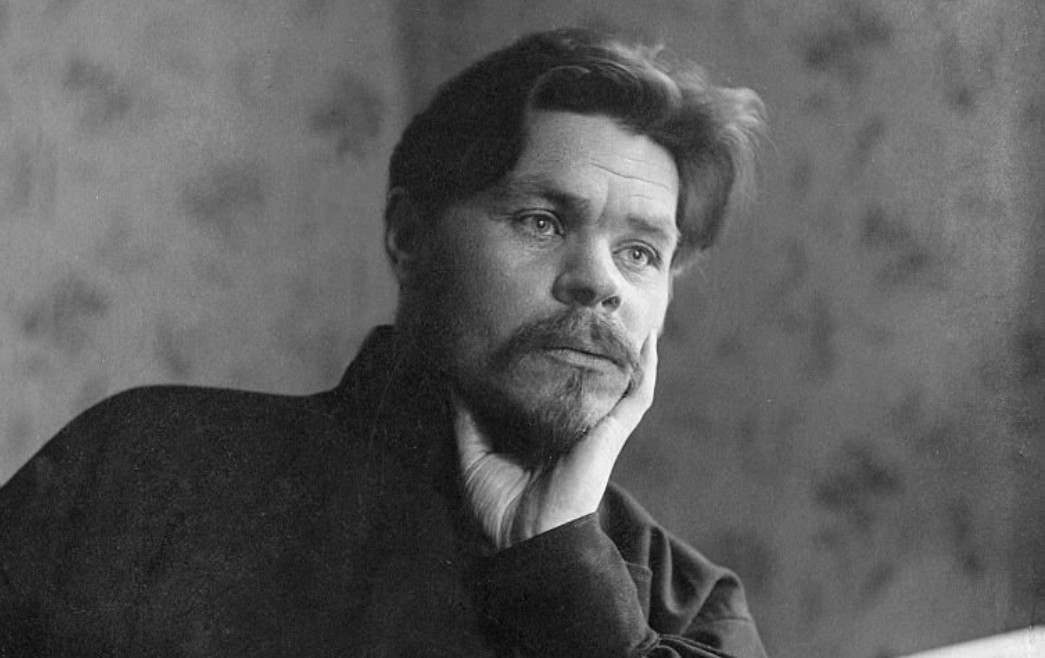
In 1922, Maxim Gorky (pictured), who Slezkine describes as a great admirer of the Jewish presence in Russia, sent a message to his friend Sholem Asch to be passed on to the “Jewish workers of America”. This stated: “The reason for the current anti-Semitism in Russia is the tactlessness of the Jewish Bolsheviks. The Jewish Bolsheviks, not all of them but some irresponsible boys, are taking part in the defiling of the holy sites of the Russian people. They have turned churches into movie theaters and reading rooms without considering the feelings of the Russian people”. [54] This letter prompted an angry response from Esther Frumkina, one of the leaders of the Party’s Jewish Section, who accused Gorky of taking part in an “attack on the Jewish Communists for their selfless struggle against darkness and fanaticism”. [55]
The Bolsheviks knew that the judeo-supremacist aspect of their regime was inciting opposition from the bulk of the population. Anatoly Lunacharsky complained that because Jews had played a key role in the revolution “some conclude from this: ‘Aha, this means that the revolution and the Jews are in some sense identical!’ This enables the counterrevolutionaries to talk about ‘Jewish dominance'”. [56] The secret police in Leningrad in the mid-1920s intercepted letters expressing such opinions: “The Jewish domination is absolute” (October 1924); “the whole press is in the hands of the Jews” (June 1925); “the Jews, for the most part, live extremely well; everything, from trade to state employment, is in their hands” (September 1925); “every child knows that the Soviet government is a Jewish government” (September 1925). [57]
One way the Bolsheviks tackled this awakening was by trying to hide the unpalatable truth. Slezkine reveals: “Prominent officials of Jewish descent took care to avoid undue prominence or to play down their Jewish descent”. [58] “Trotsky, according to his own testimony, refused the post of commissar of internal affairs for fear of ‘providing our enemies with the additional weapon of my Jewishness'”. [59] “The nationality of Emelian Yaroslavsky (Gubelman) and Yuri Larin (Lurie) was less well known; both were leading Soviet spokesmen on the question of anti-Semitism, and both consistently referred to Jews in the third person”. [60]
Trotsky told the Politburo that there was a tendency among Jewish soldiers to avoid frontline postings and that “strong chauvinist agitation was being carried on among the Red Army men and finding a certain response there”. The answer, he said, was to reallocate personnel so as to even up the imbalance between Jewish service at the front and in the rear. [61] Further concern was provoked by Lenin’s sister’s discovery, just after his death in 1924, that “their maternal grandfather, Aleksandr Dmitrievich Blank, had been born Srul (Israel), the son of Moshko Itskovich Blank, in the shtetl of Starokonstantinov in Volynia”. The party, through the Lenin Institute, proclaimed the fact “inappropriate for publication” and decreed that it be “kept secret”. [62] Slezkine adds: “The Bolsheviks kept apologizing for the numbers of Jews in their midst until the subject became taboo in the mid-1930s”. [63]
The second way in which the regime tried to silence critics of Jewish domination will be very familiar to readers today – it whipped up a scare about “anti-semitism”! According to the August 1926 Agitprop report to the Central Committee secretariat: “The sense that the Soviet regime patronizes the Jews, that it is ‘the Jewish government’, that the Jews cause unemployment, housing shortages, college admissions problems, price rises, and commercial speculation – this sense is instilled in the workers by all the hostile elements… If it does not encounter resistance, the wave of anti-Semitism threatens to become, in the very near future, a serious political question”. [64]
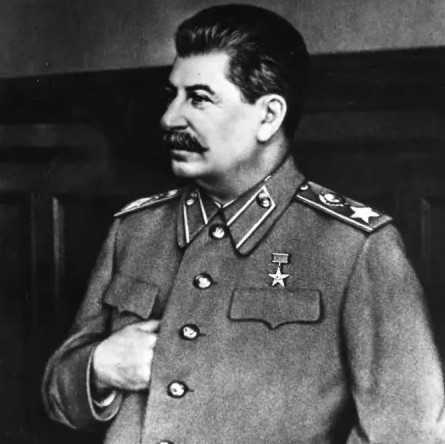
In December 1927 Stalin (pictured) launched a massive public campaign against “anti-semitism”, declaring at the Fifteenth Party Congress: “This evil has to be combated with utmost ruthlessness, comrades”. [65] The Party sponsored countless formal appeals, celebrity speeches, mass rallies and newspaper exposés to this effect – from 1927 to 1932, Soviet publishing houses produced no fewer than 56 books condemning “anti-semitism” and, says Slezkine, at the height of the campaign “articles on the subject appeared in the Moscow and Leningrad newspapers almost daily”. [66] There was, however, as he notes, a certain incoherence in the messaging as it insisted, simultaneously, that Jews did not occupy a special place in Soviet society and that Jews occupied a special place in Soviet society “for perfectly wholesome and understandable reasons”. [67]
At the same as this propaganda was being produced, surveillance and repression were being rolled out, hence the interception of the Leningrad letters cited above, which were all passed on to the Counterrevolution Department (KRO) of the secret police for further action. In March 1925, seven Russian nationalists were shot for, among other things, advocating the toppling of the “Communist-Jewish” regime. [68]
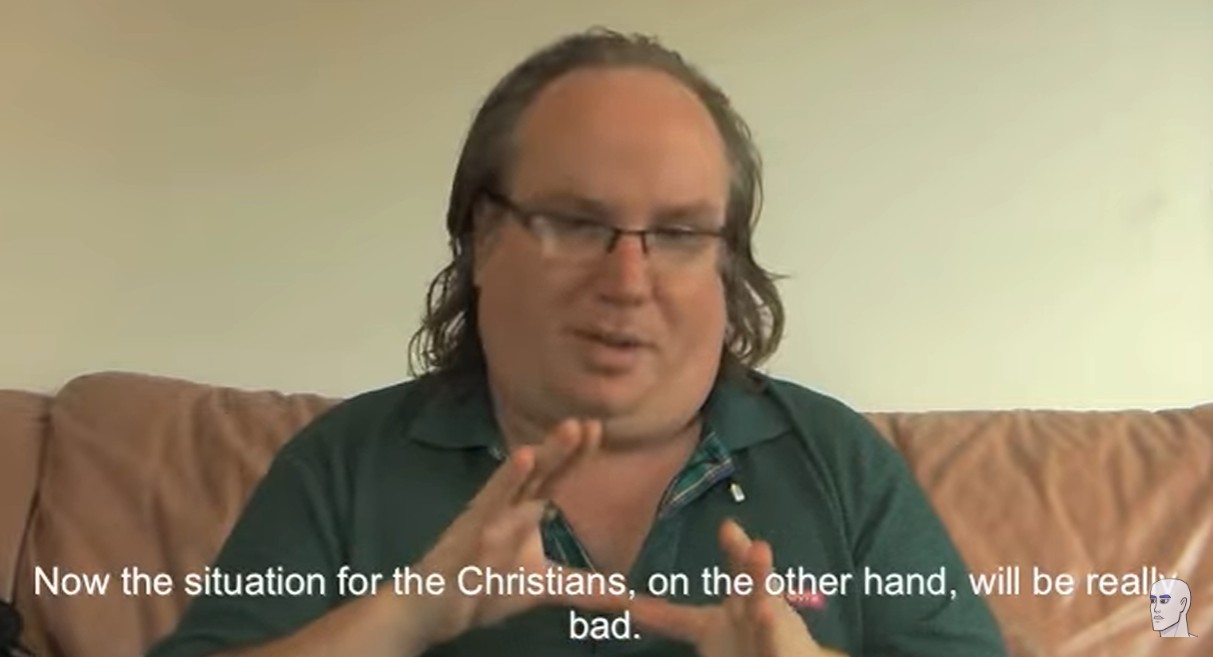
There was, in general, a rather shady and mafia-like feel to the Bolsheviks, arising perhaps from the past relationship of the Jewish population, in their Pale of Settlement, with Russia as a whole. Leonard Shapiro explains: “It was the Jews, with their long experience of exploiting conditions on Russia’s western frontier which adjoined the Pale for smuggling and the like, who organized the illegal transport of literature, planned escapes and illegal crossings, and generally kept the wheels of the whole organization running'”. [69] But the revolution and subsequent Soviet regime also revealed an aspect of Jewishness that has not historically been very visible and only comes to the fore, as Yossi Gurvitz (pictured) has explained, when “Israel is Mighty” and knows it has the upper hand and controls a given country or countries. [70]
G.A. Landau wrote in 1923: “We were amazed by what we had least expected to encounter among the Jews: cruelty, sadism, and violence had seemed alien to a nation so far removed from physical, warlike activity; those who yesterday did not know how to use a gun are now found among the executioners and cutthroats”. [71] And Ia. A. Bromberg describes his amazement at seeing the former oppressed lover of liberty turning into a tyrant of “unheard-of despotic arbitrariness”. “He is keeping, coldly and efficiently, as if they were regular statistics, the bloody count of the new victims of the revolutionary Moloch”. [72]
Slezkine mentions that some of the Jewish members of the Soviet elite “came of revolutionary age in the underground world of terrorist conspiracies” [73] and refers to the considerable Jewish involvement in the murderous People’s Will party: “The influential Orzhikh-Bogoraz-Shternberg group, centered in Ekaterinoslav and known for its uncompromising commitment to political terror, was more than 50 percent Jewish, and in the remarkable year of 1898, 24 out of 39 (68.6 percent) political defendants were Jews”. [74]
When the Bolsheviks came to power and set up their notorious secret police, the Cheka (pictured at the top of the article and below): “Jews made up 19.1 percent of all central apparatus investigators and 50 percent (6 out of 12) of the investigators employed in the department for combating counter-revolution”. [75] Shapiro remarks: “Anyone who had the misfortune to fall into the hands of the Cheka stood a very good chance of finding himself confronted with and possibly shot by a Jewish investigator”. [76]

Slezkine writes: “Specifically, and very publicly, Jewish names (and some transparent pseudonyms) were associated with two of the most dramatic and symbolically significant acts of the Red Terror. Early in the civil war, in June 1918, Lenin ordered the killing of Nicholas II and his family. Among the men entrusted with carrying out the order were Sverdlov (head of the All-Russian Central Executive Committee in Moscow, formerly an assistant pharmacist), Shaia Goloshchekin (the commissar of the Urals Military District, formerly a dentist), and Yakov Yurovsky (the Chekist who directed the execution and later claimed to have personally shot the tsar, formerly a watchmaker and photographer). It was meant to be a secret operation, but after the Whites reoccupied Ekaterinburg, they ordered an official investigation, the results of which, including the Jewish identities of the main perpetrators, were published in Berlin in 1925 (and eventually confirmed).
“At the end of the civil war, in late 1920-early 1921, Béla Kun (the chairman of the Crimean Revolutionary Committee) and R.S. Zemliachka (Rozaliia Zalkind, the head of the Crimean Party Committee and the daughter of a well-off Kiev merchant) presided over the massacre of thousands of refugees and prisoners of war who had stayed behind after the evacuation of the White Army. For her part in the operation, Zemliachka received the highest Soviet decoration: the Order of the Red Banner”. [77]
All this bloodthirsty brutality and censorship, along with the aforementioned defiling of Christian religious sites, today reminds us of the behaviour of the genocidal Israeli regime and the globally dominant zio-satanic imperialist mafia, ZIM. Slezkine addresses the connections between Zionism and communism in his book, noting for instance that “many Jewish nationalists (including such giants of Zionism as Ber Borokhov, Vladimir Jabotinsky, pictured, and Eliezer Ben-Yehuda) started out as socialist universalists”. [78]

He observes that “Zionism and Bolshevism shared a messianic promise of imminent collective redemption and a more or less miraculous collective transfiguration”. [79] “Communism was the principal religion of the young Jewish intellectuals (to be replaced by Zionism after World War II)… In Palestine, socialism (including collective farms, economic planning, and official trade unionism) became an important part of Zionist ideology”. [80]
There were also concrete links between the USSR and Zionism, Slezkine explains. “The head of the Soviet external propaganda apparatus, Solomon Lozovsky, was himself an ethnic Jew, as were the Soviet ambassadors to Great Britain and the United States, I.M. Maisky and K.A. Umansky, who met with Chaim Weizmann and David Ben-Gurion in 1941”. [81] He describes how, during WW2, the Soviet regime received $45 million of funding from various Jewish organizations, mostly in the USA, and negotiated with the leaders of the World Jewish Congress and the World Zionist Organization [82] and he adds that, in 1944, the Jewish Anti-Fascist Committee, created by the Soviet Bureau of Information, wrote to Stalin proposing the creation of a Jewish Soviet Socialist Republic in Crimea. [83]
“Everything changed, however, after the creation of the State of Israel in Palestine… the Soviet Union had supported a separate Jewish state, supplied Jewish fighters with arms (via Czechoslovakia), and promptly recognized Israel’s independence… Assuming that they were within the boundaries of the official policy, or possibly no longer caring whether they were or not, thousands of Soviet Jews, most of them Jews ‘by blood’ from Moscow and Leningrad, took the occasion to express their feelings of pride, solidarity and belonging”. [84]
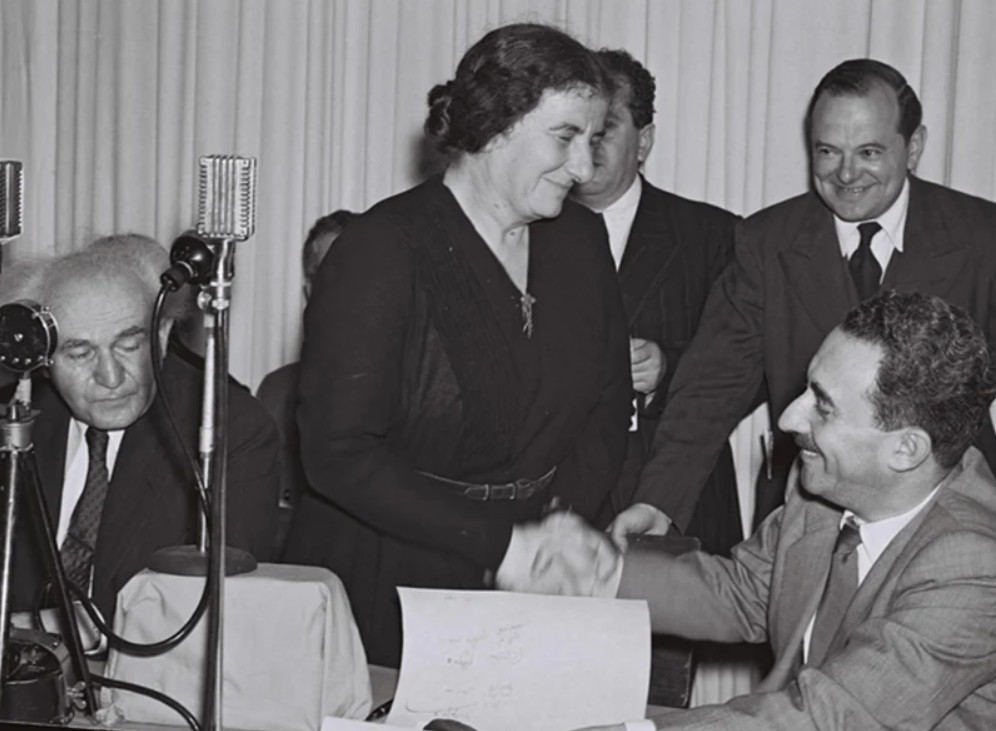
These enthusiasts declared that Comrade Stalin and the Soviet government had always supported the Zionist colonialists, unlike “the English and American scum” and petitioned the Soviet authorities regarding their desire to go and fight for Israel and “help the Jewish people in their struggle against the English aggression, on behalf of the Jewish state”. [85] Zionist fervour among Soviet Jews was whipped up in 1948 by a speaking tour by the Israeli ambassador to the USSR, Golda Meyerson (later Meir), pictured, which saw crowds chanting “Next year in Jerusalem!” [86]
Such indications of Soviet citizens switching loyalty to a new foreign state created an adverse reaction within the Soviet administration, whose upper ranks now contained more ethnic Russians and which had drifted away from strict internationalism into a “patriotic” formulation. In 1952, 13 members of the former Jewish Anti-Fascist Committee were shot after being found guilty of being “bourgeois nationalists” [87] during a brief period when judeo-supremacist influence was questioned. “The official organs of the Young Communist League and the Writers’ Union were found to be dominated by Jews… A special secret police investigation of the secret police revealed a massive ‘Zionist conspiracy'”. [88] Rumours also spread about Jewish “murderer physicians”, [89] described as “poisoners” and “murderers in white robes”. [90]
There were also government purges for alleged disloyalty, but, says Slezkine, “the attack on the Jews was on a much less massive scale and was much less lethal than the treatment of other ethnic groups”. [91] “After Stalin’s death, the anti-Jewish campaign fizzled out, and ethnic Jews returned to the top of the Soviet professional hierarchy… Jews remained prominent in the Soviet professional elite (and thus at the heart of the Soviet state) until the breakup of the USSR”. [92]
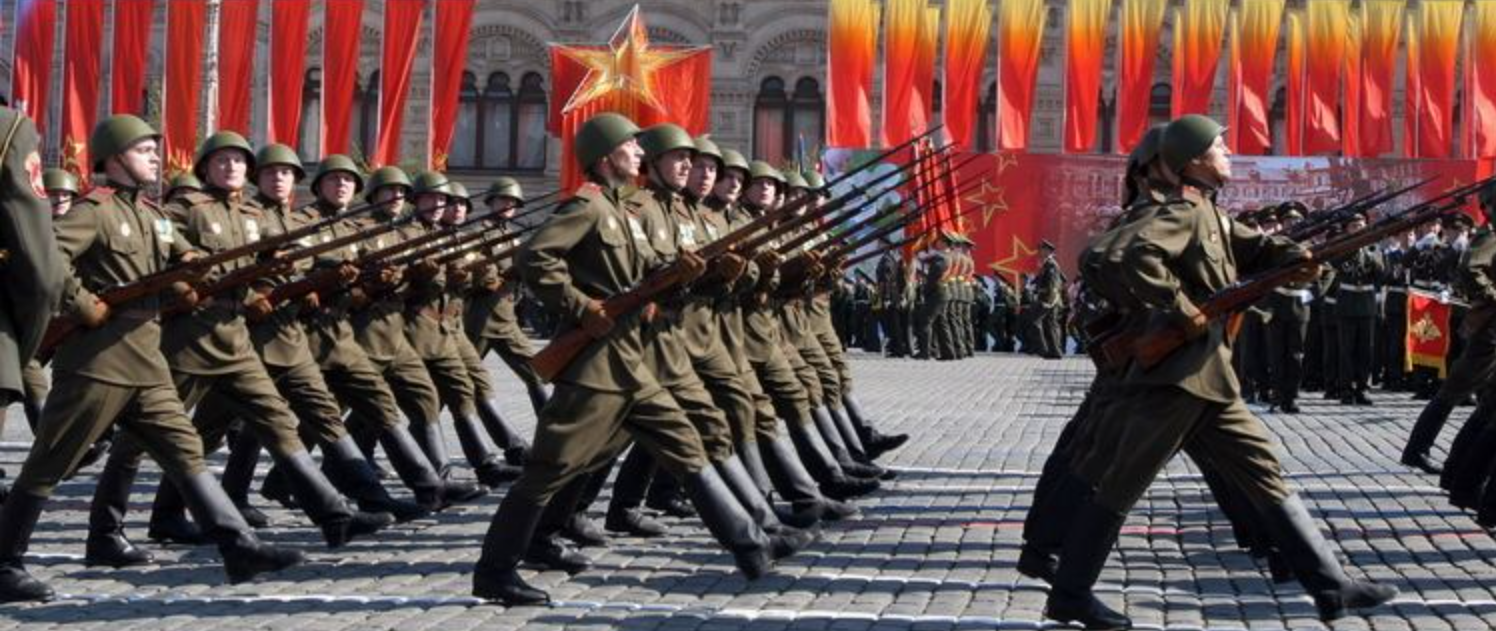
Many Jews, of course, came to see their future as lying in Israel rather than in a Russia that they concluded had never been their real home. “Along with Soviet Germans, Armenians, and Greeks, who also had prosperous foreign cousins willing to pay their ransom, the Jews were the only Soviet citizens – and virtually the only members of the Soviet professional elite – who were allowed to emigrate from the USSR. The official reason for the privilege was the existence of Israel: the Jewish ‘historic homeland'”. [93] “After the fall of the Berlin Wall in 1989, Israel opened its own consulates in the Soviet Union, closed down the notoriously porous transit point in Vienna, and ultimately succeeded in preventing the majority of the 1989-92 refugees (the largest group of all) from ‘dropping out’ en route”. By 1994, 62 percent of Jewish émigrés from the old USSR had gone to Israel. [94]
Slezkine regards Israel as being the continuation, in many ways, of the spirit which animated the USSR – “the most Jewish of all states since the Second Temple” [95] – and also of Adolf Hitler’s Nazi regime, which we now know was a Zionist golem. [96] He writes: “Israel was the only postwar European state (‘European’ in both composition and inspiration) to have preserved the ethos of the great nationalist and socialist revolutions of the interwar period”. [97] From his 2004 vantage point, Slezkine sees that Israel only gets away with its hideous behaviour because of its “claim on the West’s moral imagination” [98] and the way in which WW2 “gave birth to a new moral absolute: the Nazis as universal evil”. [99]
Today, and particularly for younger generations, that is no longer true. Universal evil is now seen by many to reside in the genocidal racist state of Israel and in the judeo-supremacist mafia which seeks to silence all criticism of its many crimes, while imposing its cruel globalist domination with all the totalitarian brutality which made its Soviet regime so loathed by freedom-loving people everywhere.

[1] https://winteroak.org.uk/2026/04/23/invisible-imperialism
[2] Yuri Slezkine, The Jewish Century (Princeton & Oxford: Princeton University Press, 2019), p. 93. All subsequent page references are to this work unless otherwise stated.
[3] Paul Cudenec, ‘The Invisible College and the plan for our enslavement’, https://winteroak.org.uk/2025/08/11/the-invisible-college-and-the-plan-for-our-enslavement/
[4] Lev Shternberg, ‘Problema evreistoi natsional’ noi psikkhologii’, Evreiskaia starina 11 (1924), p. 37, cit. pp. 93-94.
[5] p. 80.
[6] p. 162.
[7] p. 148.
[8] Ibid.
[9] pp 94-95.
[10] Paul Cudenec, ‘The globalist gag and the rainbow flag’, https://winteroak.org.uk/2026/02/09/the-globalist-gag-and-the-rainbow-flag/
[11] Burnaia zhizn’ Lazika Roitshvanetsa, in Ilya Erenburg, Staryu skorniak i drugie proizvedeniia (1983), p. 115, cit. p. 95.
[12] p. 95.
[13] Jeff Schatz, The Generation: The Rise and Fall of the Jewish Communists of Poland (1991), p. 138, cit. p. 95.
[14] p. 95.
[15] Schatz, p. 138, cit. pp. 95-96.
[16] p. 80.
[17] Ibid.
[18] Istvan Déak, Weimar Germany’s Left-Wing Intellectuals: A Political History of the Weltbühne and Its Circle (Berkeley & Los Angeles: University of California Press, 1968), pp. 28-29, cit. p. 86.
[19] p. 85.
[20] p. 90.
[21] Ibid.
[22] Paul Cudenec, ‘War, peace and global control’, https://winteroak.org.uk/2026/03/16/war-peace-and-global-control/
[23] https://jewishplock.eu/en/poale-zion-party/
[24] Nathan Feinberg, La question des minorités à la Conférence de la paix (1919-1920) et l’action juive en faveur de la protection internationale des minorités (Paris: Rousseau & Co, 1929), p. 24.
[25] Feinberg, p. 26.
[26] p. 151.
[27] p. 154.
[28] pp. 154-55.
[29] p. 155.
[30] Paul Cudenec, The False Red Flag, https://winteroak.org.uk/wp-content/uploads/2024/03/the-false-red-flag–1.pdf
[31] Antony C. Sutton, Wall Street and the Bolshevik Revolution (West Hoathley: Clairview, 2016), p. 19.
[32] Sutton, p. 100.
[33] Sutton, p. 60.
[34] https://winteroak.org.uk/2025/01/17/the-truth-about-davos/
[35] Cudenec, The False Red Flag, p. 35.
[36] p. 249.
[37] p. 152.
[38] p. 169.
[39] pp. 169-70.
[40] p. 173.
[41] Mikhael’ Beizer, Evrei Leningrada 1917–1939: Natsional’naia zhizn’ I sovetizatsiia (Moscow: Mosty kul’tury, 1999), pp. 78-79, cit. pp. 176-77.
[42] p. 236.
[43] p. vii.
[44] p. 199.
[45] p. 221.
[47] p. 224.
[48] p. 225.
[49] p. 209.
[50] pp. 217-28.
[51] p. 222.
[52] p. 178.
[53] p. 179.
[53] Ibid.
[54] Maksim Gor’kii, Iz literaturnogo naslediia: Gor’kii i evreiskii vopros, ed. Mikhail Agurskii and Margarita Shklovskaia (Jerusalem: Hebrew University of Jerusalem, 1986), p. 304, cit. p. 186.
[55] Gor’kii, p. 307, cit. p. 187.
[56] A. Lunacharskii, Ob antisemitizme (Moscow: Gosizdat, 1929), pp. 5-6, cit. p. 188
[57] pp. 242-43.
[58] p. 244.
[59] Trotsky, Moia zhizn’ (1929), 2, pp. 61-63, cit. p. 187.
[60] p. 245.
[61] Joseph Nedava, Trostky and the Jews (1971), p. 122, cit. p. 187.
[62] p. 245.
[63] p. 187.
[64] p. 244.
[65] p. 249.
[66] Ibid.
[67] p. 250.
[68] p. 244.
[69] Leonard Shapiro, ‘The Role of the Jews in the Russian Revolutionary Movement’, Slavonic and East European Review 40 (December 1961), p. 153, cit. p. 154.
[70] https://winteroak.org.uk/2026/02/11/the-acorn-109/#2
[71] G. A. Landau, ‘Revoliutsionnye idei v russkoi obshchestvennosti’, in Rossiia i evrei, ed. I. M. Bikerman et al. (Paris: YMCA Press, 1978), p. 117, cit. p. 183.
[72] Ia. A. Bromberg, Zapad, Rossiia i Evreistvo: Opyt peresmotra evreiskogo voprosa (Prague: Izd. Evraziitsev, 1931), pp. 54-55, cit. pp. 183-84.
[73] p. 227.
[74] p. 151.
[75] p. 177.
[76] Shapiro, p. 165, cit. p. 177.
[77] p. 178.
[78] p. 204.
[79] p. 211.
[80] p. 209.
[81] p. 291.
[82] pp. 291-92.
[83] pp. 293-94.
[84] pp. 294-95.
[85] pp. 295-96.
[86] pp. 296-97.
[87] p. 298.
[88] pp. 303-04.
[89] p. 310.
[90] p. 308.
[91] Ibid.
[92] pp 329-30.
[93] p. 354.
[94] p. 358.
[95] pp. 359-60.
[96] Paul Cudenec, ‘The Nazi regime was a Zionist golem’, https://winteroak.org.uk/2026/01/08/the-acorn-108/#2
[97] p. 327.
[98] p. 365.
[99] p. 366.


“The 19th Century, in the West, differed from the preceding eighteen centuries of the Christian era there in the emergence of two movements with a converging aim, which by the century’s end dominated all its affairs.
The one movement, Zionism, aimed at reassembling a dispersed nation in a territory promised to it by the Jewish god; the second movement, Communism, aimed at the destruction of separate nationhood as such.
Thus these two movements appeared at first sight to be fixedly opposed to each other, for the one made nationalism its religion, even its god, and the other declared war to the death on nationalism. This antagonism was only apparent, and in truth the two movements ran on parallel tracks, not head on towards a collision on the same line. For the god who promised land to the nation to be gathered-in also promised to set it “above all people that are upon the face of the earth” and to destroy all other nations “with a mighty destruction until they be destroyed”. The world-revolution, which pursued the second of these aims, thus fulfilled the condition set for the first of them; either by accident or by design, it too was doing the will of Jehovah.
That being so, the historian’s task is to find out, if he can, what relationship existed between the organizers of Zionism and those of the world-revolution. If there was none, and the parallelism of purpose was coincidental, then history was evidently having a little joke with the West. If relationship can be shown, the pattern of the last 170 years prefigures the shape of coming events; in that case the world-revolution has been the handmaiden of Zion.”
— Douglas Reed, “The Controversy of Zion” (1956), chapter 19 – The World Revolution
https://archive.org/details/TheControversyOfZion
LikeLike
Thanks. I’ve never read that.
LikeLike
It’s a long read, but well worth the trouble. Here’s an online version with links to a reference database, and audio for each chapter:
https://modernhistoryproject.org/mhp?Article=ControZion
“The political and military operations of two world wars have been diverted to promote the Zionist ambition and the life and treasure of the West have been poured out in support of it. Forty years of continuous bloodshed in Palestine have obviously been but the prelude to what is yet to come there. Any third world war may begin and spread outward from Palestine, and if one were to start elsewhere it would in its course foreseeably revolve around the ambition of Zion, which will not be fulfilled until a much greater area in the Middle East has been conquered, ‘other Gods’ have been thrown down, and ‘all nations’ have been enslaved.”
LikeLike