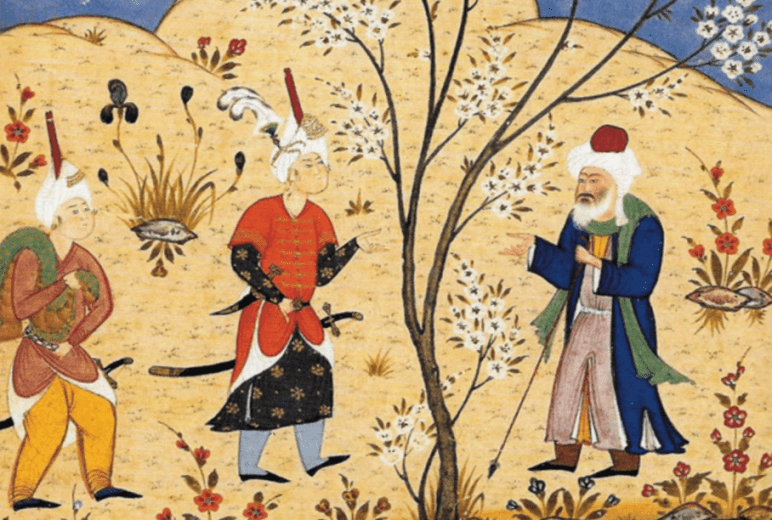
To mark the tenth anniversary of Paul Cudenec’s 2016 novel The Fakir of Florence, here is a chapter from a fictional dimension very far from the contemporary world and thus much closer to truth. You can listen to him reading it here.
Early one morning while Perantulo was wandering in the hills south of Beziz he was caught in a violent thunderstorm.
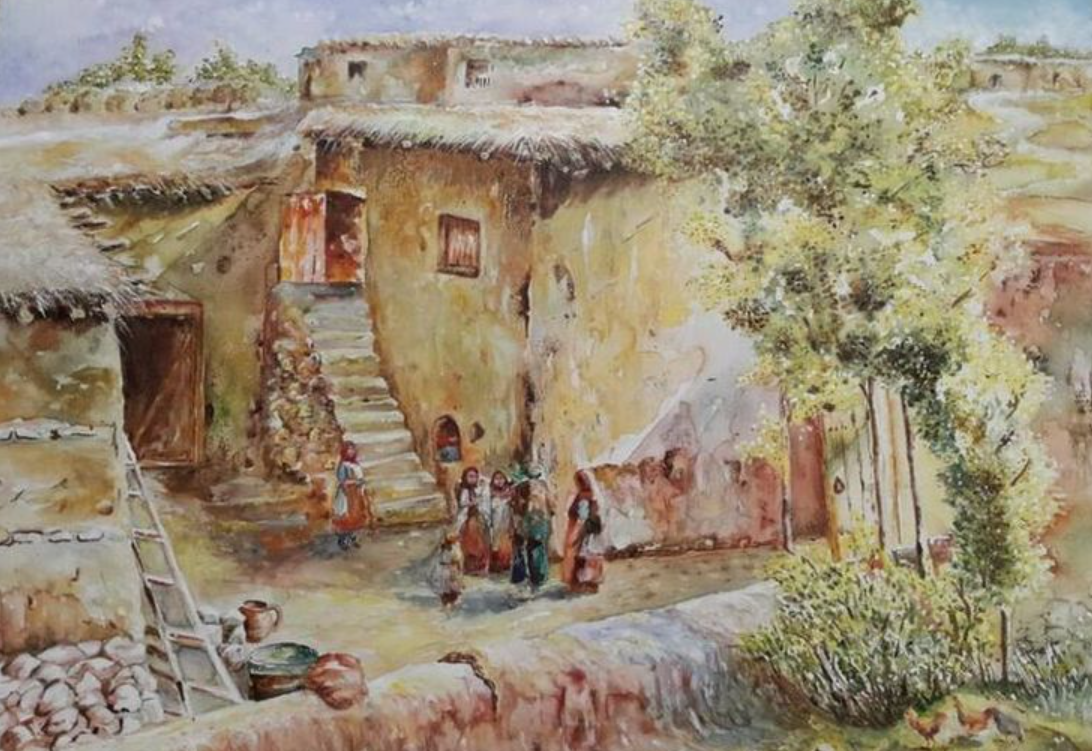
Spying a village ahead, he quickened his pace through the deluge in the hope of finding shelter.
He was heading for the temple, where he had thought to escape from the rain for a while, when he spotted a great hollow yew within its grounds.
“Ah!” said Perantulo. “What better resting-place for a man of my kind!” and he curled up in the dry interior of the ancient tree and fell asleep.
When he awoke, an hour or so later, it was to the voices of three earnest young men, deep in conversation outside the temple.
He climbed out of the tree and went over to them, carefully avoiding the many puddles and little streams of water left over from the storm.
After they had greeted each other, and Perantulo had explained a little of the calling in life that brought him so far from the land of his birth, the most forthright of the young men said to him: “It is a stroke of good chance for the three of us, O Sage, that you have arrived in our humble village at this moment, for you may be able to help us with this dispute concerning the destiny of our souls”.
Perantulo nodded and agreed to listen.
“It’s like this,” said the first young man. “My friend here, Walil, follows the teachings of the School of Farzib and insists that when our current existences end, we are each of us reincarnated in some new-born creature or person.
“I, on the other hand, am a disciple of the School of Lezzam Lezu and am certain that after death, our souls are united in the Superior Realm and freed from all confines of earthly existence”.
Perantulo nodded again and turned to the third fellow, asking: “And what is your view of the matter, young Sir?”
The other two laughed and the lad looked a little embarrassed as he said he didn’t know.
“Humik has no opinion,” said Walil. “That’s why Koffu and I are discussing all this again for the seven thousandth time – each of us is trying to persuade him of our approach.
“He spends his days tending goats and eating wild figs and really hasn’t got any views at all on these weighty matters”.
Koffu and Walil both chortled merrily at the expense of the little goatherd, whose eyes betrayed a certain hurt at being thus humiliated in front of this erudite stranger.
A stern look flashed across Perantulo’s eyes. The look was so severe that a small cat, sleeping in the shade beside the temple, woke up and splashed off through a puddle with a plaintive yelp.

“I think,” he said, “that we should discuss this at the village tavern, always such a convivial location for the most important of conversations. Pray lead the way, my young friends!”
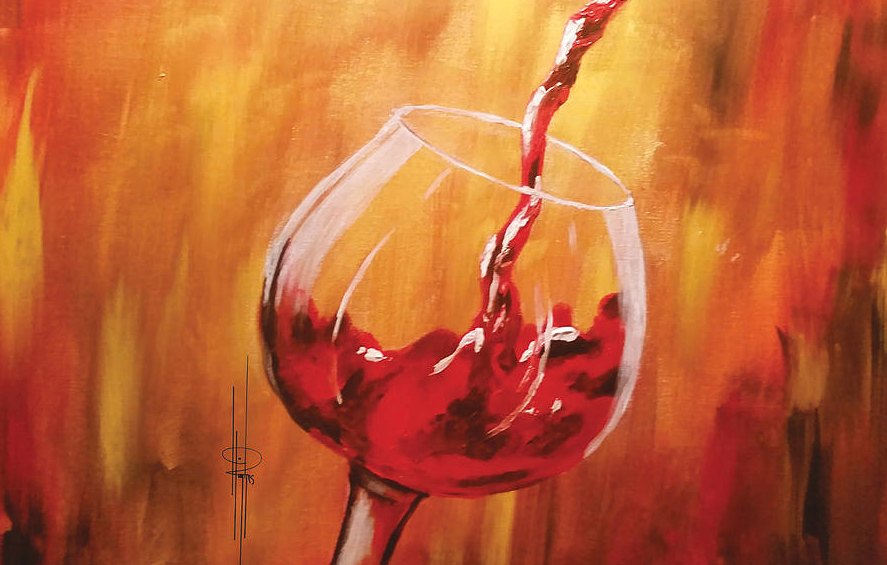
When they had taken a seat outside the tavern, Perantulo had the keeper bring a large jug of the finest red wine available.
The innkeeper was a suspicious, mean-spirited character and, looking at Perantulo’s simple clothes and ungroomed appearance, doubted whether he would have the means to pay.
His distrust was so strong that it burst out of his narrow little mind and made itself known to Perantulo, who headed off any ill will by immediately proffering a silver dinar which would more than cover the cost of the refreshment.
The youngsters, being of humble background, were not accustomed to such good living and their tongues were dry in anticipation of the expensive wine.
But when the innkeeper brought four glasses for the drinkers – the best he could lay his hands on, since the old stranger had paid him so handsomely – Perantulo immediately took two of them and wandered off to the other side of the street.
His companions strained their necks to see what he was up to. He seemed to be scooping up muddy water from a puddle into the wine glasses!
Indeed, he now returned slowly and cautiously to the table bearing the two glasses filled to the very brim with filthy rainwater and placed them in front of Koffu and Walil.
“Now,” he said. “Who would like some wine?” He started as if to pour some for Koffu and Walil, but could not do so as their glasses were already full, so instead he poured a healthy dose into the empty glass in front of Humik.
All three young men looked completely confused.
“And now,” said Perantulo. “To the subject of your dispute. Koffu, you are right to say that beyond its individual existence, the soul is united with all others”.
“Yes!” exclaimed Koffu, slapping his hand on the table and grinning gleefully at Walil.
A stern look creased Perantulo’s brow. The look was so severe that a baby started to cry, far far away on the other side of the village.
“But at the same time as being right, Koffu, you are also wrong!” he said firmly.
“You are wrong to think that it is freed for ever from the obligation of earthly being. Yes, there is a glorious moment when the individual spark is reunited with the flame of the whole, but the separation from material existence is momentary and there is still living to be done in other forms”.
“Exactly!” burst out Walil, with a triumphant glow. “Don’t you see, Koffu? We are reincarnated, time and time again!”
A stern look passed over the brow of the Holy Man. It was so severe that a cloud passed over the sun and the birds stopped singing in the trees.

“Walil,” said Perantulo. “You are young and you have much to learn”. And with these words his mood lifted, the sun emerged from behind the cloud and the birds resumed their song.
“Both of you,” he said, calmly and kindly and looking at each of his listeners in the eye one after the other, “have had your minds filled with the muddy water of incomplete and corrupted doctrines, preventing the glasses of your intellect from being filled with the wine of Knowledge.
“More than that, you have now accepted so many of the false assumptions of these doctrines that it will be difficult for you to be able to receive Truth within the shape of those modes of thinking”.
He reached out and seized the glasses in front of Walil and Koffu, one with each hand, emptied out the dirty water on to the ground and then flung them down, shattering them into hundreds of pieces.
The innkeeper peered out from indoors and cursed to think that the extra profit he was gaining from the silver dinar had just been dramatically reduced.
“The soul after death is no longer a thing that follows the rules of this world,” said Perantulo, “in the same way as these glasses have lost the form which rendered them of use for the drinking of wine at this tavern.
“The idea of time is an idea of this world and relates only to the way in which our individual existence forms part of the Eternal Whole. It is the means by which we can subjectively understand and experience the extent of our individual existence, but that subjectivity no longer exists when the subject has died.
“It therefore makes no sense at all to speak of what becomes of the soul ‘after’ death”.
The three youngsters looked at Perantulo. The bashful Humik was taking a first sip from the glass of wine that the old man had poured him. The other two looked uncomfortable and the sage saw that they had not yet understood.
“It makes no sense O Koffu, Disciple of the School of Lezzam-Lezu, to talk of us being cut off from physical reality in a Superior Realm,” he said, “because we remain part of what is, always has been and always will be the reality of the entire Universe.
“And it makes no sense O Walil, Student of the School of Farzib, to talk of us undergoing a series of reincarnations, because we are already part of what is…”
At this point Perantulo’s voice trailed off, as his words were taken up by the simple goatherd.
“Because,” Humik was saying, with a look of deepest delight spreading across his young face, “we are already part of what is, always has been and always will be the reality of the entire Universe!”
Perantulo smiled, poured himself a glass of red wine, downed it in one gulp and then said farewell to the trio, leaving the village behind as he headed back off on his travels.
Later that night, as the tavern-keeper slept, the silver dinar wriggled its way out of his purse, jumped aboard a shaft of moonlight and shimmered its way back to its master.


