by Paul Cudenec, who reads the article here
Last summer I wrote about the origins of the Royal Society in London and in particular about its precursor organisation The Invisible College, also known as the Hartlib Circle after Polish-born Samuel Hartlib (1600-1662). [1]
I drew on the work of Professor Yosef Kaplan of the Hebrew University of Jerusalem who writes of “the connections that Hartlib and his partners formed with Jews from Holland and other places”. [2]
The significance of this connection is that the Jewish merchants in Amsterdam had identified England as the ideal new base for their worldwide commercial imperialism – what we today call “globalism”.
But in order for the country to serve this function, the obstacle of traditional ways of thinking and behaving – in what was still very much a rural society – had to be swept away.
An attachment to old customs, a widespread belief that nature was sacred and a moral aversion to usury and profiteering had to be replaced by a new outlook better aligned with industrial imperialism.
Hence, explains Kaplan, efforts were launched “to help people become more rational” as well as to convince them that “the revelation of the true worship and religion was transmitted to humanity by means of Judaism”. [3]
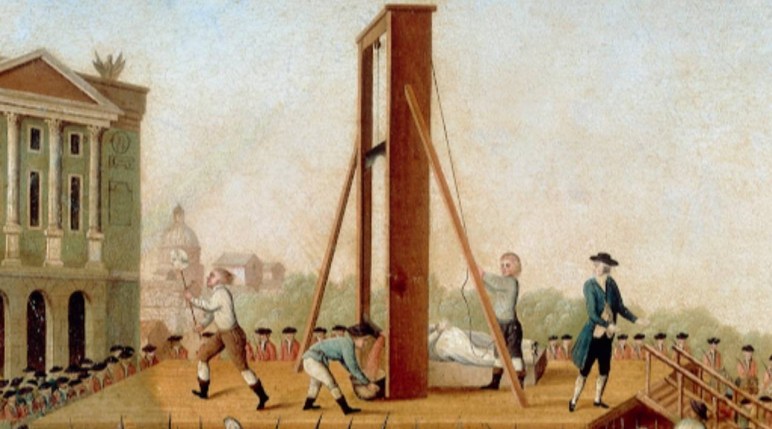
The Invisible College was formed in 1630, 12 years before the start of the English Civil War that led to the beheading of King Charles I in 1649, while the Royal Society was established in 1660, six months after the subsequent restoration of the monarchy.
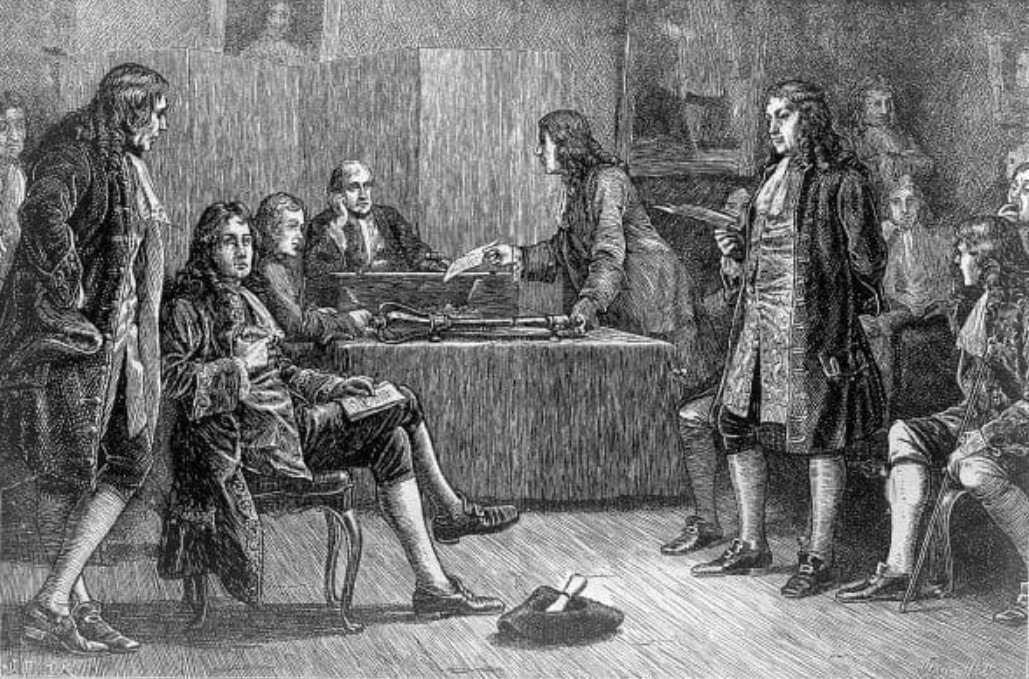
The latter still exists today, of course, and Wikipedia states: “The society fulfils a number of roles: promoting science and its benefits, recognising excellence in science, supporting outstanding science, providing scientific advice for policy, education and public engagement and fostering international and global co-operation”. [4]
Similar bodies were established across the Channel in France when it was still a monarchy.
In 1666 the Académie royale des sciences was founded – it continues to function today, albeit without the “royale” in the title – and says on its website that it “contributes to the internationalization of science” to meet “challenges, most of which are global in scope”. [5]
Members of this Académie were involved in the creation of L’Académie royale des sciences et belles-lettres de Nancy in Lorraine, eastern France, in 1751.
This was at the initiative of Stanislas Leszczynski, Duke of Lorraine and the exiled King of Poland, whose daughter Marie became Queen of France by marrying King Louis XV and was the grandmother of Louis XVI, who was to be beheaded in 1793. [6]
And in 1757, in the other big city in Lorraine, a Société royale des sciences et des arts de Metz was established. [7]
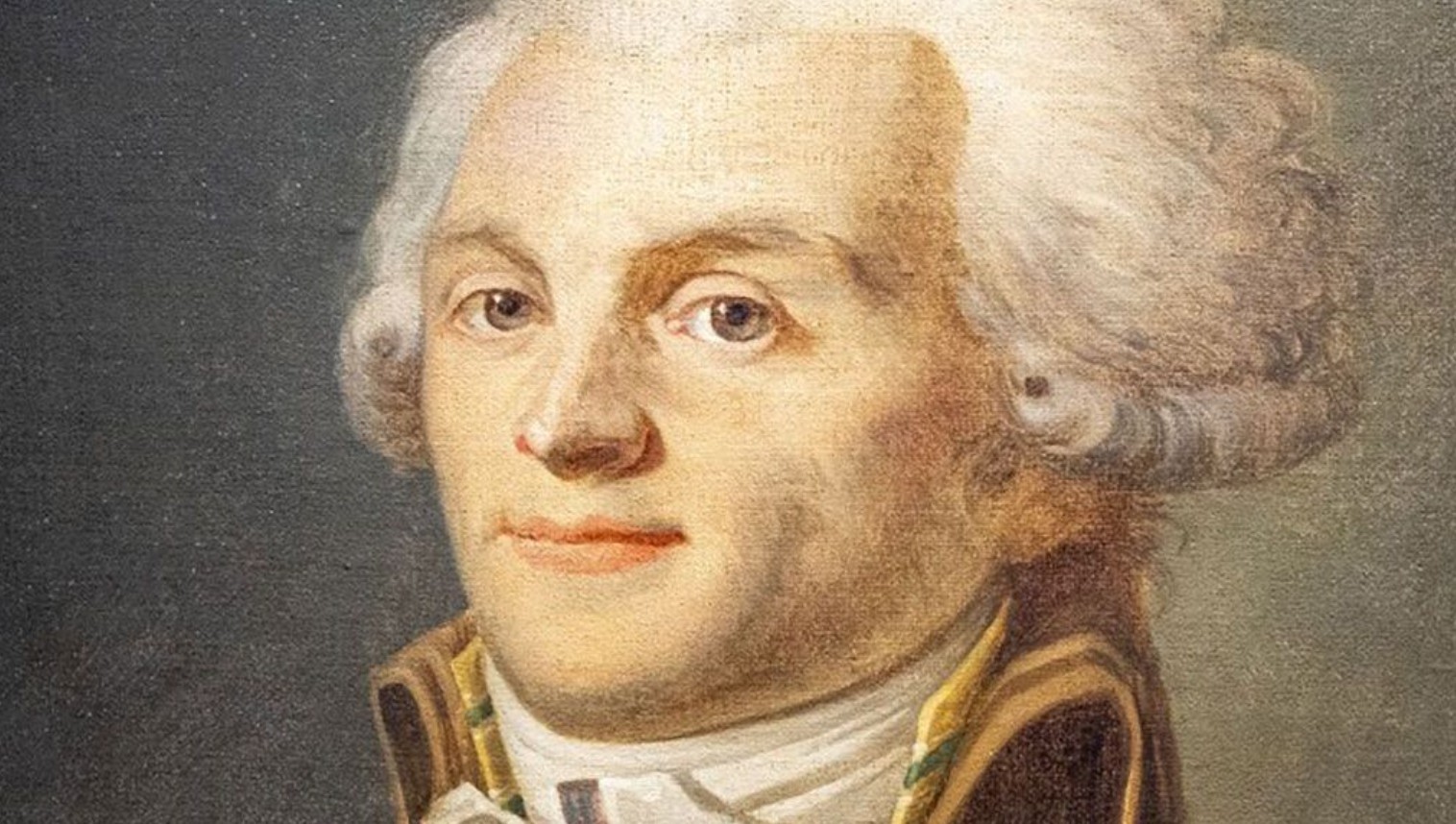
Among its members and indeed lauréats (prize winners) was Maximilien de Robespierre (pictured), a leading figure in the revolutionary Reign of Terror in which at least 15,000 “enemies of the revolution” were guillotined, and who himself ended up meeting the same fate in 1794. [8]
The reason why this body came to my attention is that it is mentioned in Pierre Hillard’s highly informative Archives du mondialisme (‘Globalist archives’).
This is in the context of his account of how, in France, the Enlightenment was used to promote not only “scientific” and “rational” thinking but also the standing of Jewish people and their religion – the same combination as Hartlib’s Invisible College in England.
Hillard says that, even before the 1789 revolution, traditional French society was gradually being brought closer to “the Judaic and talmudo-kabbalistic world”. [9]
As an example of this process, he describes how in 1788 the Société royale des sciences et des arts de Metz awarded its prize to Henri Grégoire, a revolutionary priest. [10]
This was for a work entitled Essai sur la régénération physique, morale et politique des juifs (‘Essay on the physical, moral and political regeneration of the Jews’).
Here, says Hillard, he “heralded the victorious return of the Sanhedrin” [11] – this being the Jewish legislative and judicial assembly which judeo-supremacists believe has global jurisdiction and can impose their appallingly racist Noahide Laws on non-Jews everywhere, with decapitation the punishment for non-compliance. [12]
As we saw with the peace treaties of 1919, the admirable idea of universal rights for everyone, including Jews, can be deliberately misused as a Trojan Horse for Jewish privilege. [13]
From the Jewish supremacist perspective, which asserts that Jews are God’s chosen people, there can in fact be no such thing as universal rights – those of the Jewish people are necessarily more important because of their special existential status.
So the process of combatting prejudice against Jews can in practice amount to a step towards enabling the “God-given” Jewish right to lead humanity and make sure we all think and behave in approved ways – that we “follow the science” of Jewish rationality.
Hillard’s account shows how French clergy, aristocracy and royalty, under the influence of freemasonry, set in motion the transition to a “modern” society which was then dramatically accelerated by the revolution.
He explains how Grégoire, the Société royale des sciences et des arts de Metz prize-winner, wrote to a Jewish friend Isaïe Bing, in Metz, in February 1789, a few months before the revolution, saying: “Tell me, my dear Bing, as the Estates General [former national assembly] is about to meet, should you not get together with other members of your nation to claim civic rights and benefits? More than ever, this is the moment…” [14]
A month after the famous storming of the Bastille in Paris, the new republic issued its Déclaration des droits de l’homme et du citoyen (‘Declaration of the rights of the man and the citizen’) under the stated auspices of the “Supreme Being”, which Hillard explains is not just the freemasonic deity but also “the En Sof of the Kabbala”. [15]
He adds: “This Declaration of the rights of man was not drawn up a few days before the date of the proclamation. It was the typical fruit of the reflections of those who, in their lodges, fashioned the words and phrases constituting the new metaphysics ruling France from 1789 onwards”. [16]
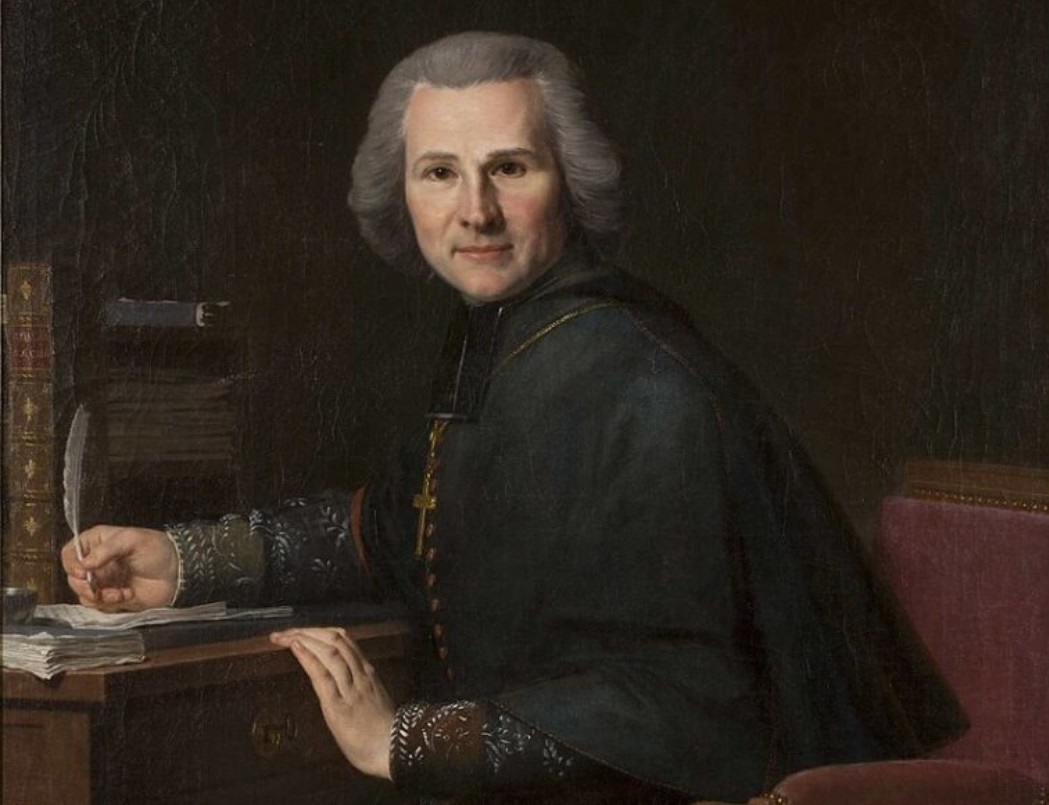
Grégoire (pictured) continued his efforts to push the issue of Jewish rights in the new National Assembly, though it took longer than he would have liked.
In October 1789 he succeeded in having a Jewish delegation address this parliament [17] and a subsequent message from the lobby stressed the role of Jews in bringing about the revolution and said they should be able to “enjoy the benefits of their own handiwork… in the name of humanity and the nation”. [18]
Hillard comments that this wording is “typical of the humanitarian religion of the Noahide rights of man”. [19]
Jewish people were finally granted citizenship in September 1791, which on the surface seems only fair enough. But there was something else going on, as reflected in the words of the revolutionary Anacharsis Cloots (1755-1794), a Prussian aristocrat, of Dutch ancestry, granted French citizenship in February 1792. [20]
In his book La République Universelle he expounded his idea of “Philadelphia”, which Hillard describes as “an esoteric term for global governance”. [21]
Cloots (pictured) wrote: “Europe, and Africa, and Asia, and America will take each other by the hand in the vast and happy city of Philadelphia.
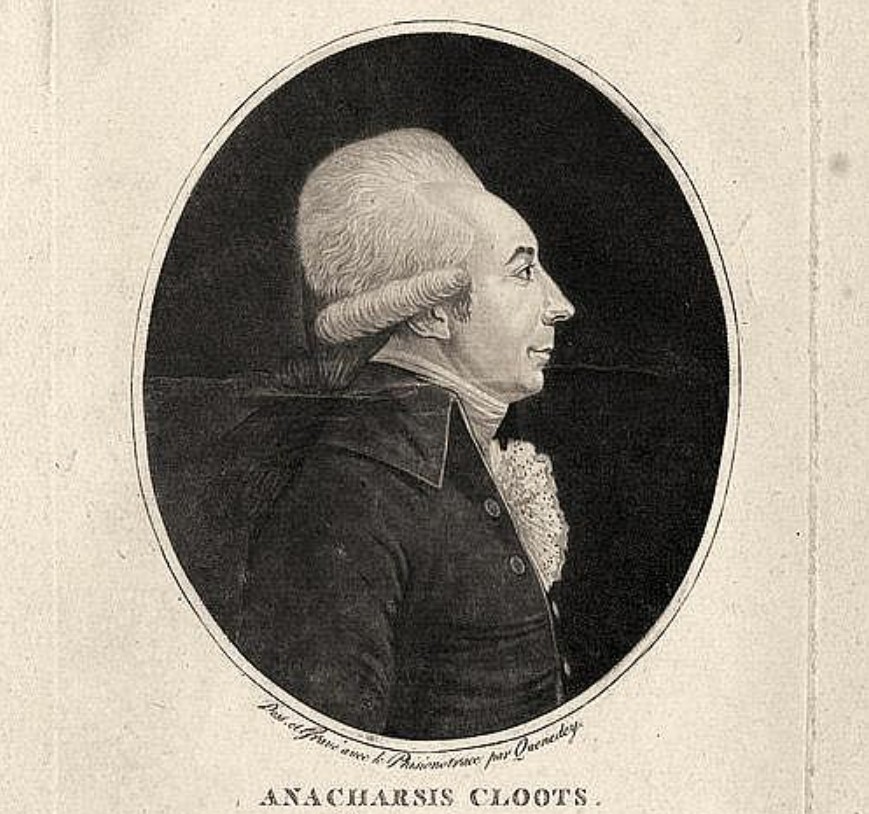
“I have shown geographically, politically, physically and morally that the commune of Paris will be the meeting point, the central beacon of the universal community… We will find powerful auxiliaries, fervent apostles in the Judaic tribes who regard France as a second Palestine. Our circumcised fellow citizens are blessing us in all the synagogues of their exile.
“The Jew, degraded across the world, has become a French citizen, a world citizen, thanks to our philosophical decrees. This fraternisation is alarming many a German prince; all the more so in that wars in Germany could neither begin nor endure without the activity, intelligence, organisation and money of the Jews. The armouries and munitions of all kind are supplied by Hebrew capitalists and all the junior supply agents are from the same nation”. [22]
Cloots, by the way, was guillotined in 1794. Heads were certainly rolling in Paris at that time!
Hillard sees the rule of Napoleon Bonaparte in France from 1804 as being the next step on the path to the universal global republic, referring to “the emergence of a new world, of a financial power, whose birth Napoleon facilitated”. [23]
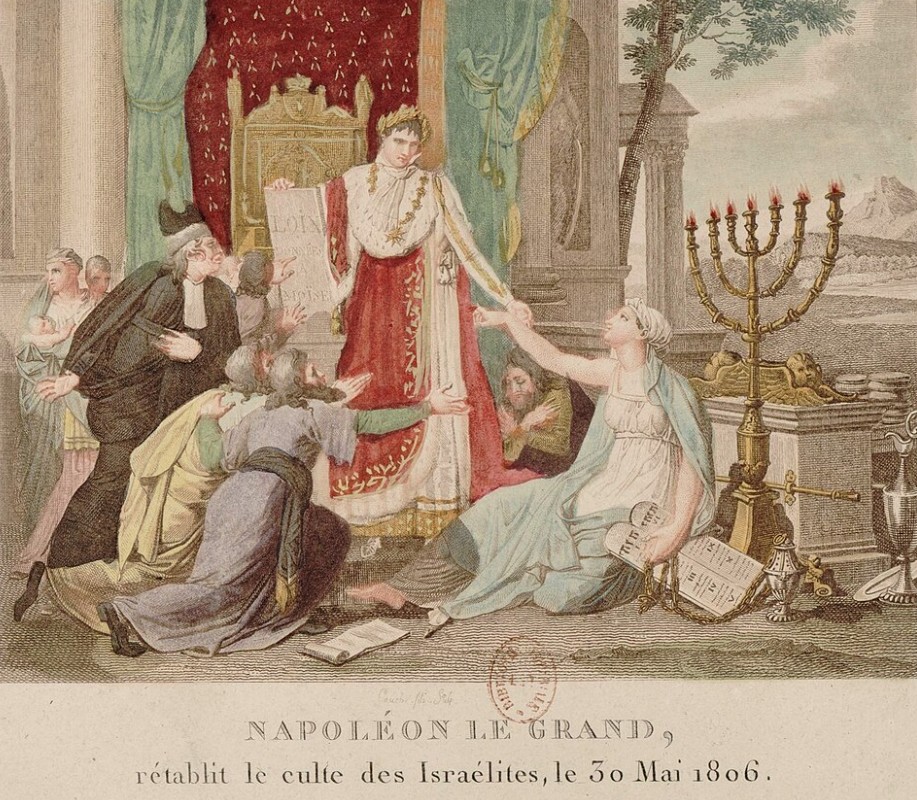
For one thing the emperor established the Consistoire central israélite de France to represent and administer the Jewish community in France. [24]
And, for another, his wars of conquest across Europe, in particular in Frankfurt, and his eventual defeat at Waterloo, played a key role in bringing about the modern society we know and love today.
Hillard writes: “The great movement established by the revolution of 1789 and its apostle Napoleon allowed the shift from one world to another, perfectly symbolised by the emergence of a family called upon to govern the future of the goyim: the Rothschilds”. [25]
If you are not familiar with those enemies of the people and their corrupt global empire, then I have a bit of back-reading lined up for you… [26]

[1] Paul Cudenec, ‘The Invisible College and the plan for our enslavement’, https://winteroak.org.uk/2025/08/11/the-invisible-college-and-the-plan-for-our-enslavement/
[2] Yosef Kaplan, ‘Jews and Judaism in the Hartlib Circle’, Studia Rosenthaliana, 2006, p. 190, https://pluto.huji.ac.il/~kaplany/hartlib.pdf
[3] Kaplan, p. 195.
[4] https://en.wikipedia.org/wiki/Royal_Society
[5] https://www.academie-sciences.fr/nos-missions
[6] https://fr.wikipedia.org/wiki/Louis_de_France_(1729-1765)
[7] https://fr.wikipedia.org/wiki/Acad%C3%A9mie_nationale_de_Metz
[8] https://en.wikipedia.org/wiki/Maximilien_Robespierre
https://theconversation.com/the-french-revolution-executed-royals-and-nobles-yes-but-most-people-killed-were-commoners-200455
[9] Pierre Hillard, Archives du mondialisme: De la guerre contre l’Ancien et le Nouveau Testament (Lopérec: Editions Nouvelle Terre, 2019), p. 160. All translations are my own.
[10] Hillard, p. 160.
[11] Ibid.
[12] Paul Cudenec, ‘The globalist gag and the rainbow flag’, https://winteroak.org.uk/2026/02/09/the-globalist-gag-and-the-rainbow-flag/
[13] Paul Cudenec, ‘War, peace and global control’, https://winteroak.org.uk/2026/03/16/war-peace-and-global-control/
[14] Hillard, p. 162.
[15] https://www.elysee.fr/la-presidence/la-declaration-des-droits-de-l-homme-et-du-citoyen, Hillard, p. 161
[16] Hillard, p. 161.
[17] Hillard, p. 164.
[18] Hillard, p. 173.
[19] Ibid.
[20] https://fr.wikipedia.org/wiki/Anacharsis_Cloots
[21] Hillard, p. 176.
[22] Anacharsis Cloots, La République Universelle, cit. Hillard, p. 177.
[23] Hillard, p. 195.
[24] https://fr.wikipedia.org/wiki/Consistoire_central_isra%C3%A9lite_de_France
[25] Hillard, p. 194.
[26] https://winteroak.org.uk/books/


Having only now begun reading the huge opus of largely peerless work by Paul Cudenec, I see how much catching up I have to do! Previous to this fascinating piece, I had had no idea of how Jewish supremacists had infiltrated and used key science institutions of our once-Christian culture. Crucial work, thank you very much.
LikeLike