by W.D. James
I think we need to seriously consider being more Appalachian.
I try to avoid using the world ‘libertarian.’
This is mainly because the primary associations of the term for Americans is different than for other people. Here the primary connotation is to a political ideology and philosophy which is a strong form of classical liberalism: individualism, negative rights, very limited government, and as many interactions as possible are to be handed over to the market to sort out.
Outside of The States the term usually has much broader resonance, being applicable to anyone who is pro-liberty; you could even be a collectivist libertarian I think, which would be seen by American libertarians as an oxymoron.
Ron and Rand Paul would typically be considered American Libertarian politicians.
However, in thinking about the political culture of Appalachia, ‘libertarian’ seems like the best term to me, but it isn’t the sort of libertarianism I usually call ‘American libertarianism’ (to avoid confusion with my European friends).
Here I would like to sort out two sorts of American libertarianism then. The first sort I think it is better to call Liberal Libertarianism (though that risks semantic redundancy) and the second sort Organic Libertarianism.
Liberal Libertarianism
What a pretty boy.
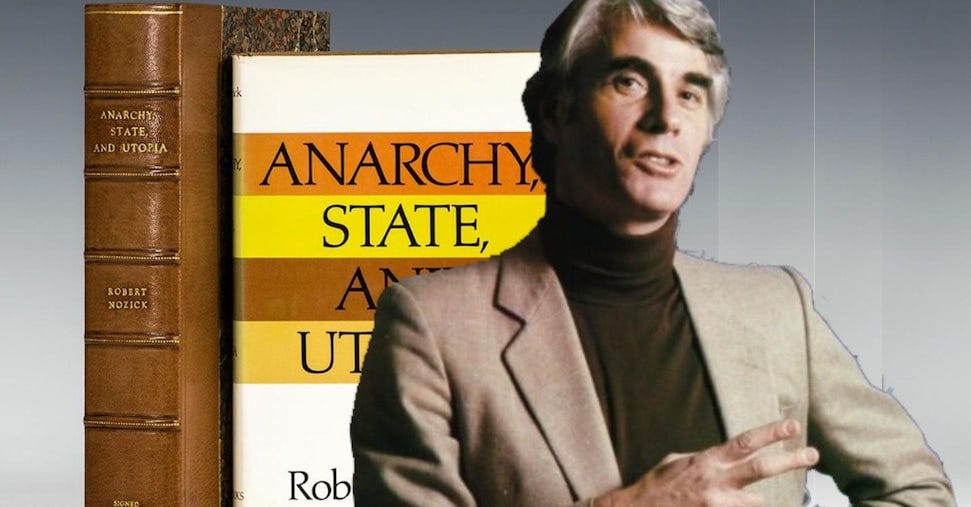
Robert Nozick (1938-2002) was a political philosopher at Harvard and his Anarchy, State, and Utopia (1974) is probably the best theoretical statement of Liberal Libertarianism.
In this work, Nozick was writing against the defense of the social welfare state of his Harvard colleague John Rawls’ (1921-2002) A Theory of Justice (1971). Hence, Nozick’s main focus is on the distribution of goods within a society and what role the State plays in regulating that distribution.
At the core of his theory is his conception of The Entitlement Theory of Distribution. This evaluates the justness of owning something, based on a 3-step schema:
You can own something through ‘just acquisition’ (making it or justly claiming it).
You can come to own something through ‘just transfer’ (voluntarily buying or being given it).
Finally, there is no just holding except as arrived at via one of the above two means (hence any government redistribution would need to meet some extreme criteria to justify it).
Nozick is putting forth a State of Nature sort of theory, so the starting point is the assumption of no government. Given that, what is the maximum amount of government that can be justified?
He assumes individuals within the state of nature will seek to defend their holdings (no government needed for that). He foresees people banding together to provide that for themselves collectively more effectively. This could be like a heavy-duty neighborhood watch association. Also, some groups might contract with a company to provide security services. Now, in this situation, there is no extrinsic law that either the neighbors or the security firms are operating under: they simply exist to protect property. Or, you could form them to go take other people’s property. Or if every street hires a different security firm, the employees of those could get into scuffles. Hence, it will be in the interests of everyone around the area to establish a ‘dominant association’ to provide reliable security for the protection of property.
This is the emergence of government on Nozick’s account. This represents what he terms the ‘ultra-minimal state’: a subscription service that individuals pay for to provide effective security and protection of property. Is that the extent of legitimate government? Not quite on his account. He sees that the moral justification for establishing this armed subscription service was the possession of the right to defend one’s property.
Now, there will be people who cannot afford to pay for the subscription service but who have some property (at least in their persons) that they would like defended. Can they be denied this? They can’t pay, so why get the protection? On Nozick’s view, the ‘police’ are operating according to the interests of the subscribers. He thinks that for that to be morally justified, there is a need to recognize the rights of others and to ensure they have this same level of basic protections for their property as well.
Hence, the ‘minimal’ or ‘night watchman state’ comes into being. It is proper to tax the citizenry to provide basic security services to all members. This is the only redistributive function Nozick holds is justified. Hence, no larger, more active, state can be legitimated.
I have a ton of objections to Liberal Libertarianism. Chief among them are:
- Its assumption of the sovereign or atomized individual is false. We are necessarily members of families and communities.
- As members of those families and communities we have both legitimate claims to make upon them and non-chosen obligations to them (I have the right to expect my family to do its best to feed me when I am young and I have an obligation to pitch in and help the family unit as appropriate).
- What the Liberal Libertarian calls ‘liberty’ represents a high degree of political liberty, but only to be handed over to complete economic domination as inequality spirals out of measure and those without property are left with no recourse against the oligarchs and the corporations. What the Liberal Libertarian giveth with one hand, he taketh away with the other (for all except the very wealthy, which after a couple of generations has very little to do with one’s merit or desert).
I respect the rigor of Nozick’s argument and in America it will get a decent hearing because it is a modern, and extreme, version of the old Classical Liberalism which was important at our Founding. However, I’m again’ it utterly.
Organic Libertarianism
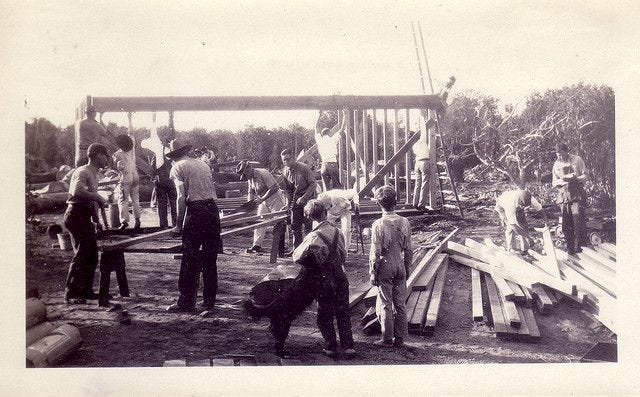
I think there is a more authentic, socially grounded, and workable alternative to Liberal Libertarianism which is likely to preserve genuine liberty better. To an extent, it was the dominant ‘American way’ in most places through most of our history, but it can come into especially sharp focus in the context of Appalachia.
Here we’ll look at the cultural values and religious forms characteristic of Appalachia, at least as it stood several decades ago when its cultural integrity was more fully intact.
Loyal Jones (1928-2023) was a folklorist and was considered the ‘father of Appalachian Studies.’ In his seminal essay, ‘Appalachian Values,’ he suggests that the geography of the mountains and the settlement patterns of the people who came there played a major part in the development of Appalachian culture and values. Whether they were originally from England, Scottland, Wales, Germany, France, or Africa, the settlement patterns of Appalachia suggest a people who were looking for seclusion and independence. Jones does not exclude the native Cherokee inhabitants of the southern parts of the region from that mix. He says “…we avoided mainstream life and thus became self-reliant.”
“For a people escaping from infringements of church and state,” he observes, “Appalachia was ideal for a new way of life, for a time, away from ‘powers and principalities.’” The relative isolation of the mountains provided the “freedom to do much as they pleased” because the mountains afforded land and solitude.
This isolation, combined with the fact that the first generation or two tended to eschew formal education, led to both the regional distinctiveness of the people and many of the negative stereotypes associated with them. Further, organized religion was also absent in the early decades of settlement and when the church folks eventually caught up to them it was a distinct mountain form of religion that developed (though ‘mainliners’ have insisted on sending ‘missionaries’ ever since to help civilize the people of the region).
Libertarian Values
Prior to the Northern companies coming to the region to extract its resources, primarily coal and timber, the vast majority of Appalachians were subsistence farmers. Small-holdings stretched up many of the ‘hollers’ (the relatively flat and narrow land at the base of and between mountains; also called ‘coves’ in southern Appalachia) of the region. This created natural community ties between those who lived in the same holler and natural distance from those in other holllers or the outside world more broadly.
Jones notes that the values of traditional Appalachian people are rooted in their religion and the Bible. The forms of Christianity that took root and developed in the region stemmed from The First Great Awakening. This was comprised of a faith more ‘optimistic’ than old-style Calvinism with its total depravity and denial of free-will. The newer faiths were Methodist and Free-Will Baptist in orientation. These were largely forms of religious expression created by and for the lowly members of society with a distinctly emotional aspect (what critics termed ‘enthusiasm’).
However, these movements were transformed when they moved into the mountains. Mountain people were not optimistic about human perfectibility, individually or socially. As a result, mountain religion took on both a sort of fatalism that what will be, will be, and yet a spiritual earnestness, directness, and fervor which gave pride of place to individual spiritual experience, often of a visceral sort.
Appalachians also valued independence, self-reliance, and pride above most other values. As Jones puts it, they were Americans, they were Southerners, they were rural, and they were farmers: “independence raised to the fourth power,” as he expressed it. They grew or made almost everything they needed, including their own music, of course. They didn’t need the outside world much and they wanted that world to just leave them alone for the most part.
They were also neighborly and hospitable. Part of the reason for this is that if someone came to visit you, they had probably gone through a lot of effort to get there. You needed to feed them and probably put them up for the night. Hopefully they brought their instruments with them and you could make a little music together when supper was over. Learning a new tune or playing style were possibilities. And the hosts enjoyed the company, so they expressed their appreciation with their hospitality.
The family was at the center of mountain people’s lives. Notoriously, there tended to be a lot of genealogical interconnection between the families in a holler and the other hollers nearby. They had more of an extended-family conception of family than of the nuclear family that came along later. Children would be reared in this larger, extended, kin group and it was this group that gathered on holidays or for significant events like marriages and funerals.
An additional value Jones identified was what he termed ‘personalism.’ This manifests itself in a great reluctance to offend others. The flip side of that is that if you don’t offend anyone, they got no right meddling in your business. He notes that this value extended to matters of race in a way pretty unique in the South. During the war (ie, the main one, the Civil War), Appalachians tended to be pro-Union and anti-slavery. Slavery was little practiced in the area; it did not lend itself to large-scale agriculture. Western Virginia even broke off and became its own state. People in the mountain regions of even Tennessee and northern Georgia and Alabama often fought for the Union. Confederates had a hard time moving troops or supplies through eastern Tennesse, for example. Jones presents legal segregation as a post-war “imposition” on Appalachian culture. Though that is probably a little generous.
Related to this, folks tend to be humble and modest, deflecting compliments or heightened status that would come from individual achievements. Jones states they are “levelers;” insisting they are as good as anyone else, but no better. This is reflected in the Appalachian emphasis on humor and funny story telling (also often reflected in funny folk songs). Humor is both a coping mechanism and a way of knocking those who have gotten too big for their britches down a notch or two.
Appalachian people also demonstrate a great love of place. Given the dominating influence of geography in the region, place imposes itself; one can’t help but be mindful of it. But people tend to love the mountains as well, both for their natural beauty and the way of life they have supported. It is still not unheard of to refer to one’s locale as ‘God’s Country.’
They are also patriotic. The ‘overmountain men’ (the settlers who moved over the mountains during the colonial days) largely declared their independence from the more civilized eastern settlers. They were self-consciously their own breed. When the British, during the Revolutionary War, demonstrated the ill-advised plan of moving over the mountains they were defeated at King’s Mountain by the backwoodsmen. However, like Southerners in general, Appalachians have always had high volunteer rates when the country as a whole found itself in armed conflict. Jones boasts that in Korea and Vietnam 8 or 9 percent of American soldiers were from Appalachia, but they earned 18 and 13 percent, by respective war, of Medals of Honor awarded.
However, there is something of a contradiction here as well. Given the economic turbulence introduced to the region during modernization (and the attempt to resist some of that process), people often supplemented their situation by producing and selling moonshine. This was a craft carried over and sustained from the old country. Jones assiduously avoids discussing practices tied to the hillbilly stereotype. But this was a real thing and ‘the revenue man’, often a federal official, was hated and distrusted. The Whiskey Rebellion only ended in Appalachia in the last half century. Hillbillies will volunteer to serve, but historically, they would not allow themselves to be imposed upon.
Finally, Jones notes their love for, and sense of, beauty. No doubt this stems from the rough beauty of the topography. Most Appalachian handcrafts were items designed for functional utility. However, it became very common to incorporate aesthetic attributes. This would include things like wood inlay or scrollwork on a rifle.

Or the fineness of the stitching and beauty of design of a quilt made of scrap fabric.
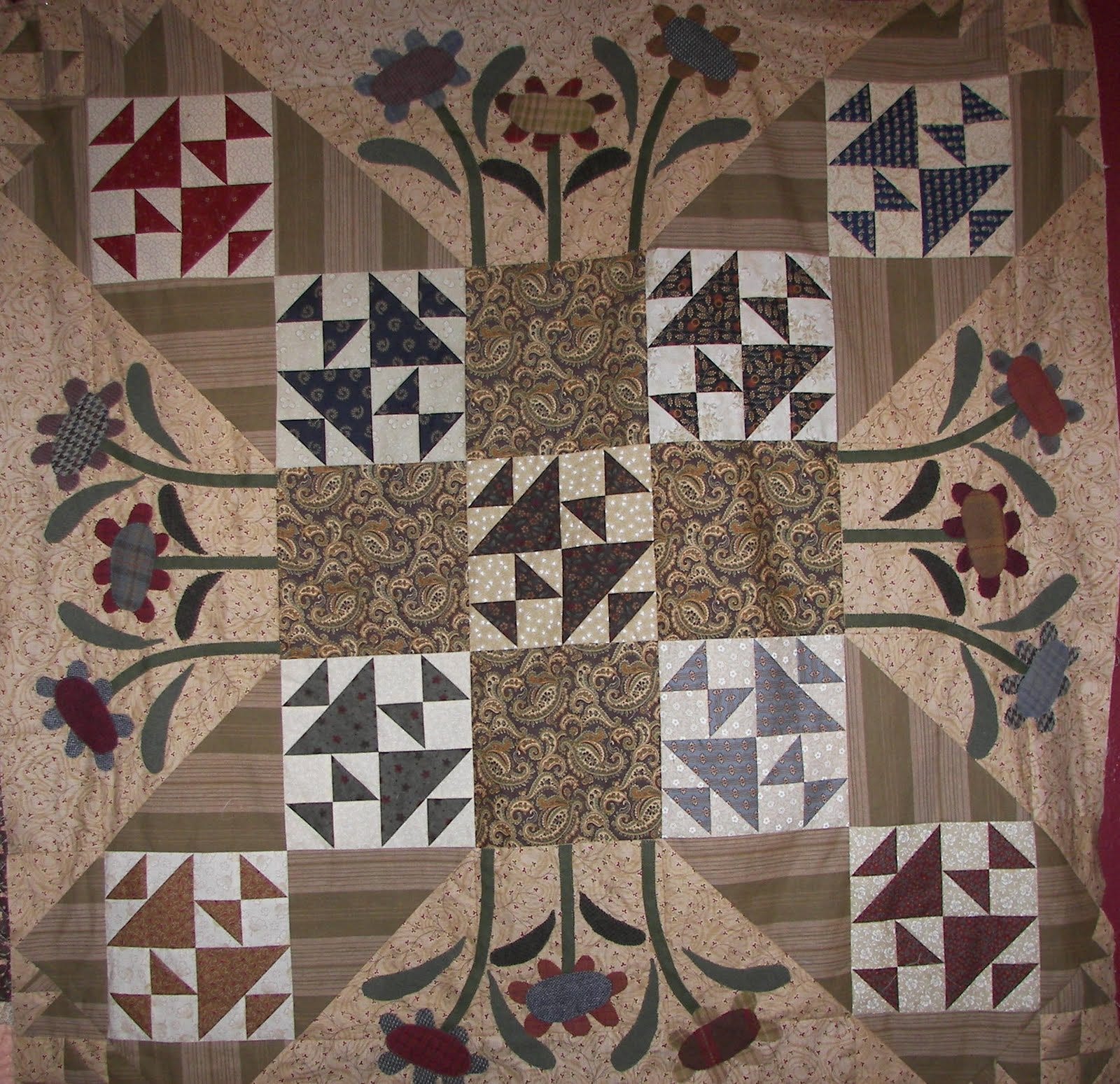
The picture that emerges is of a people who are not fancy or refined, but authentic, hardy, self-reliant, sociable, and who built their lives, products, and communities from the ground up in a way that expresses their unique identity.
Mountain Religion
The most important social entity, besides family, in Appalachia for most of its history was not the State or the government, or even the town, but the local church. Hence, it is here, I think, that we can get a sense of what Appalachian Organic Libertarian social institutions look like.
My guide is Bill J. Leonard and his Appalachian Mountain Christianity: The Spirituality of Otherness. He focuses on two main strands of mountain religion, the old style religion of the Primitive and Old Regular Baptists and the newer (late nineteenth and early twentieth century) Pentecostal and Holiness churches.
First and foremost, religion was a do-it-yourself sort of affair. Appalachians disliked outsiders approaching them through missionary activity. They built their own churches and denominations.
They also distrusted experts. Ministers were not chosen based on their academic qualifications. In fact, many denominations forbade seminary education. The minister was to be called by God to ministry, not by themselves or by a church hierarchy. If God called them, God, it was presumed, would equip them for the work.
This accounts for some of the distinctive preaching styles of Appalachia where the minister may become lost in thought, speaking directly to God to give him a word, perhaps entering into a sort of sing-song and back and forth with the congregation that God show him what to preach.
Further, ministers were not paid well and, again, some denominations forbade ministerial salaries altogether. You did it because you knew you had to, because ‘called,’ not as a career. That was Plato’s old move of divorcing authority from material reward or power. Paid ministers would be ‘hirelings,’ people beholden to their paychecks and those who wrote them.
Also, preaching and worship in general has a strong emotional component, a characteristic of all plebeian spirituality. This comes to the fore in Pentecostalism with speaking in tongues, dancing, and other ‘works of the spirit’.
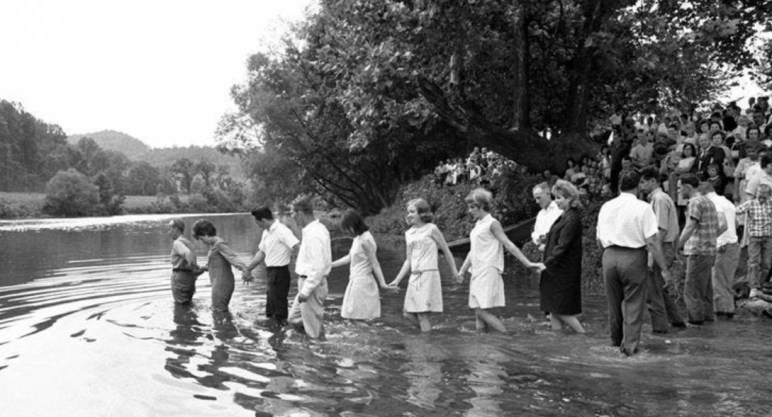
Mountain religion also emphasized certain basics. Literalism in biblical interpretation. Acapella singing. Baptism in living (flowing) water. Keep it rooted and real, not fancy and sophisticated.
Finally, Appalachian religions placed a special emphasis on what was sometimes called the ‘third sacrament;’ foot washing.
Foot washing both humbles the individual and binds the community; mutual service.
Imagine how your place of employment would be different if everyone humbled and conjoined themselves in this way. A social revolution!
(And I didn’t even mention serpent handling.)
Hillbillies and the Faded Republic
Liberal Libertarianism was never anyone’s actual way of life. What I want to draw out is that Organic Libertarianism is actually rooted in individual and societal ways of life (Appalachia providing just one example).
The point is not to suggest that we somehow reconstitute some pristine and past mountain culture. It is that this is one more instance of a living inspiration that as Americans we have available to us to draw upon, one more branch, or even headwater, of the river which is the republic.
As this first series of essays on The Faded Republic draws near its close, that is really what all the essays have probably been about. If it is true that the past is never really dead, we ought to try to remember it sometimes, just to understand ourselves. And also, to understand some of the deep resources we have to draw upon. This opens up new but rooted options we might consider.
The world of mass media militates against that. The world of consumerism positively assaults it. For several decades, an outright ideological war has been waged against the memory of our history; making it a positive sin to remember.
It is my conviction that our republic is faded from memory, but it is my hope that it is still there.

Works relied upon:
Loyal Jones (photographs by Warren E. Brunner), Appalachian Values, The Jesse Stuart Foundation, 1994.
Bill J. Leonard, Appalachian Mountain Christianity: The Spirituality of Otherness, The University of Georgia Press, 2024.
Robert Nozick, Anarchy, State, and Utopia. Basic Books, 1974.
Bonus: Alison Krauss:
You can read all of W.D. James’ work, and listen to his musical recommendations, at his Philosopher’s Holler blog on Substack.


Excellent article, Paul! Although I’ve never been to Appalachia myself, I have people from there and done a little on the subject here and there. So much of what we now regard as quintessentially American was historically derived from or exemplified by the Appalachian culture that you’d almost assume that they must be among the most honored groups on the country. Sadly, however, they seem to be among the most despised groups on the country, despite (or because of?) that fact.
You hit the nail on the head there: the absence of slavery in Appalachia was almost entirely a function of the fact that those mountains were unsuitable for growing cotton or other cash-crops. What agriculture occurred there was small-scale and mostly subsistence-oriented. And that is what accounted for the fact that there almost no black people there.
This might surprise a lot of people, but it turns out that unlike New England and Tidewater Virginia, Appalachia was not exactly a hotbed of republican sentiment during the War of Independence. This is not because the people there held any romantic notions regarding ‘throne and altar’; rather, it was mostly a function of the fact that they associated the independence movement with the cotton barons of Tidewater Virginia, whom they saw as a far greater danger to their way of life than some distant king in London. The Appalachians must have abided by motto, ‘Better a faraway master than one close at hand’.
Incidentally, referencing your point above, this fact likely also contributed to their general disdain for secession during the Civil War, which was, once again, being most strongly pushed by those same cotton barons who now dominated the state houses of the Old South. Obviously, it also true that they had no interest in preserving slavery, owning no slaves themselves — and they surely weren’t going to die for it! But you are probably right in supposing that this all had little to do with any real sympathy for the blacks, who were largely absent from Appalachia at that time. In fact, the importation of Africans was probably one of many things they held against the Tidewater aristocracy back east. The Appalachians, in general, were far too inward-turned a people ever to believe in something like today’s ‘multiculturalism,’ which would have led them eventually to support segregation, once the issue of secession was out of the way. (Selective assimilation of the Indians, however, did sometimes occur, as you noted. But the Indians, of course, were not ‘imports’; they were already there when the first Scots-Irish arrived.)
Keep up the good work!
LikeLike
The article is by W.D. James rather than by me but I certainly agree with you that it is a good one! Paul
LikeLike