by Paul Cudenec, who reads the article here
“Druidic thinking is neither collectivist nor individualist, it is both at the same time“, [1] writes Jean Markale in the book that I have been exploring in this series of essays.
While I have found much in ancient Celtic spirituality that resonates with my own outlook, here I particularly noticed the similarity to (real) anarchism: you could easily substitute the word ‘anarchist’ for ‘druidic’.
In a similar way to both Taoism and Sufism, anarchism delights in overcoming binary either/ors, nimbly leaping free of such traps in order to declare itself “neither” or “both”. [2]
Markale explains that this rejection of dualism also led the Celts to believe that there was no fundamental distinction between matter and spirit: “Spirit was Matter and Matter was Spirit”. [3]
Likewise, as we learned in a previous essay, [4] the Celts’ apparent polytheism was in fact a disguised monotheism, making possible the subsequent synthesis with Christianity.
Markale writes: “God is the Totality. God is thus the multi-formed whole of all individual actions. There is unity in the multiple, multiplicity in the unity”. [5]
“In order to manifest itself, divinity needs to break up into its multiple faces. This is the passage from the Absolute to the Relative. In these conditions, the gods of the Celtic Pantheon are the manifestations of the functional multiplicity of an absolute, unknown, incomprehensible, unnameable and thus infinite god, who we suppose to have been at the origin of everything”. [6]
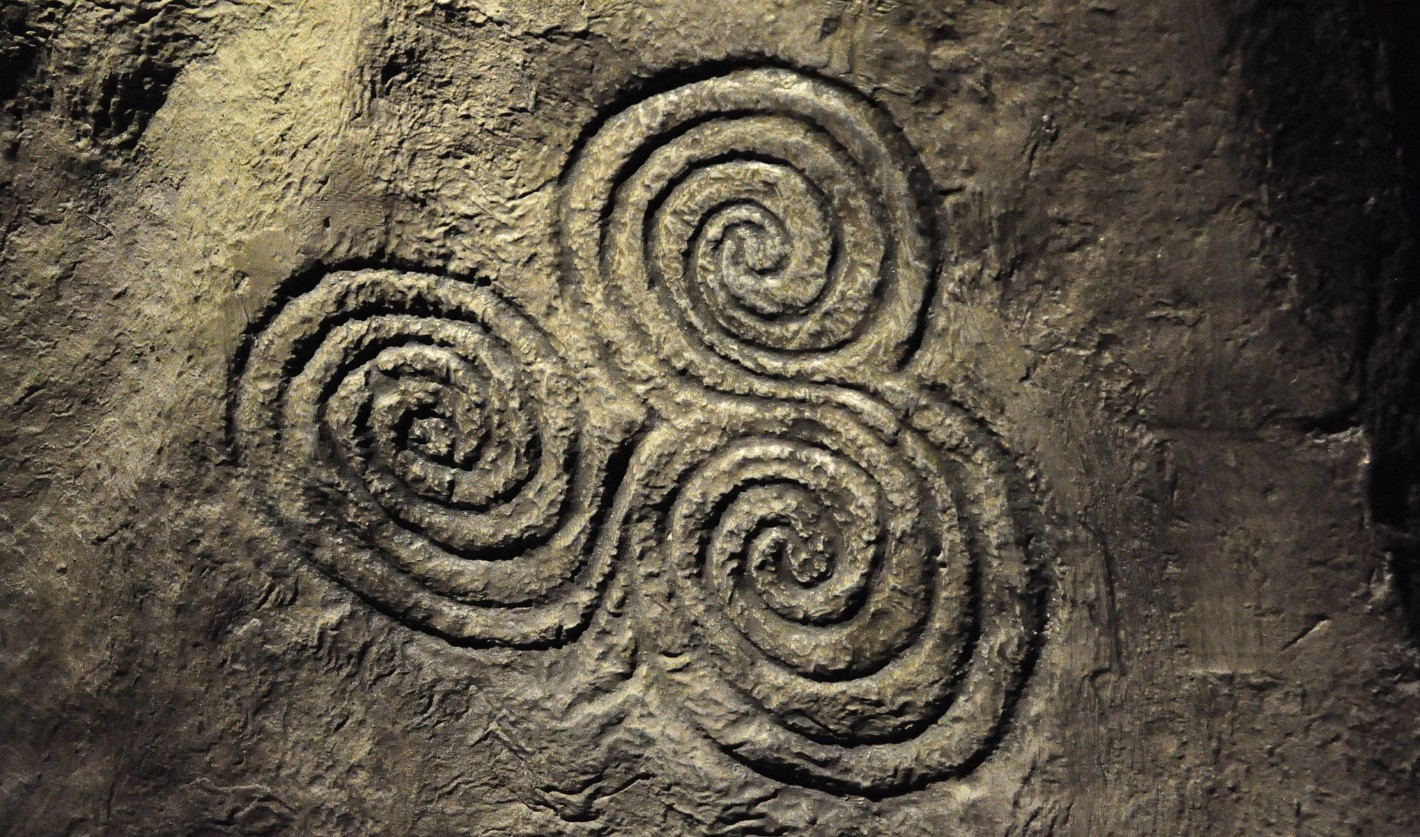
A sense of energy and movement also lies at the heart of the druidic spiritual outlook. This is well represented by the spiral, which we saw in the last essay [7] is emblematic of Celtic culture and metaphysics.
As I point out in my 2025 book Our Sacred World, the spiral is cyclical but not static: “This rotation is not flat and the circle is never closed, as the great becoming of the cosmos gradually unfolds”. [8]
Markale says: “The spiral is made in the image of the evolution of the universe, its evolution-involution”. [9]
It represents the Celts’ belief in “a perpetual evolution of a becoming in which creator and created are merged”, he adds. “They were not far from thinking that everything in the universe, whether spirit or matter, was vibratory energy“. [10]
Since we are part of the universe and its energy, we naturally have a role to play in its (and our) self-shaping.
The druids saw themselves as regulators of that perpetual becoming, Markale says: “The druids can be found at all the key points of Celtic society, as guides who are conscious of applying the divine plan to human society”. [11]
This Celtic need for action is in stark contrast to the attitude of certain Eastern religions that have attracted so many spiritually-starved Westerners, he points out. [12]
Instead of an emphasis on “non-action” it insists on a positive responsibility to be involved in this world and to help make it more perfect, to make it more like the parallel mystical Otherworld in which the divine plan is reflected.
Markale says of the Celts: “In eliminating the notion of sin, they did not eliminate the idea of responsibility”. [13]
Accordingly, although they did not recognise the idea of moral Evil in the Christian sense, they did see it in the metaphysical sense in the form of an individual’s failure to do everything they can to assist the divine in its harmonious becoming.
Markale says: “In the face of superior realities, the human being does not always know how to act or react. He does not fully take part in the universal action, hence the deficiencies, diversions and dead ends”. [14]
“Being free means being fully aware of the causes and effects of one’s actions and assuming responsibility for the lot”. [15] “Each lack, each weakness, each mistake is another delay in the universal evolutionary momentum”. [16]
This urgent feeling of the need to act in the name of all that is right and true reminds me of the existentialism of Albert Camus and Jean-Paul Sartre that inspired me as a schoolboy and propelled me into political activism from an early age.
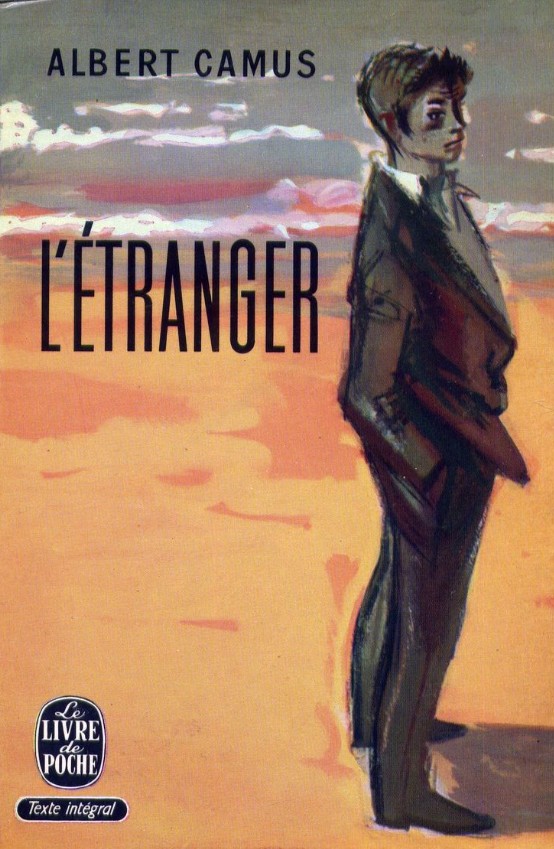
Indeed, I wonder whether its emergence in 20th century French philosophy (and in Britain, with Colin Wilson) was some kind of re-surfacing of the druidic outlook!
From the ancient Celtic perspective, the need for individual action has its source in the Whole of which that person is an ephemeral incarnation.
I see similarities with Sri Aurobindo’s insistence that the task of a spiritual person is to clear away the egotistic obstructions that prevent them from fully acting as a part of the Whole and thus in the interests of the Whole of which they are part. [17]
Markale writes of druidic thought: “Action is manifested energy. Everything is energy, matter like spirit, the two playing their specific roles, irredeemably tied to one another. The body is thus considered as a provisional manifestation of the spirit which thereby affirms its existence”. [18]
“Every human being, according to druidic thinking, has a ‘mission’ to achieve something… each human being has a role to play to perfect the world, to complete it and this completion can only be brought about by individual action within collective action”. [19]
“Each individual, recognised as autonomous, as free, as gifted with specific talents, has the duty to take on the quest and to come back and say what he has seen. They will not all have seen the same thing and the individual experience will enrich the collective. [20]
“The quest is compulsory. Nobody can shirk it without attracting ‘shame’ in the collective context, this magical and sacred ‘shame’ being the most terrible thing that could be attached to an individual, according to druidic doctrine”. [21]
The call is to become a hero, in whatever way best suits you and your abilities – a failure to even make the effort essentially amounts to a shameful failure to live.
Stresses Markale: “The Celtic hero lives in the world and acts on the world, desiring to change the world so as to make it conform to the divine plan”. [22]
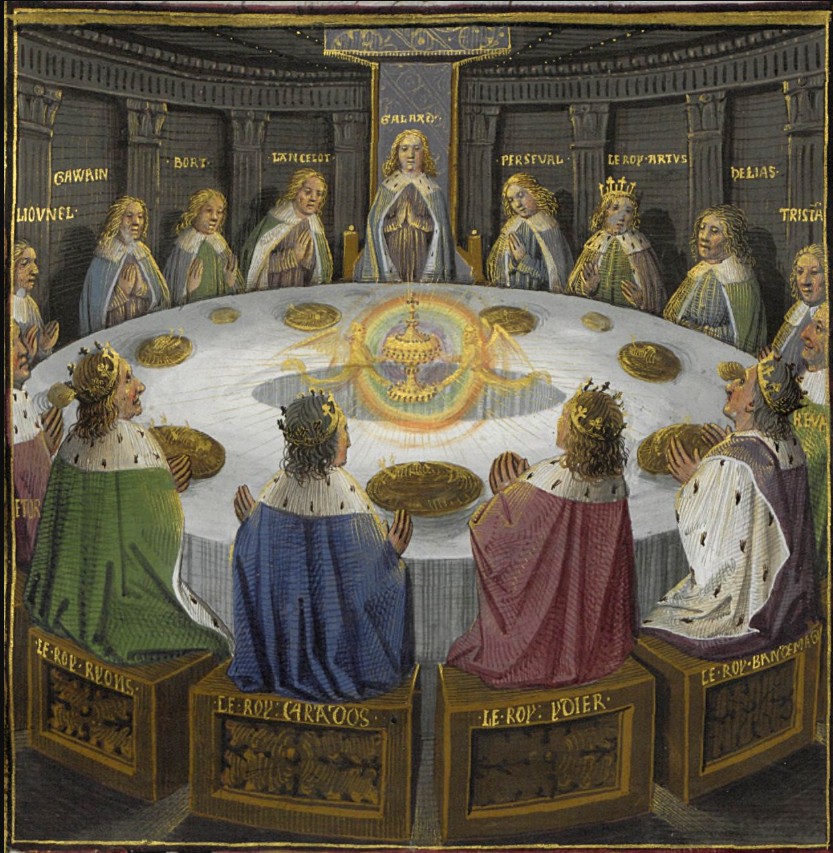
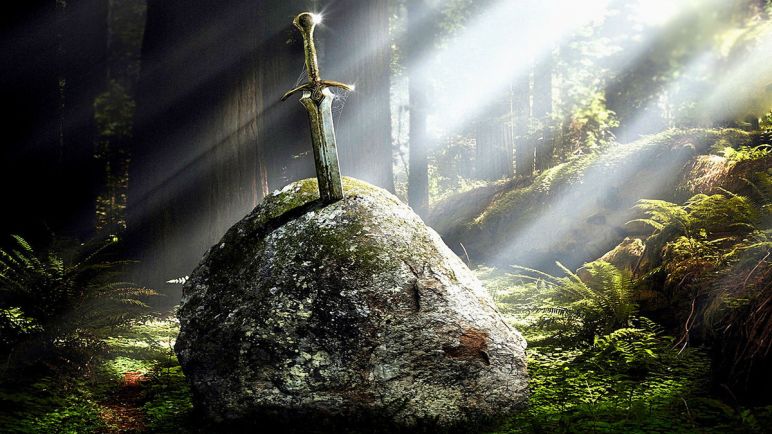
The best known example of this attitude is, of course, the Arthurian legend of The Knights of the Round Table, whose origins are druidic, despite the Christian elements.
Markale notes: “Each knight carries out a solitary and singular quest for a unique goal, the Holy Grail for instance. But when the knight returns to the court to relate what he has done and what he has seen, we very much feel that the responsibility of the group is invested in the individual action of one its members”. [23]
He says that an important element in heroic action was that the Celts did not fear death – he puts this down to their belief in the immortality of the individual soul, although I would add that the same applies if you know that you are ultimately part of the greater Whole and that the individual form of your existence is merely temporary.
This disconcerted the Greeks and Romans, who did not share this conviction, and a rather envious-sounding Julius Caesar regarded this as some kind of motivational technique on the part of the druids.
He wrote in Commentarii de Bello Gallico: “They wish to inculcate this as one of their leading tenets, that souls do not become extinct, but pass after death from one body to another, and they think that men by this tenet are in a great degree excited to valour, the fear of death being disregarded”. [24]
The British Celts certainly fought bravely against the Roman Occupation which began in 43 AD (Caesar having returned to Gaul after his earlier invasion) – during the forty-year conquest of Britain it is estimated that up to 250,000 Britons were killed, out of a total population of only two million. [25]
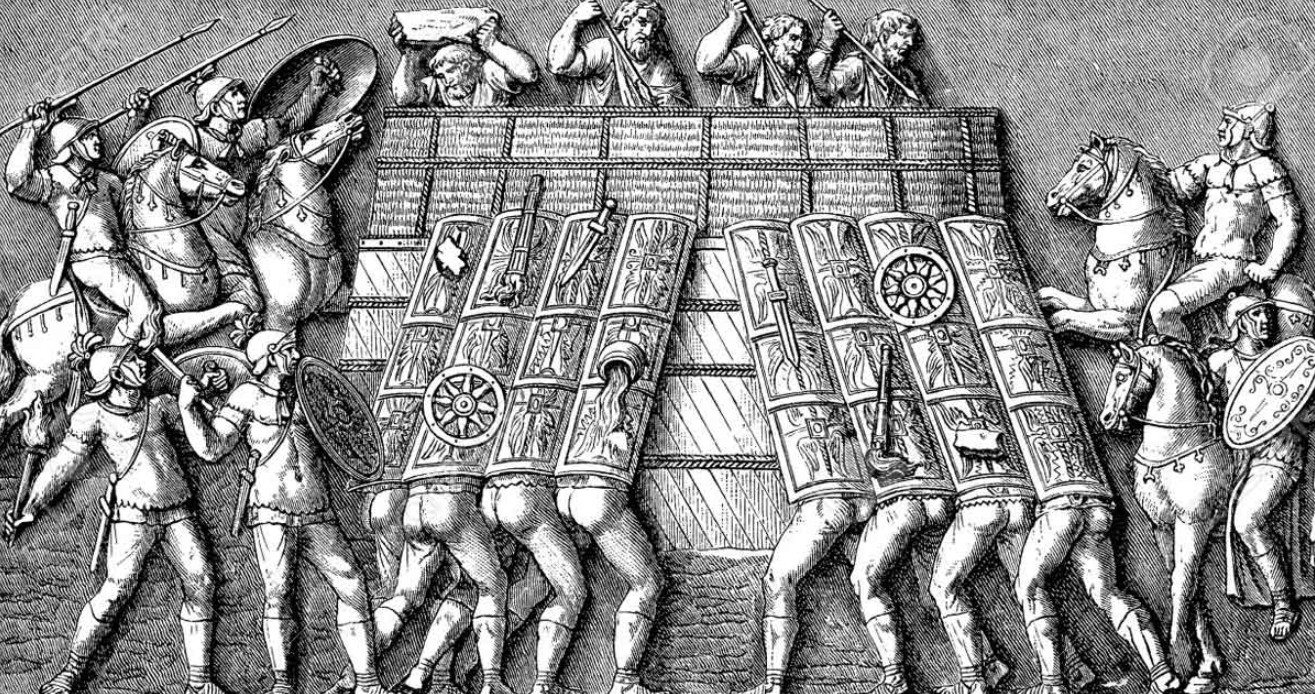
Their resistance may have been overcome, but 400 years later the Romans were forced to withdraw their troops from the island as they came under increasing attack on the continent and shortly afterwards the Western Roman Empire collapsed.
Empires do not last for ever and resistance is never futile, even when it seems to bring no immediate reward.
I feel as if, through Markale, the ancient Celts are reaching out across 2,000 years to teach us what the meaning of our lives should be.
They are imploring us to act as physical embodiments of the divine, to be fully present and aware of our responsibility to protect or restore the harmony of the world of which we are part, to cast fear aside and to accept our sacred mission to play an active and heroic role in the great becoming of the universe.
I was not born to live a man’s life, but to be the stuff of future memory. The fellowship was a brief beginning, a fair time that cannot be forgotten. And because it will not be forgotten, that fair time may come again. Now once more I must ride with my knights to defend what was and the dream of what could be.
King Arthur in John Boorman’s 1981 film Excalibur.
Previously in this series:
For a future inspired by the past
Through nature we can touch the divine
[1] Jean Markale, Le druidisme: traditions et dieux des Celtes, (Paris: Payot, 1985), p. 276. All translations are my own and all subsequent page references are to this work, unless otherwise stated.
[2] See Paul Cudenec, The Anarchist Revelation (2013), https://winteroak.org.uk/wp-content/uploads/2021/05/the-anarchist-revelation-w.pdf
[3] p. 259.
[4] Paul Cudenec, ‘Spiritual roots entwined’, https://winteroak.org.uk/2026/07/17/spiritual-roots-entwined/
[5] p. 276.
[6] p. 244.
[7] Paul Cudenec, ‘Another way of being’, https://winteroak.org.uk/2026/07/24/another-way-of-being/
[8] Paul Cudenec, Our Sacred World (2025), p. 54, https://winteroak.org.uk/wp-content/uploads/2026/04/our-sacred-worldonline-2.pdf
[9] p. 254.
[10] p. 256.
[11] p. 249.
[12] pp. 249-50.
[13] p. 260.
[14] p. 265.
[15] p. 260.
[16] Ibid.
[17] See Paul Cudenec, ‘A spiritual warrior against the Empire of Greed’, https://winteroak.org.uk/2023/09/20/a-spiritual-warrior-against-the-empire-of-greed/
[18] p. 259.
[19] p. 274.
[20] p. 275.
[21] pp. 276-77.
[22] p. 275.
[23] p. 275-76.
[24] Julius Caesar, Commentarii De Bello Gallico, VI XIV,
https://www.gutenberg.org/cache/epub/10657/pg10657-images.html
[25] https://en.wikipedia.org/wiki/Roman_Britain


I always wondered where the strength of the Druids lay! Thank you, Paul, for digging in and explaining it! Incidentally, the natural law that there is no fundamental distinction between spirit and matter, reflected in the (Celtic) spiral, is distinctly featured in the works of (the late) Viktor Schauberger, whose history and innovations are beautifully summarized in Hidden Nature: The Startling Insights of Viktor Schauberger by Alick Bartholemew (2003). If you haven’t read this I highly recommend it.
LikeLike
OK, thanks for that.
LikeLike
If there is a sin against life, it consists perhaps not so much in despairing of life as in hoping for another life and in eluding the implacable (stubborn and relentless) grandeur of this life. – Albert Camus
LikeLiked by 1 person
Exactly!
LikeLiked by 1 person