by Paul Cudenec, who reads the article here
My understanding of what lies beneath the surface of the modern world has vastly increased since I first read the book by Richard Hunt that I described in my last article [1] – and this learning accelerated dramatically six years ago.
So it was inevitable that in my second reading of To End Poverty: The Starvation of the Periphery by the Core I spotted connections that would never have occurred to me 30 years ago and which I do not imagine ever occurred to the author.
I already mentioned that the book reveals that it was Cecil Rhodes – a Rothschild puppet, I know now – who passed a law taxing African men and thus forcing them into the financial system dominated by that same banking dynasty.
Elsewhere in the book I saw signs of the “Glafia” (global mafia) whose base Mees Baaijen has traced moving from Venice to Amsterdam and then on to London and New York [2] – next stop Beijing? Buenos Aires? Kiev? Jerusalem?
Hunt writes: “The rulers of Byzantium, the ageing core, needed military help to hold on to the throne and were, as usual in such conditions, prepared to sell out their own people to get such help. Venice, the growing core, demanded the control and profits of all Byzantine external trade”. [3]
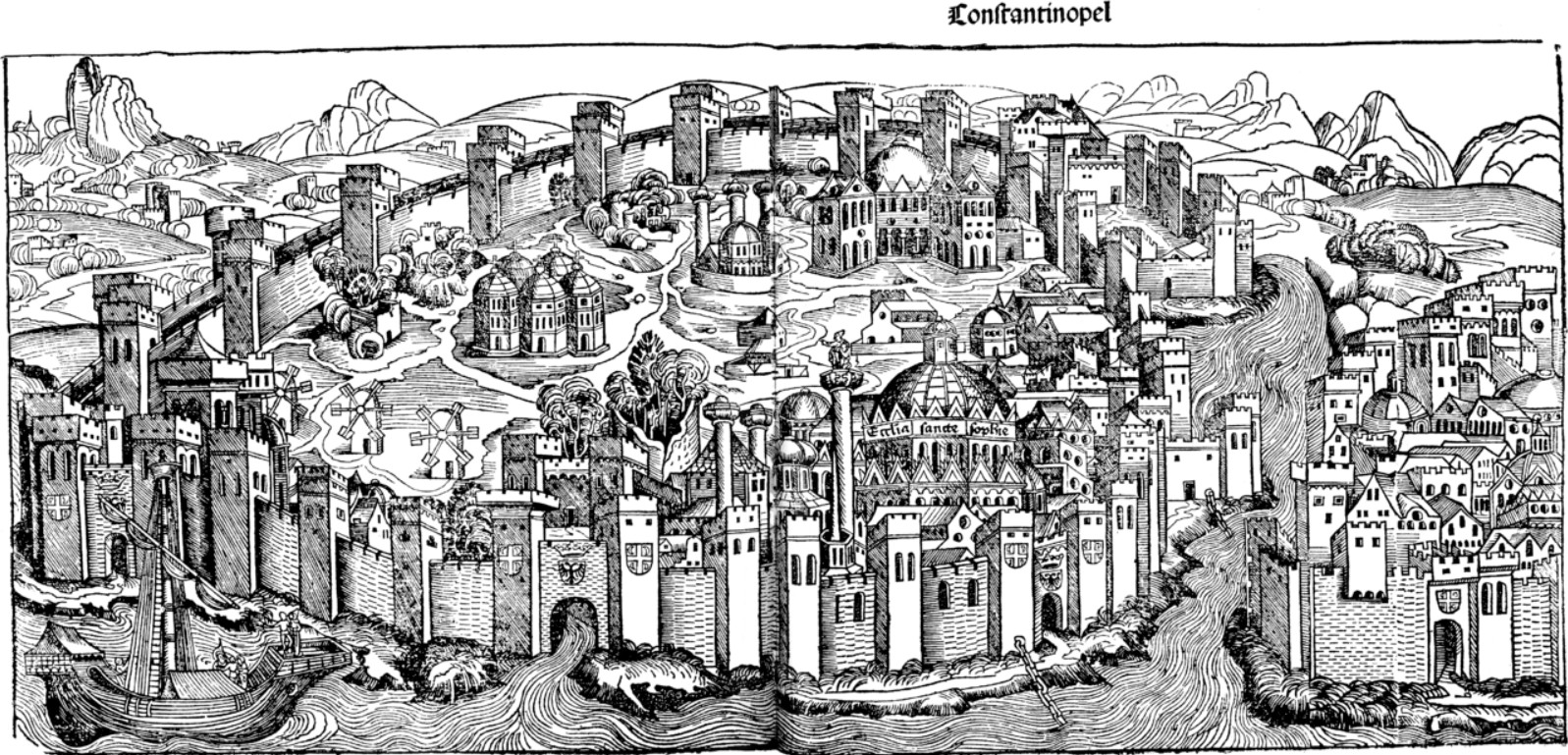
He quotes Professor Robert Lopez as explaining how the Byzantine Empire, based in the city that was then Constantinople and is now Istanbul, was being pressed simultaneously by the Turks in the East and the Normans in the West and so bought massive naval assistance from the Venetians at the heavy price of exempting them from all duties still paid by their own subjects in various ports.
Lopez says the treaty “made the native Byzantine merchants underprivileged in their own land”. [4]
In his essay ‘The Economic Decay of Byzantium’, Charles Diehl writes: “The treaty of 992, the first of a series that was to make Venice’s fortune in the East, allowed Venetian merchants considerable reductions in import and export duty payable at the Dardanelles as well as guarantees against molestation by the Byzantine officials.
“The treaty of 1082, renewed, confirmed and amplified during the twelfth century, increased these privileges… Thenceforth Venetian merchants could buy and sell in every part of the Empire free of duty or customs examination… Their vessels sailed into the Black Sea, to the Crimea, to fetch wheat from South Russia”. [5]
Hunt describes how, with these privileges, the Venetians undercut rival Byzantine merchants and eventually took over all the Byzantine trade.
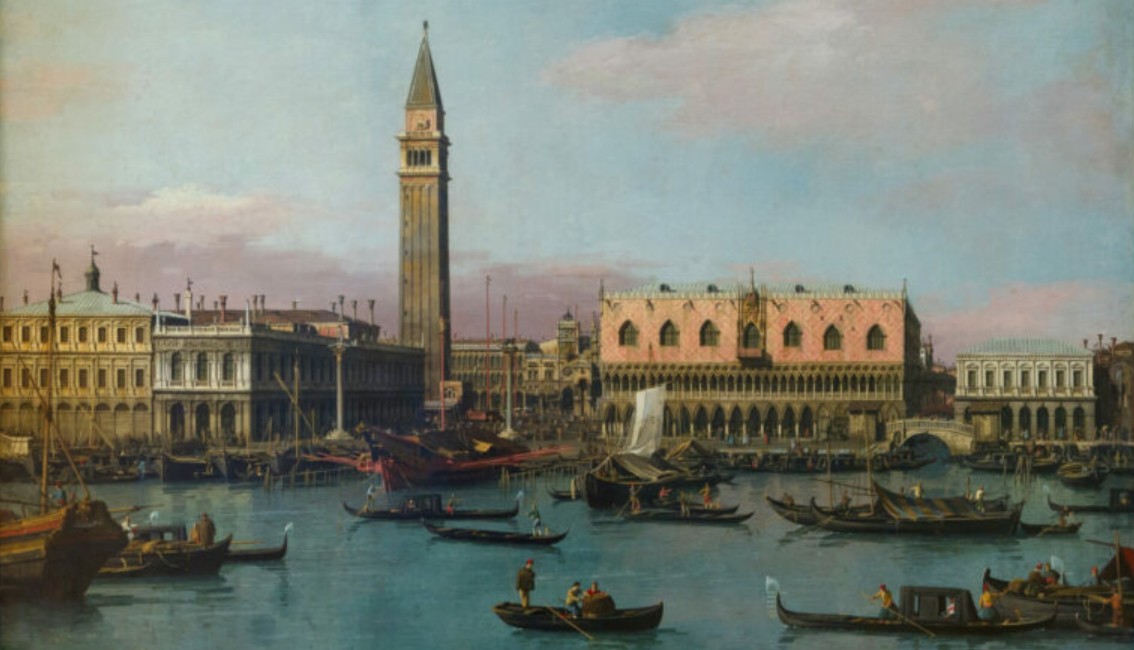
“The profits from that trade went to Venice and not to Constantinople which was gradually bled dry and finally couldn’t afford a large enough army to confront the Turks.
“In 1453 Constantinople fell. The Islamic conquerors had no need for Venetian protection, so Venice could no longer demand the trading privileges which had created its wealth. It was gradually forced out of the Black Sea and the Eastern Mediterranean”. [6]
When a parasite has destroyed its host, it has to seek out a new victim and this is presumably why the merchants of Venice, according to Baaijen’s account, now decided to set up shop in Amsterdam.
Here again, the wealth of the core was extracted from a poor periphery.
Harry Miskimin writes: “Had Poland developed large cities and supported a substantial nonagricultural population engaged in trade and manufacturing, it is highly likely that Amsterdam and many other cities of the west would have starved… Amsterdam could not have survived without access to the 70,000 square miles of grain fields in the Vistula Basin”. [7]
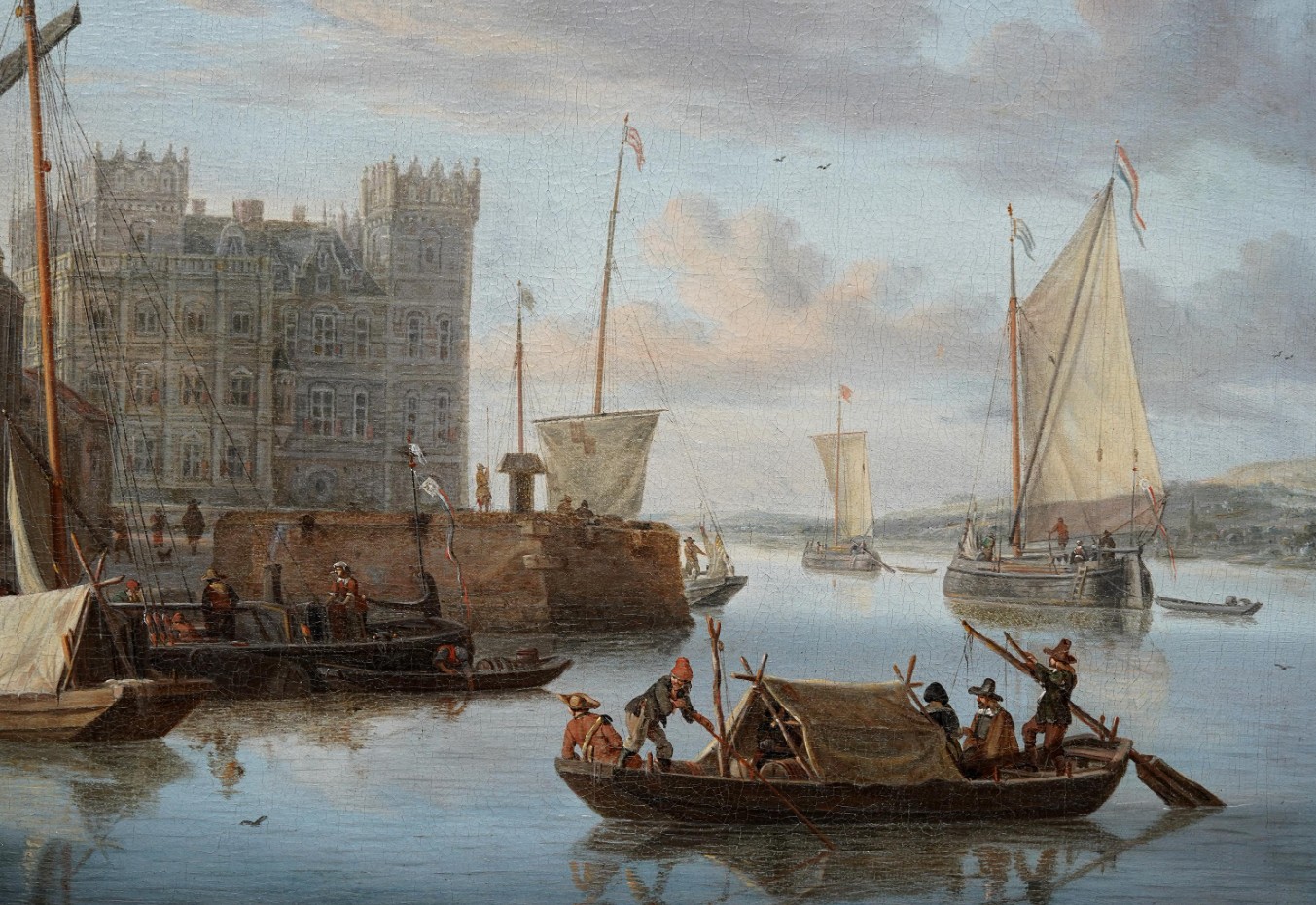
It was not just Polish peasants who were exploited in order to make the rich of Amsterdam even richer.
In The Perspective of the World, Fernand Braudel says that in the Dutch city the most menial tasks “were generally allotted to German immigrants, poor wretches who seem to have become more numerous after 1650 and who were known generically as the Hollandgänger, those who go to Holland, usually to work on the earthworks of the polders. Germany was a pool of cheap labour”. [8]
Glafia did not fully switch operations to London until the 1688 coup d’état absurdly known as the “Glorious Revolution” – the new Dutch-born king, William III, is reported to have been helped to seize power by a loan of 2,000,000 guilders from Francisco Lopes Suasso, a Jewish banker and financier in the Dutch Republic who was known within his Sephardic community as Abraham Israel Suasso. [9]
But the way had already been paved by Oliver Cromwell, often accredited with (or blamed for!) the official readmission of Jews into Britain following their expulsion in 1290.
I wrote last year how Cromwell had close links to Rabbi Menasseh ben Israel and other “Jewish merchant princes” from Amsterdam, foreseeing their important role in English commerce and imperialism. [10]
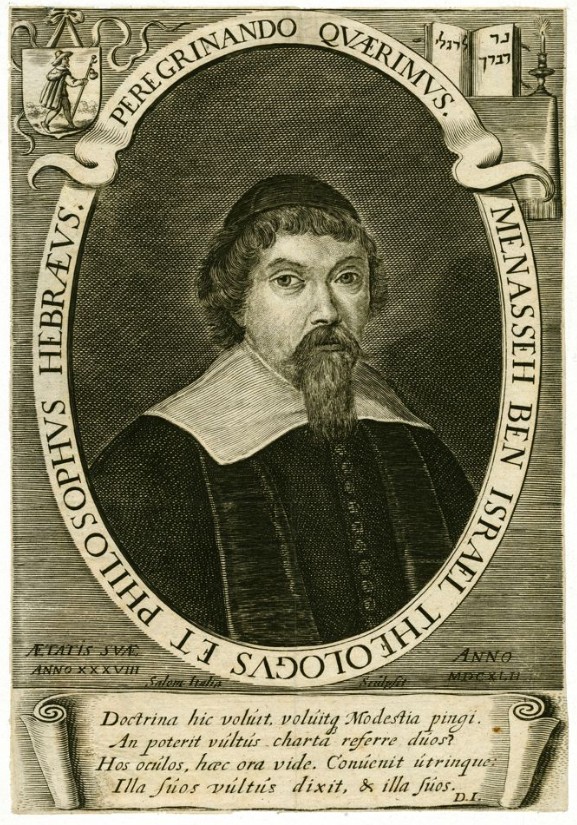
This fits with Hunt’s account that in 1640 state revenue in England was way behind that of the Dutch and French governments because Parliament did not want to grant Charles I more taxes.
But once Parliament had triumphed in the Civil War, and the king had been decapitated, Cromwell was able to persuade it to raise more taxes.
Hunt writes: “This was England’s breakthrough. It was now able to build the navy that drove Holland and France off the seas. It was able to get itself an empire, its own private periphery, paid for by the poverty of a heavily taxed population”. [11]
A breakthrough for the wealthy is always a setback for everyone else.
Angus Calder states: “The tax system helped rich individuals grow richer, transferring money to them from the poor. The money needed to fight war after war was chiefly raised by indirect taxes on commodities used by everyone – alcoholic drinks, bricks, salt, glass, tea, sugar and tobacco.
“It was handed over to holders of government bonds, to contractors, to shipbuilders, and to ironmasters. The profits and capital of business was virtually untaxed”. [12]
I also had a “lightbulb” dot-connecting moment when reading about an earlier period of England’s history, when it was not an exploitative core country but part of the exploited periphery.
It had just been taken over by a previous invading King William – in this instance William the Conqueror (Guillaume le Bâtard) who arrived from Normandy in 1066.
He brought with him monks, to whom he gave great estates, explains Hunt, and they led the way in providing the raw materials, wool, for the textiles industry of Flanders, which was then part of the core.
Says Hunt: “In the classic tradition of rulers in periphery countries, the people were driven off their land and replaced with exportable crops, in this case sheep”. [13]
Particularly involved in this commercial endeavour were Cistercian monks, who needed to sell wool in order to pay off the substantial debts they were incurring in their ambitious building programme, including the likes of Rievaulx Abbey and Fountains Abbey in Yorkshire.
Dom David Knowles writes: “At the death of that great financier, Aaron of Lincoln, in 1186, no less than nine Cistercian abbeys, and among them Rievaulx itself (pictured), were in debt to him for the gross sum of more than 6,400 marks”. [14]

This reference in Hunt’s book obviously sparked my curiosity and I learned: “Aaron of Lincoln (c. 1123 – 1186) was an English Jewish financier. He is believed to have been the wealthiest man in Norman England; it is estimated that his wealth exceeded that of the King”. [15]
The Wikipedia profile adds that by using a network of agents he built up “what was practically a great banking association that spread throughout England”.
“He made a specialty of money lending for the purpose of building abbeys and monasteries. Among those built were the Abbey of St Albans, Lincoln Minster, Peterborough Abbey, and no fewer than nine Cistercian abbeys”.
Knowles writes about this in a passage not cited by Hunt, stating: “The greater part of the money in these and similar cases had been raised from the Jews, who consequently figure in a number of the chronicles.
“At Bury in 1180 we hear, among other creditors, of Isaac fitz Raby Joyce, of Benedict the Jew of Norwich, and of Jurnetus, and matters had reached such a pitch that the tribe had quartered themselves on the abbey, using its strong-room as a bank, lodging their women and children in the offices and wandering about the minster while Mass was being sung.
“At St Albans in 1166 most of the debts were to Jews, and in 1183 Aaron the chief creditor made himself at home in the abbey, boasting that he had built the shrine of the patron saint”. [16]
Wikipedia adds: “Aaron not only advanced money on land, but also on corn, armour and houses, and in this way acquired an interest in properties scattered through the eastern and southern counties of England”. [17]
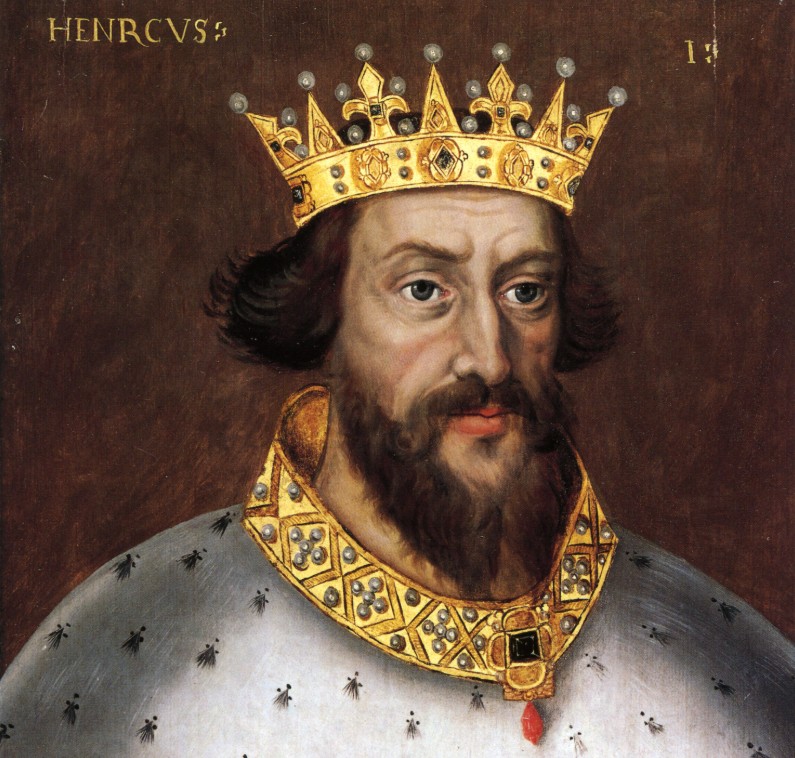
When Aaron died, Henry II (pictured) seized his property and thus also, in theory, the money still owed to him, although this does not all seem to have been recovered, even though the king did not charge interest, as Aaron obviously did.
So even in the 12th century, English folk were being thrown off the land to make way for commercial operations which ultimately benefited Jewish usurers.
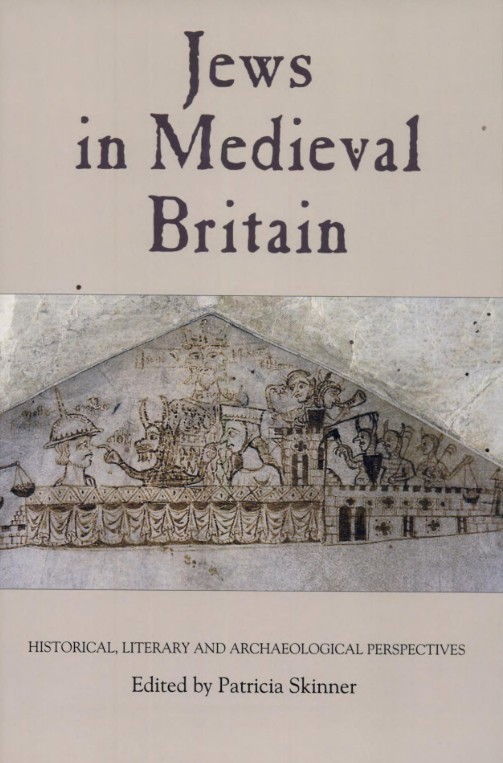
In his contribution to a 2003 book entitled Jews in Medieval Britain, Joe Hillaby goes so far as to describe the Jewish presence in the country as “colonisation”. [18]
He writes: “The twelfth century witnessed the Jewish colonisation of England, that is the establishment not only of the London but also, by 1189, of twenty-four provincial Jewries”. [19]
Making the link to the aforementioned Yorkshire abbeys, he remarks: “The rapid growth and great prosperity of York’s Jewry no doubt owes much to this trade in land with the Cistercians”. [20]
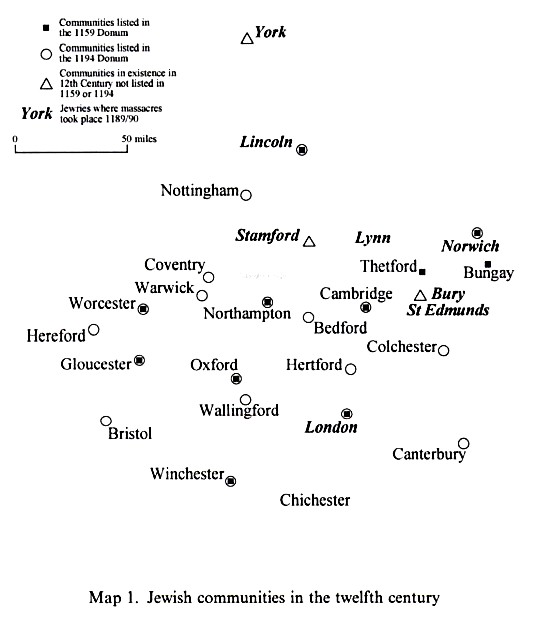
“The London community was the child of the Rouen Jewry. William of Malmesbury tells us that it was the Conqueror who had transferred the London Jews from Rouen. The wealth of the latter community in the late eleventh and early twelfth centuries is reflected in the size, and the quality of the workmanship, of the synagogue or yeshiva walls, which still stand to some 5 metres. [21]
“Natives of Rouen, Rabbi Josce and his family played a major role in London’s Jewry for well over a century, until 1236. To the rear of their house at the north-east end of Old Jewry, they built the great synagogue, magna scola, its design strongly influenced, no doubt, by that at Rouen…
“The London Jewry was strengthened in the late eleventh century by the arrival of a number of wealthy Rouennais seeking refuge from events at home”. [22]
Hillaby says that in Norman England the demand for money for warfare, castle-building and monastic foundation was very high but there were considerable risks involved, since the occupied indigenous population was not fully under control.
Jews therefore insisted on protection from local powers and tended to live in towns with castles.
“In emergencies effective power lay locally, usually with the magnate as sheriff… There was thus a strong, if not always apparent, financial nexus between the provincial Jewries and the local power brokers, even when the sheriff was not a magnate”. [23]
“It was not merely castles that attracted Jews to the new centres. All but one of the nine mint towns [listed] had retained their mints during Henry I’s reforms and even from Cambridge an independent baronial issue has now been found. Indeed, it has been suggested that some moneyers were Jewish”. [24]

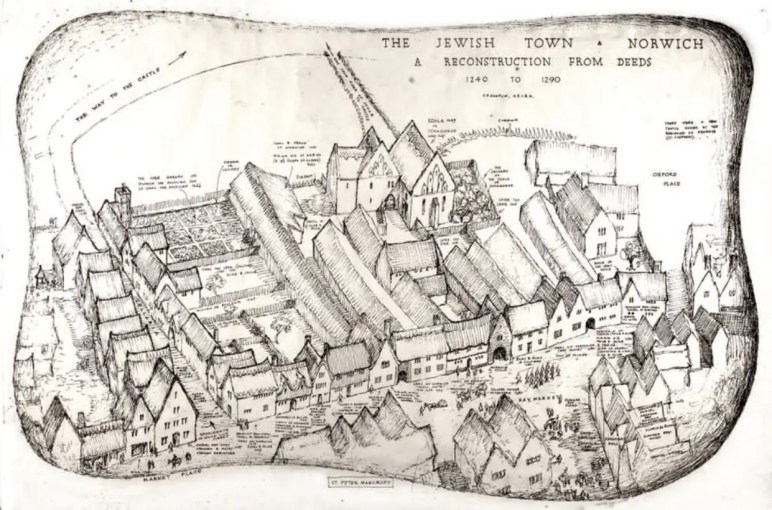
The medieval Jewish colonialists in England concentrated in places where there was money to be made, such as at King’s Lynn in Norfolk, says Hillaby.
“Here Jews from [Castle] Rising had settled close to the new, Tuesday, market. Lynn is of particular interest as an unusual range of evidence explains why, even without castle and mint, it attracted Jewish settlement. Its port, now doubled in size, was booming, offering opportunities that could not be resisted”. [25]
And the Jewish settlers evidently did very well from all these “opportunities”, at the same time as the English population was being plunged into poverty.
As Hunt never ceases to remind us, wealth is not created by trade and commerce, but merely transferred – in this case into the hands of what Hillaby terms “Jewish magnate families”.
The latter writes: “It has been argued strongly, both for Germany and for England, that the Jewish family was smaller than its Christian counterpart.
“However, the existence of very large families, at least among the upper echelons of the English medieval Jewry, throws doubts on such claims as far as this country is concerned.
“In fourteen families considered there were at least fifty-nine sons, an average of over four, for which the standard sex ratio suggests a total of about 118 children and an average of over eight.
“The most recent study of Jewish magnate families adds four further examples. Chera of Winchester had at least nine children, her granddaughter Belia at least six, while Licoricia of Winchester had at least five and her son Benedict at least seven by his first marriage”. [26]
He notes that Aaron the usurer also seems to have had a hand in the early colonisation of Ireland: “In 1170… Richard de Clare, Strongbow, led an expedition of 200 Anglo-Norman knights and 1,000 men at arms against Leinster. After Aaron of Lincoln’s death the records of those owing him money included Strongbow”. [27]
In his contribution to the same book, Robert C. Stacey sums up the Jewish success story in England: “By 1241, after two decades of economic and demographic growth, the five thousand men, women, and children who made up the English Jewish community controlled approximately 200,000 marks in liquidable assets, a sum equivalent to roughly one-third of the total circulating coin in the kingdom.
“Per capita, this made them almost certainly the wealthiest Jewish community in Europe. A wide variety of Jewish communal institutions flourished in England during these prosperous years, including schools of Jewish learning in all the major towns”. [28]
However, it all suddenly went wrong. “By 1258, however, this enormously wealthy Jewish community was financially ruined and spiritually demoralised. Twenty years of exorbitant royal taxation bankrupted its leaders and ignited destructive conflicts within it.
“In the resulting chaos, Jewish communal and charitable institutions collapsed and large numbers of Jews, including the archpresbyter (the royally appointed ‘head’ of the English Jewish community), converted to Christianity.
“Nor did the pressure ease thereafter. Between 1263 and 1267, Jewish communities throughout the country were looted and Jewish leaders murdered by the followers of Simon de Monfort (pictured).

“When the baronial wars ended, a series of statutory limitations on Jews and Jewish lending quickly followed, culminating in 1275 with a complete prohibition of lending at interest, hitherto the economic backbone of English Jewish life”. [29]
A backbone to be proud of!
The expulsion of the Jews in 1290 followed what Stacey calls “the escalating complaints of dispossessed Christian debtors” [30] although there were no doubt other factors involved in their unpopularity.
Patricia Skinner writes in her introduction to the book: “It is notable, for example, that the earliest and most frequent accusations of ritual child murder occurred in English settings”. [31]
Question marks remain over the thoroughness of the expulsion, especially considering that Jewish merchants were in any case itinerant and “must have been crossing the Channel regularly, especially from southern enclaves such as London, Winchester and Canterbury, or the burgeoning East Anglian trade centres”. [32]
Skinner adds: “Another subject that would reward study, however, is the status of those who converted to Christianity in the last, difficult years before 1290 and who were supported in some way by alms or in the London ‘House of Converts’. We can only speculate as to the sincerity of their change of faith”. [33]
Happily, as we know, Jewish “colonisation” of England resumed at full throttle at the end of the 17th century and, many would say, never stopped.
I will conclude with a final choice quotation from Hunt’s book on which I feel no need to comment.
“A major factor in a population’s exploitation is a foreign ruling class. A foreign invader is not influenced by any kinship ties and can be far more ruthless”. [34]

[1] Paul Cudenec, ‘Centuries of theft: the starvation of the periphery by the core’, https://winteroak.org.uk/2026/08/10/centuries-of-theft-the-starvation-of-the-periphery-by-the-core/
[2] See Mees Baaijen, Predators Versus the People, https://thepredatorsversusthepeople.substack.com/
[3] Richard Hunt, To End Poverty: The Starvation of the Periphery by the Core (Oxford: Alternative Green, 1997), p. 99. All subsequent page references are to this work, unless otherwise stated.
[4] R. Lopez, The Commercial Revolution of the Middle Ages, 950-1350 (Cambridge: Cambridge University Press, 1976), p. 65, cit. p. 99.
[5] Charles Diehl, ‘The Economic Decay of Byzantium’, The Economic Decay of Empires, ed. Carlo M. Cipolla (London: Routledge, 1970), cit. pp. 99-100.
[6] p. 100.
[7] Harry Miskimin, The Economy of Later Renaissance Europe, 1460-1600 (Cambridge: Cambridge University Press, 1977), pp. 63-64, cit. pp. 101-02.
[8] Fernand Braudel, The Perspective of the World: Civilization and Capitalism 15th-18th Century (London: HarperCollins, 1984), p. 186, cit. p. 98.
[9] https://en.wikipedia.org/wiki/Resettlement_of_the_Jews_in_England
[10] Paul Cudenec, ‘The Invisible College and the plan for our enslavement’, https://winteroak.org.uk/2025/08/11/the-invisible-college-and-the-plan-for-our-enslavement/
[11] p. 133.
[12] Angus Calder, Revolutionary Empire: The rise of the English-speaking Empires from the fifteenth century to the 1780s (London, Jonathan Cape, 1981), p. 789, cit. p. 133.
[13] p. 116.
[14] Dom David Knowles, The Monastic Order in England: a history of its development from the times of St. Dunstan to the Fourth Lateran Council, 940-1216 (Cambridge: Cambridge University Press, 1963), p. 352, cit. p. 116.
[15] https://en.wikipedia.org/wiki/Aaron_of_Lincoln
[16] Knowles, p. 305, https://archive.org/details/monasticorderine0000know_v4b3/page/n11/mode/2up?q=Aaron
[17] https://en.wikipedia.org/wiki/Aaron_of_Lincoln
[18] Joe Hillaby, ‘Jewish Colonisation in the Twelfth Century’ in Jews in Medieval Britain: Historical, Literary and Archaeological Perspectives, ed. Patricia Skinner (Woodbridge: The Boydell Press, 2003),
https://books.google.fr/books?id=GKXbD-RiQ2oC&q=hillaby&pg=PA15&redir_esc=y#v=onepage&q=hillaby&f=false
[19] Hillaby, p. 15.
[20] Hillaby, p. 28.
[21] Hillaby, p. 16.
[22] Ibid.
[23] Hillaby, p. 23.
[24] Hillaby, p. 24.
[25] Hillaby, p. 30.
[26] Hillaby, p. 35.
[27] Hillaby, p. 36.
[28] Robert C. Stacey, ‘The English Jews under Henry III’, in Jews in Medieval Britain, p. 41.
[29] Stacey, p. 41.
[30] Stacey, p. 50.
[31] Patricia Skinner, ‘Introduction: The History of the Jews in Britain’, in Jews in Medieval Britain, p. 9.
[32] Skinner, p. 8.
[33] Skinner, p. 10.
[34] p. 52.


Byzantine is used to describe a complex or intricate system, often with a connotation of being devious or secretive. Complicated is another word for byzantine, as it describes something that is intricate and difficult to understand. Other synonyms include convoluted and complex.
Notable individuals on the Theranos board of directors included Henry Kissinger, former U.S. Secretary of State; George Shultz, also a former Secretary of State; James Mattis, a retired U.S. Marine Corps general; and William Perry, former U.S. Secretary of Defense. Other members included prominent figures from various sectors, but many lacked substantial experience in healthcare.
Anecdotal evidence points to scandal-ridden and defunct Theranos as the original attempt by the so-called “Epstein Class”, Deep State, Globalists etc. to manufacture a pandemic via deceptive/fraudulent medical testing, namely Theranos’ flagship product: A fraudulent blood-testing machine which was headed for every Walgreen’s and Safeway location across America, until a very small group of men and women blew the whistle on the blood-testing machine’s junk status and the massive fraud was exposed in the 2016 timeframe.
After the Theranos fraud blew up in a major scandal, the “Epstein Class”, Deep State, Globalists resorted/turned to Christian Drosten and the fraudulent, now-infamous Pandemic-manufacturing PCR test, which went on to fraudulently detect COVID cases in large numbers, in what the medical testing industry calls false positives, – billions were pushed, coerced, ordered, frightened into receiving the deadly COVID mRNA injections … and the rest is world-record-breaking criminal history.
To the point: People need to/must know and understand that Theranos was the original plan for creating a fake global pandemic, leading to a Fascist eugenicist major depopulation of humanity.
See: https://onenessofhumanity.wordpress.com/2026/08/16/edward-curtin-and-alex-krainer-need-to-talk/
LikeLiked by 2 people
Terrific article. Well researched. Thank you.
LikeLiked by 2 people
Thanks
LikeLike
Great podcast thank you.
Now that the ”indigenous” have become wageslaves repaying their luxurious lifestyles they’ve become perfectly controllable.
LikeLiked by 2 people
Cheers. Yes, unfortunately.
LikeLiked by 3 people