This is the third in a selection of chapters from the book King of the Squatters by jaybo which we are delighted to be able to share on Winter Oak. The whole text can be found as a pdf here. Here we are in 2015.
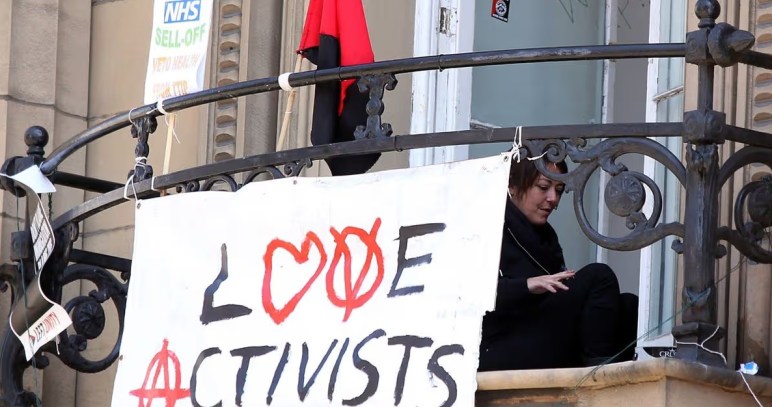
I do not recall my last night in Ireland, at all. I was extremely upset to leave Amy and all of our new friends behind. They got me very drunk to deal with the situation. When I arrived back in Liverpool, the Love Activists (LAs) had achieved support and notoriety in the city, after squatting six different high-profile places in a few months. The LAs had started out in London, declaring themselves to be anarchists driven, by love, to help house and feed the homeless and bring down the evil bankers and their corrupt system.
One LA known as ‘Grandad’ described the LAs eviction from the Bank of England to me. He said that they had been kept on lock-down, a prison term for everyone being locked up in their cells, for two long weeks by the police. The police had erected a tall steel fence which completely surrounded the bank and a cordon of cops then stood completely surrounding the fence all day and night. Upon witnessing this action local people spontaneously formed their own human chain surrounding the police and also maintained a 24/7 presence. Supporters cheekily threw many crucial supplies right over the polices heads to grateful activists who caught them on window balconies!
He said, “Almost everybody who entered the bank respected the building. Only a few made some graffiti on walls, and that could have easily been painted over. But the police did not respect the building cutting through those amazing doors.” Grandad also told me, with great pride, “The fire bobbies were called to the eviction. When they arrived, they talked and quickly decided that they were employed to save lives, not evict homeless people. They fucked off, to cheers from the crowd of hundreds surrounding the police. Ha Ha!”
Having been unceremoniously evicted from the Bank of England on Castle Street in the spring, the LAs had blazed a trail of six squats from the city centre, south, ending up on Sefton Park meadows. They had set up camp “right outside fat Joe’s new offices”, fat Joe being the name many of our people in the city used to describe the deeply unpopular mayor of Liverpool. The LAs had squatted a Georgian terraced block of houses in the city centre, and they did a sit-down protest on the road at the entrance to the Mersey car tunnel, closing the tunnel down completely. They had stormed the city, which had not seen any squatting in the previous twenty years, and received the support and admiration of thousands of ordinary people across the region.

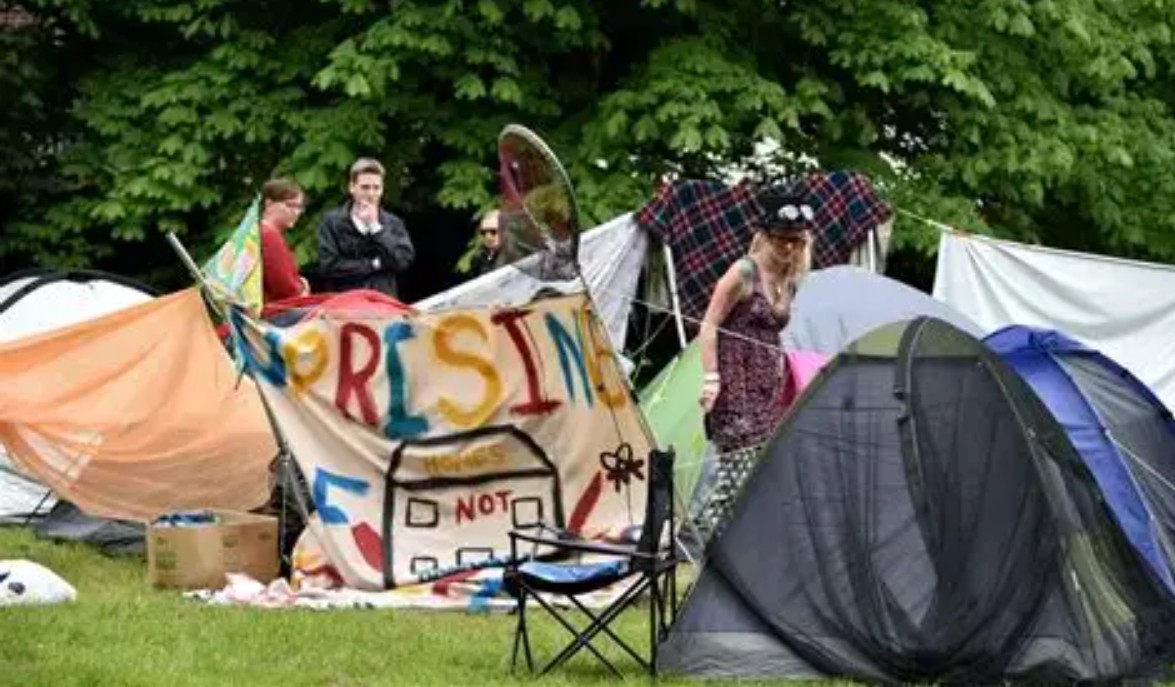
As I approached the LAs camp on Sefton Meadows for the first time, it warmed my heart to see the anarchist flag that had hung from the Bank of England flying high, together with a Bob Marley flag. As I got closer, I saw a big banner at the side of the kitchen, next to the camp’s entrance, which read in large letters, ‘Uprising of the Homeless’. I never expected to read such an audacious banner and was utterly intrigued.
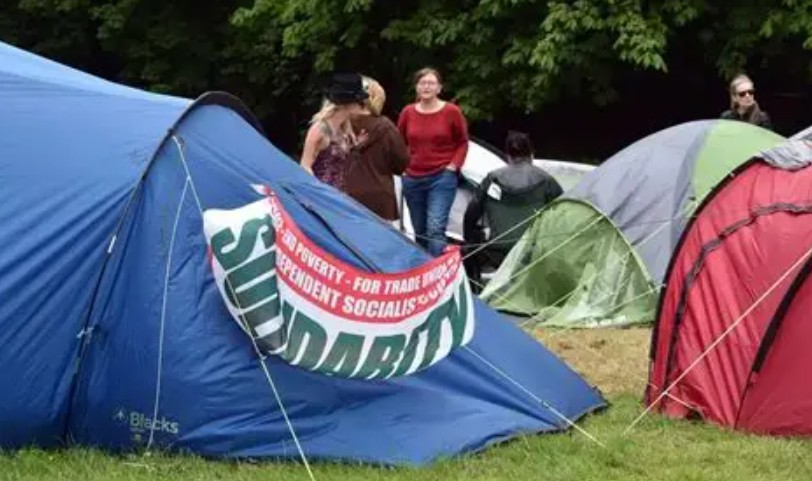
The LAs and Uprising of the Homeless (UOTH) camp was right on my old doorstep. Situated just across Princes Park to Sefton Park on the meadows beyond. A lovely, open site that had been left to the people of Liverpool, two hundred years previously, in perpetuity, i.e. forever, as a green haven in an industrial city. Sefton Park was one of Liverpool’s biggest and best parks, just a short walk from the city centre and the River Mersey. There were huge, magnificent, old trees surrounding the meadows, and about twenty-five raggle-taggle tents had been erected in the middle, surrounded by a rope border.
On a beautiful early summer’s afternoon, with everything I owned in my backpack, I slowly walked across the meadows towards the camp, full of anticipation. There was a group of mostly men sitting around a small fire. I saw Jed and Grandad first. They both gave me a huge smile as I got closer. Then I saw Lisa Love, looking like a futuristic steam punk. She also gave me a huge smile and had a very powerful energy. She seemed to have all of the men’s respect. Then I saw Biggy, and he gave me possibly the cheekiest smile I had ever seen. I knew immediately that I would be fine with the LAs and UOTH. I was definitely in the right place.

Most of the guys that I met at the camp considered themselves to be both LAs and UOTH. I asked about the Bank of England occupation and quickly got all the gory details from several of the people who had been inside for the whole occupation, including the last few weeks, which they all referred to as the lock-down. They told me proudly how they had cooked approximately two thousand meals for any homeless or poor people who had wanted to eat them. Prior to the lock-down, between one and two hundred homeless or poor hungry people per day had entered the Bank of England for food and shelter.
After a few months of such insubordination, the city’s mayor, Joe Anderson, had sent in the heavies. I liked Grandad’s version of the story best. Having given his heart and soul to the LA’s action, permanently in the bank, one afternoon he left briefly to buy tobacco from a shop only minutes away. When he returned, the entire bank had been surrounded by a high steel fence. He had been locked out, and he was perhaps the person who had wanted to be inside more than anybody else there.
As a result, he returned every day for the entire lock-down, to shout at the police and buzz off the ruckus. The police made a human wall around the steel fence and kept it manned twenty-four seven. So, the good folk of Liverpool had made a human ring around the police and also maintained a twenty-four seven presence, throwing supplies of food, drink and cannabis (several ounces, apparently), straight over the heads of the statue-like police.
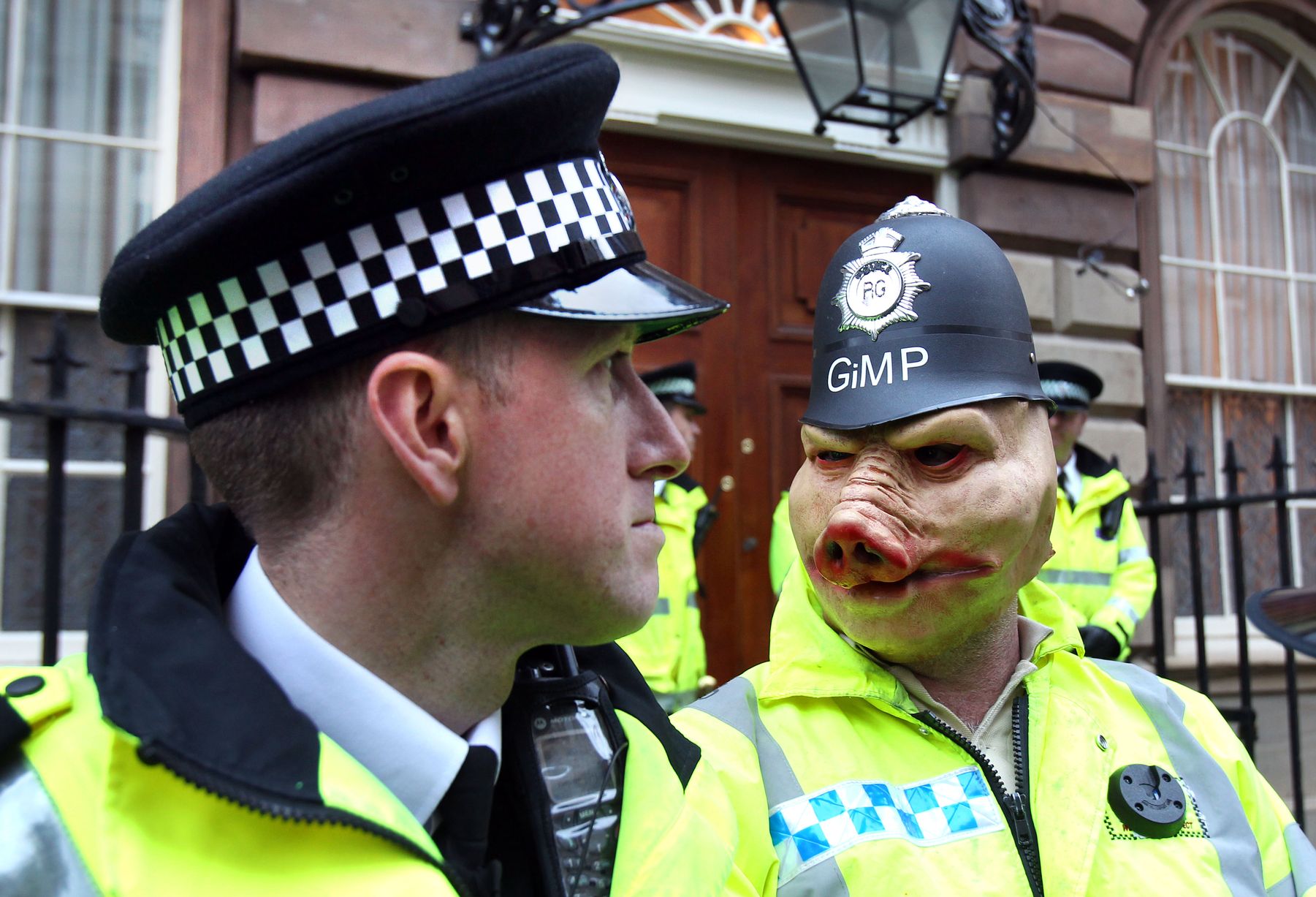
At the camp, most of the people were homeless. Some had hostel spaces, but most had been sleeping on the streets prior to the bank being occupied. I split my sides when told that they had actually climbed into the palatial Bank of England through an open ground-floor window. Better, they were hidden by the two for-sale signs in a ‘V’ shape, completely concealing their entrance.
The camp residents had a great vibe going. Many had squatted for the first time and they had all been through a lot together. Most of the men and women were twenty-odd years old, and most of them had already been in jail six times. This was nothing to them, or at least they put a brave face on it. But in the bank, the LAs had started nightly meetings for everyone to have their say and feel equal, whether homeless, squatter or whatever.
There was a wonderful sympathetic local photographer, who always had the trust of the activists and homeless, and he took an incredible set of images from the actions. The empowerment felt by those mostly young men and women was tangible in so many of the photos. After having so much trouble and trauma in their short lives, they had learned how to use their anger and frustration positively. They began to gain the confidence to run their own lives, and they had grown from strength to strength. Most of the young men had got the same tattoo on their necks: the LA’s symbol, which was an anarchy ‘a’ in a heart, instead of a circle.

But those guys’ stories often broke my heart. Incarcerated, some as children; like Jed, who had witnessed his dad being murdered by his uncle, right in front of his eyes. Was it any surprise Jed ended up in jail, before he was old enough to vote? He played the hard man, because that was all he had ever known. The horror stories of the working class never get any easier to hear, but those guys’ stories were more extreme than many I had previously heard.
I warmed to all the guys quickly, and they did to me. I was perhaps a small father figure for some, and perhaps they were a small replacement for my estranged daughter. Grandad was everyone’s grandad and had no problem with the title. Sid was an older, long-time homeless man, who had initiated UOTH in the Mello Mello squat. In a lovely, messy way, we were all one big dysfunctional family. We loved each other, and we stood solid together. We were the homeless, the oppressed and exploited, but we were ‘famous’. We were prepared to fight and die for each other, on a daily basis. And we laughed, a lot.
Daily life was equally hilarious and tragic, camping and surviving with those guys. Although the camp was predominantly male, there were a few very strong women, both living at or regularly visiting the camp. One woman called Marianne lived near to the camp. She brought food supplies to the camp, several times a day. Although she was a member of the Green Party and quite posh, she took all the nonsense that was thrown at her daily, and never lost her sense of humour or compassion. And how can I forget Lisa Love shouting at the men in general one morning, “Can you stop leaving your cum socks all over the camp?!”
Perhaps the most notorious of all the young men and women at the camp was a young man called Tez. I did not meet him for a while, as he was a night owl. Several of the guys ‘grafted’ at night and slept in the day, unless they had to go for regular sign-ins with the forces of law and order, who put electronic tags on their ankles and other restrictions on their movements. I was worried about meeting Tez, from the descriptions I had received. I was expecting a monster.
When I actually met a small guy with a smile almost as cheeky as Biggy’s, I did not think it could be Tez. He was a little apprehensive at first, but soon told me with his eyes lit up that he was a rapper, and he asked if I wanted to hear some of his lyrics. I did, and I was moved to the point of choking back tears. Tez could only write from the heart and was certainly a natural-born rebel with no respect for authority, in any shape or form. I took a huge liking to Tez, who was more like a child when I showed a genuine interest in him spittin’ his lyrics than the monster that he had been described as. He was also extremely funny. Tez had been in prison six times, by the time he was twenty-one years old.
I usually awoke first each morning, followed by Biggy. Just seeing Biggy’s face and smile made me laugh. Sometimes he woke first, and one morning when I looked out and saw him alone, lying on a massage table as if he was paddling out to sea on a surfboard, it nearly killed me. He was hilarious just in his own company. But I need to explain how and why that happened.
The camp was usually kept clean, and the two biggest issues were stolen goods and spice. The most serious issue for me was the constant attempts by two of the group, Juliette and Connor, to control and dominate the camp, dis-empowering the empowered, attempting to govern the gloriously ungovernable. Juliette and Connor were not homeless. I had suspected that they were members of the Socialist Workers Party, whilst some other people suspected them to be infiltrators. They came to stay at the camp for weekends and insisted on calling meetings upon their arrival. They wanted no stolen goods or spice on camp.
Stolen goods and spice were, for some, the daily bread and butter of life. I quickly came to hate spice when I saw what it did to Grandad and others. After research, I discovered that spice was more addictive, harder to get off, than heroin and crack cocaine. I had read Terence Mackenna, the Noam Chomsky of natural highs, about the African root Iboga. There was no miracle-cure Iboga available for the homeless.
The guys were out stealing from rich cars every night, and after several meetings where people screamed for no more stolen goods on site, I woke to see Biggy, paddling on the massage table. The massage table was brand new. With a heavy wooden frame and covered in bright pink leather, it had been placed right in the middle of the camp, visible from the meadows all around. The guys had excelled themselves the previous night. I never asked how they achieved that heist. I did not need to. It was just great to see Biggy dreamily lying on it. I think the spice use got worse and, although Grandad said that he had wanted to stop smoking it, it was everywhere and half the price of cannabis.
I remember a comical moment one night as many of us were all in our tents ready to sleep. Someone shouted, “I am getting my tent carpeted,” and someone else replied, “I’m gettin’ underfloor heatin’’’; then someone else replied “I’m gettin’ a conservatory”, followed by “I’m gettin’ a front lawn”, then “I’m gettin’ a first floor”, and so on, as we joked ourselves to sleep.
Also from the book:
Never Accidentally Offer Luxury Recycled Cream Cakes to Portuguese Vegan Punks!
Jaybo is currently living in a cave in southern Spain. If you would like to contact him, please write to winteroak@greenmail.net and we will forward your email to him.

