by Paul Cudenec, who reads the article here
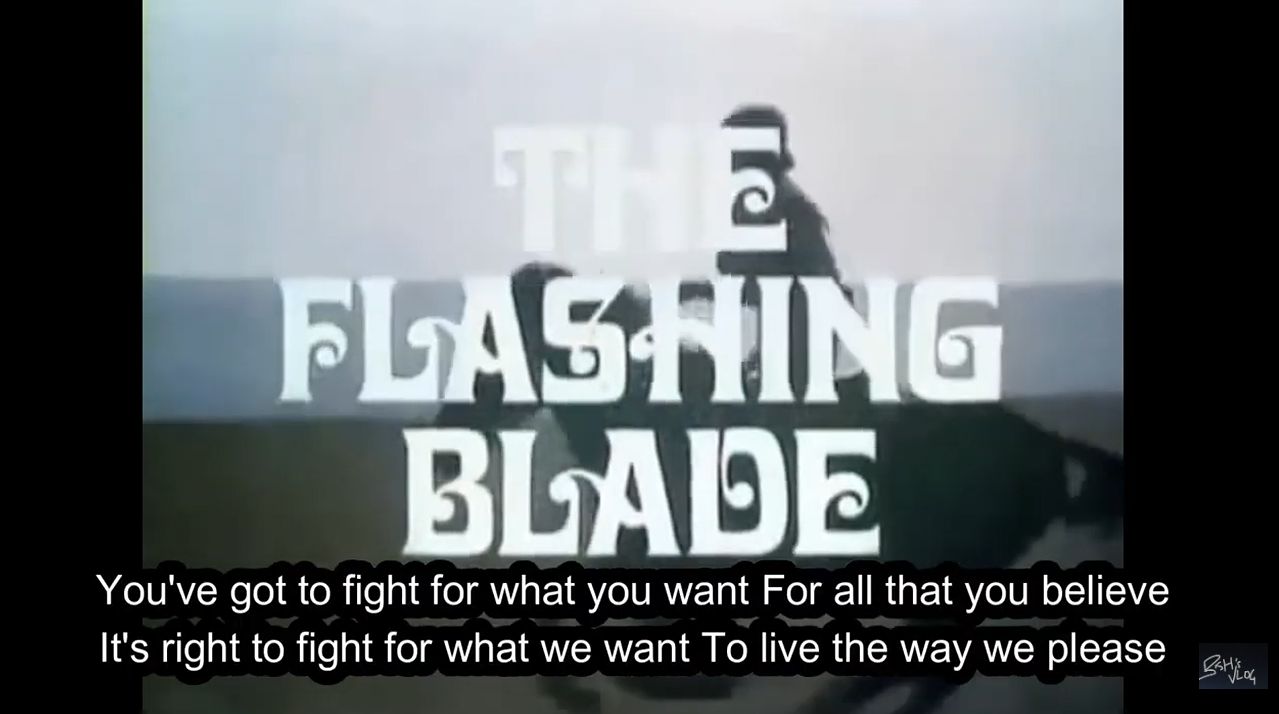
You’ve got to fight for what you want
For all that you believe
It’s right to fight for what we want
To live the way we please
As long as we have done our best
Then no-one can do more
And life and love and happiness
Are well worth fighting for
These lyrics, together with the stirring tune to which they are set, made a great impression on me when I was a boy.
The song Fight by The Musketeers, released as a single in 1969, was the theme music for The Flashing Blade, the English version of a French TV series called Le Chevalier Tempête. [1]
The story is based on historical events during the 17th century War of the Mantuan Succession between France and Spain, but I do not think the details of the plot interested me much – it was the song that I loved!
I knew somehow – in my bones, in my blood, in my guts – that what the words were saying was both true and important.
The song’s message was still ringing in my ears when I first launched myself, as a teenager, into my ongoing – but so far unsuccessful – efforts to bring down the venal and usurious globalist system.
I must have already come across the same spirit in the tales of Robin Hood, William Tell and other heroes and so I suppose one could argue that the outlook had been implanted in me by the cultural environment in which I grew up.
But I would say, rather, that it was already there at my birth – in the innate pattern of my mind, heart and soul – and that external stimuli like the song merely activated a thought that was waiting to be thought, provided the means by which an unconscious attitude became conscious.
And, even though not everyone thinks that way, I would say that we are looking here at an idea – a principle, rather – that generally forms part of our collective culture, in Europe and elsewhere.
We see it, for instance, in medieval Norse culture, in the Elder Edda of Saemund Sigfusson:
“A cowardly man thinks he will ever live, if warfare he avoids; but old age will give him no peace, though spears may spare him”. [2]
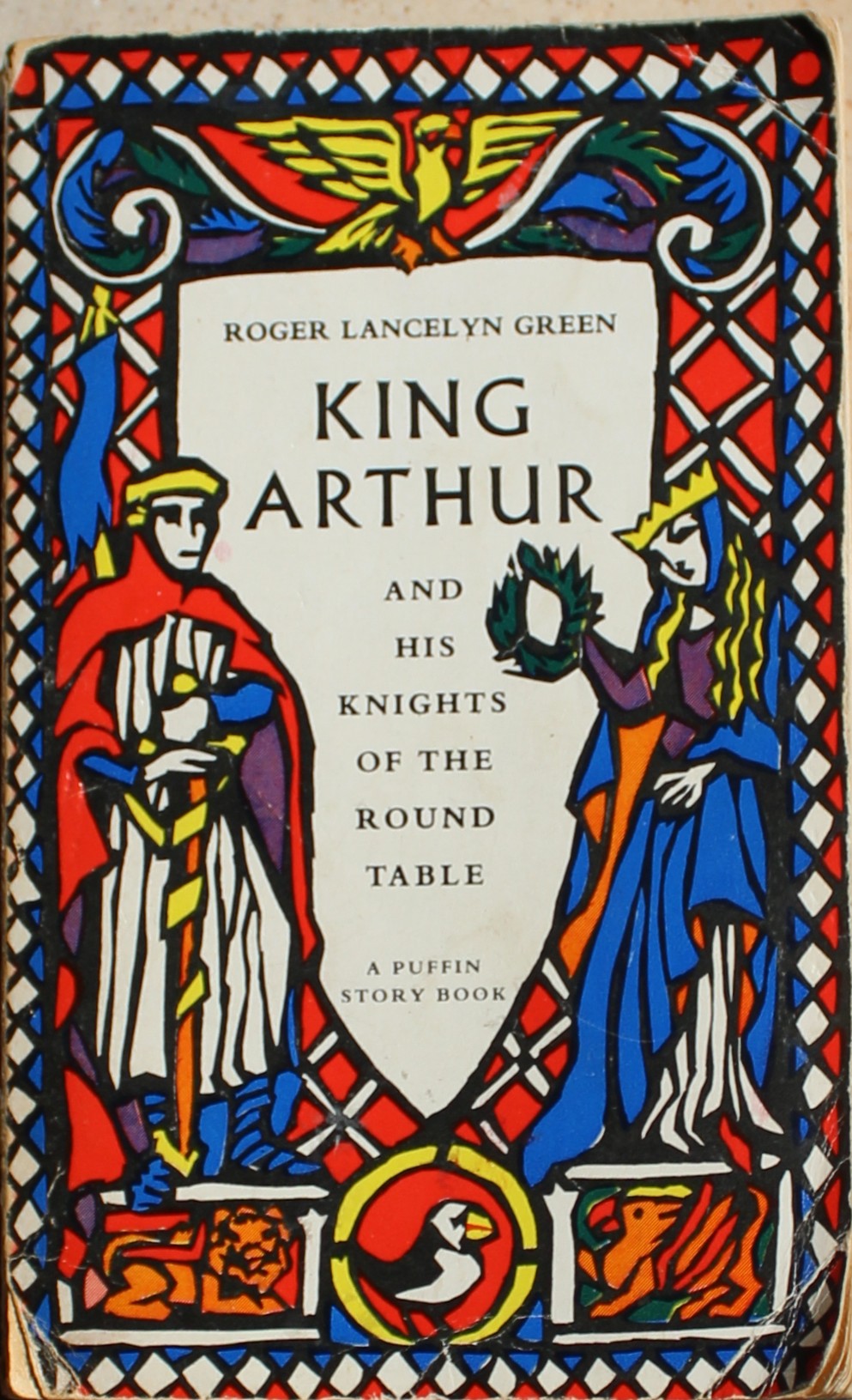
It is also present, of course, in the Arthurian legends, as I noticed when re-reading a book that I have kept hold of since my childhood – King Arthur and His Knights of the Round Table by Roger Lancelyn Green (1918-1987), a friend and biographer of the author C.S. Lewis. [3]
Although this was published by Penguin under the “Puffin” label aimed at younger readers, it is a serious and eloquent re-telling based on Sir Thomas Malory’s famous account and weaving in material from various other sources.
I was amused to see the title of the aforementioned TV series make an appearance when Merlin the magician/druid announces, regarding young Arthur: “In Avalon the elves are forging Excalibur to be the sword of his right – the clean flashing blade that shall be raised only in the cause of right, shining on the earth until the time comes when they shall call it back again”. [4]
Likewise, Sir Launcelot of the Lake tells Sir Percivale of Wales: “Not in great deeds of arms lies the true worth of knighthood – rather in the heart of the doer of such deeds: if he be pure and humble, doing all things to the glory of God and to bring that glory and that peace throughout our holy kingdom of Logres”. [5]
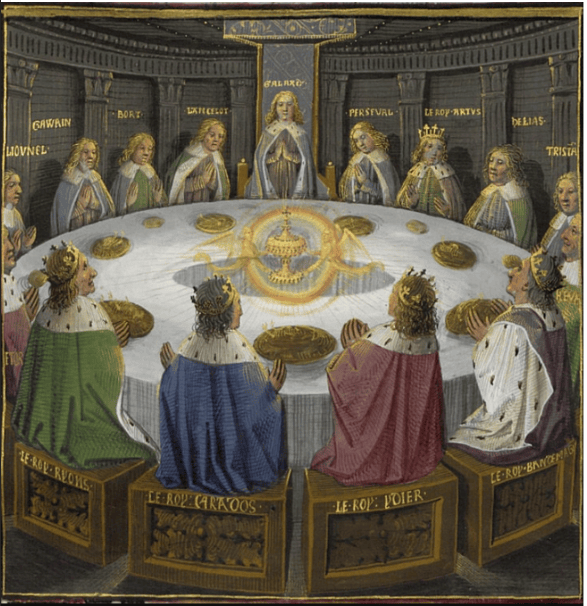
At the inauguration of the Round Table, Merlin declares: “All of you, and those who shall sit afterwards at this Table, are the Knights of Logres, and for the glory of Logres, the Realm of Righteousness, do not ever depart from the high virtues of this realm.
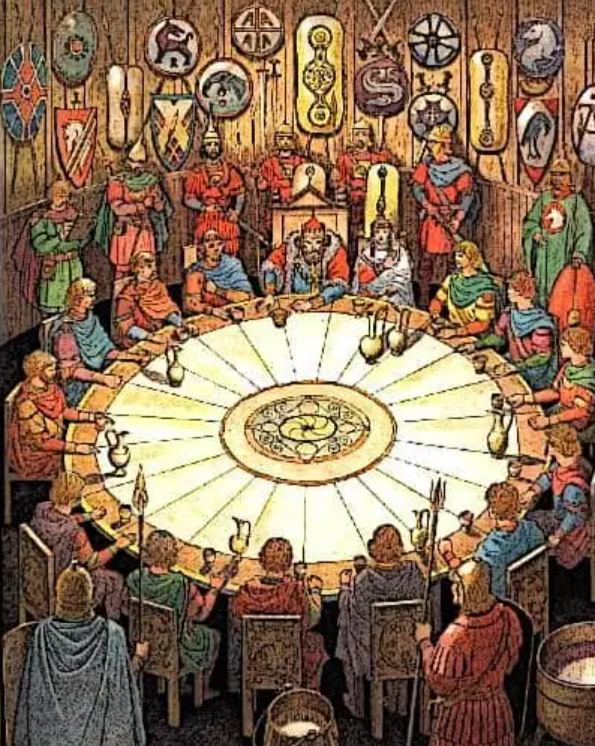
“Do no outrage nor murder nor any cruel or wicked thing; fly from treason and all untruthfulness and dishonest dealing; give mercy unto those who seek it – or sit no more at this Table.
“And always give all the help in your power to ladies and damsels, go out to succour gentlewomen and widows, turn from all else to right any wrong done to any woman in the world – and never, on pain of death and eternal disgrace, do you any ill thing to a woman, or suffer it to be done. Nor, for love or gain, fight in any quarrel that is not just and righteous”. [6]
By the way, the sign of Logres – “the land of true good and piety, nobleness and right living” [7] – is described by Lancelyn Green as being a five-pointed star [8] like the one that forms the organic radical logo below, together, in our case, with the rising sun of renewal and the greenery of life.
We are certainly not (still or yet) in the glorious times of Logres – indeed, power is currently in the hands of an evil zionist gang following a six-pointed star, whose moral stance is the exact opposite of that of Arthur and his knights.
They are far from being pure and humble, they delight in murder and cruelty, believe in showing no mercy at all to their enemies and consider they have the God-given right to rape any unchosen woman they want to.
Their supremacist cause is inherently unjust and they specialise in treason, untruthfulness and dishonest dealing, considering that being what they term “artful and shrewd” [9] makes them somehow superior to the rest of us.

A population sharing a strong sense of right and wrong, of ethics and honour, can unfortunately easily fall victim to a “trickster” [10] tribe whose machinations, crimes and lies hardly seem possible human behaviour to those with any sense of decency.
So what is the answer? To act likewise, to lower ourselves to their level and fight them on the terrain that suits them best?
No, of course not. We need to understand clearly what they have been doing to us and then rediscover, nurture and activate that righteous courage that lies within us.
The Knights of the Round Table never hesitate to charge into battle, even when the odds seem to be heavily stacked against them.
We should do the same and remember “a knight’s duty ever to defend the weak and punish the cruel and evil” [11] as we act “in pureness of heart and in obedience to the law of Heaven”. [12]
We might also heed that rebel wild and free Edward Abbey, when he declares: “Win or lose, the important thing is resistance. Defiance. Rebellion. Better to die on our feet than live on our knees”. [13]
Or we could hearken another verse of The Musketeers’ inspiring song:
And we should never count the cost
Or worry that we’ll fall
It’s better to have fought and lost
Than not have fought at all

[1] https://www.youtube.com/watch?v=j7hFUZB41nY
[2] https://www.gutenberg.org/files/14726/14726-h/14726-h.htm
[3] https://archive.org/details/cslewisbiography00gree_0
[4] Roger Lancelyn Green, King Arthur and His Knights of the Round Table (Harmondsworth: Penguin, 1970), p. 23.
[5] Lancelyn Green, p. 176
[6] Lancelyn Green, p. 63.
[7] Lancelyn Green, p. 81.
[8] Lancelyn Green, p. 86.
[9] Yuri Slezkine, The Jewish Century (Princeton & Oxford: Princeton University Press, 2019), p. 24, cit. Paul Cudenec, ‘Invisible imperialism’, https://winteroak.org.uk/2026/04/23/invisible-imperialism/
[10] Slezkine, p. 8.
[11] Lancelyn Green, p. 182.
[12] Lancelyn Green, p. 217.
[13] Edward Abbey, Hayduke Lives! (New York: Little, Brown and Company, 1990), p. 234, cit. Paul Cudenec, ‘A rebel wild and free’, https://winteroak.org.uk/2026/10/02/a-rebel-wild-and-free/

