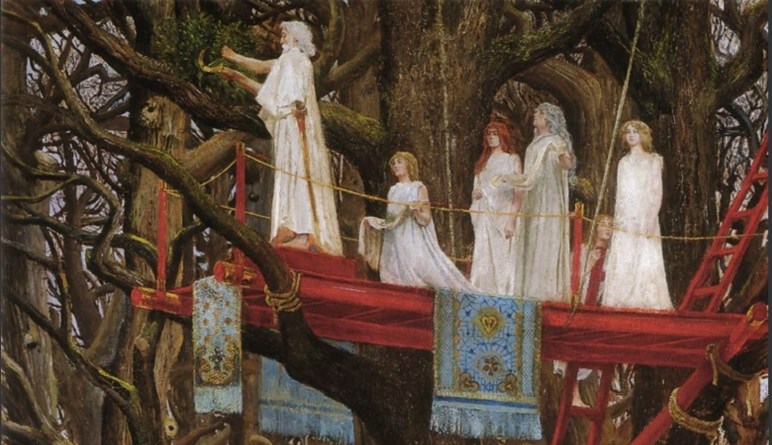
by Paul Cudenec, who reads the article here
The spirituality of the ancient Celts, like that of most pre-modern peoples, was deeply rooted in human belonging to nature.
Jean Markale, in his very interesting 1985 book on druidism, explains that this was reflected in the fact that “before being conquered by the Romans or assimilated by the Greeks, the Celts never built any temples“. [1] They were rather the “men of the Tree” and officiated and taught in sacred clearings, nemeta, in the middle of the forests. [2]
“Knowledge and wood are symbolically placed in parallel”. [3] “The druids had a predilection for the forests and all the druids of Gaul met once a year in the forest of the Carnutes. In Britain, the druidic establishment on Ynys Môn (the island of Anglesey) was in a forest”. [4]
Describing a Celtic sanctuary near Marseilles, the Spanish-born Roman poet Lucan (39-65 AD) wrote: “The druids live in the deep woods (nemora alta) and withdraw into the uninhabited forests… They worship the gods in the woods without using temples”. [5]
As well as forests and islands, springs were also held sacred by the Celts (and many other peoples), says Markale – “there they found contact with the vibrant and fertile forces surging mysteriously from the centre of the earth”. [6]
Animals were obviously important in this spiritual withness to nature – for instance, we learn that one of the roles of the Dagda, an important Celtic god described in the first article in this series, [7] was as “master of the wild animals which he was charged with looking after in the forest”. [8]
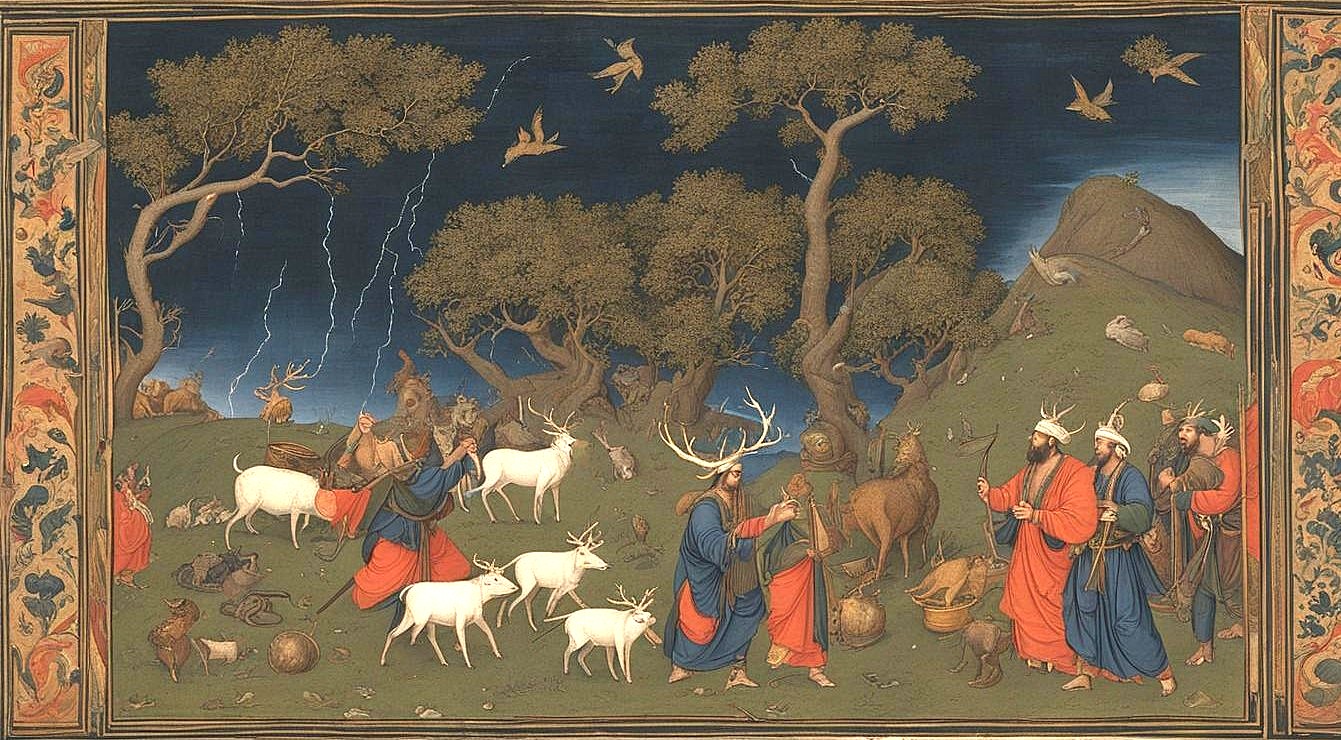
And, as we saw in the second article, [9] there was a totemistic element to the Celts’ culture, with Markale noting that their myths often involve people “in animal form or bearing the names of animals”. [10]
Thus the legendary Irish hero Cú Chulainn, born Sétanta, got his new name (which means ‘Hound of Culann’) after killing Culann’s dog, then replacing him as this man’s protector – Markale sees this as an initiation rite into a clan whose emblem was the dog. [11]
In Irish and Scottish mythology, Diarmid Ua Dwibhne was closely linked to a wild boar and the same animal was also important in Wales and in Gaul. [12] Markale notes that most Gallic tribes seem to have gone into battle under the sign of the wild boar [13] – and I would add that similar images today adorn the vehicles of those who like to hunt sangliers in rural France.
He continues: “Young Kulhwch [a cousin of King Arthur] was born in the middle of a herd of domestic pigs and young Pryderi, son of Rhiannon, was abducted at birth and then placed in a stable in which a foal had just been born”. [14]
“We also have to wonder why the Irish Art, son of Conn, which is to say “Bear, son of Dog’, has to have as his wife, having won her through braving terrible dangers, Coinchend Cennfada, in other words ‘Dogs’ heads’. The name of King Arthur, which is not of Latin origin as they would like us to believe, is derived from artu or arto, ‘bear'”. [15]
As well as these symbolic namings, we also come across the shamanistic side of Celtic spirituality whose possible origins were mentioned in the last piece.
Says Markale: “We know that shamans, by their incantations and their ecstatic practices, can become animals, either by incorporating the spirit of the animal into themselves or by projecting themselves on to the animal. The transformation does not perhaps take place on the real material level, but operates on a real psychological and mystical level”. [16]
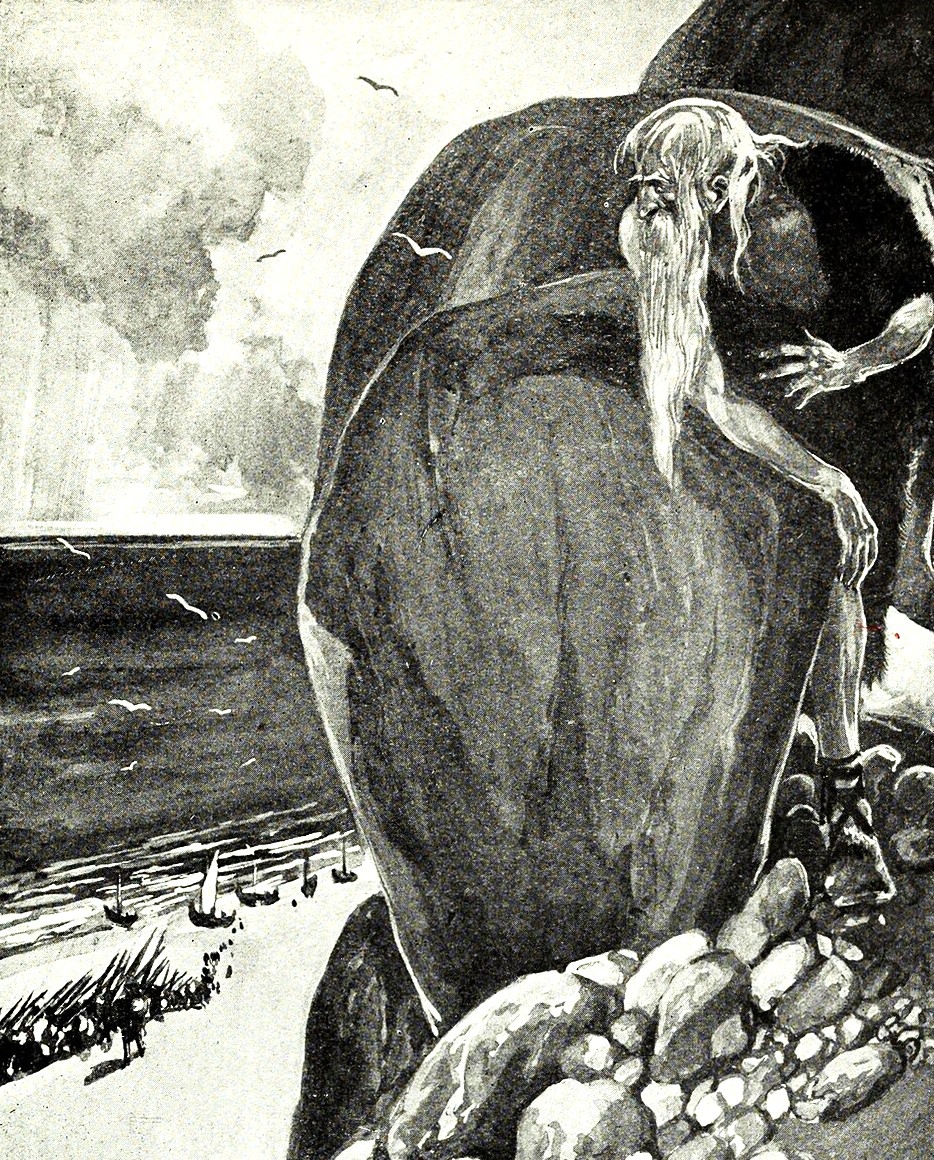
“A good example of this is the story of Tuan mac Cairill (pictured), a highly interesting character from the Irish tradition. A witness to the five great invasions of Ireland, from the time of Partholon, he survived by changing forms. Initially a man (more precisely, a druid), he became a stag, a wild boar, a falcon and a salmon before turning back into a man”. [17]
Markale insists that this is not a question of a series of reincarnations, as some have suggested, but of successive metamorphoses of one being and one body: “Tuan mac Cairill is the image of primordial Man, still capable, as Mircea Eliade said of shamans, of reconstituting the golden age of humankind’s beginnings, when people and animals spoke the same language and did not kill each other”. [18]
He says his transformations “bear witness to the awareness that a being is not isolated in the universe and forms part of a whole, bringing together all the elements and all the diverse energy”. [19]
Vegetation, as well as animal life, was central to the druids’ life-rooted [20] thinking and practice. Druids were, among many other things, healers and, says Markale, “there is no doubt that the most important part of their therapy was medication by plants”. [21]
The Roman statesman and philosopher Marcus Tullius Cicero (106-43 BC) met and spoke with the Gallic druid Diviciacus and reported: “He claimed to know the law of nature – what the Greeks call physiology”. [22]
Pliny the Elder (24-79 AD), the Roman author, soldier and naturalist, wrote: “The druids – that is what they call their magicians – hold nothing more sacred than the mistletoe and a tree on which it is growing, provided it is a hard-timbered oak [robur]…
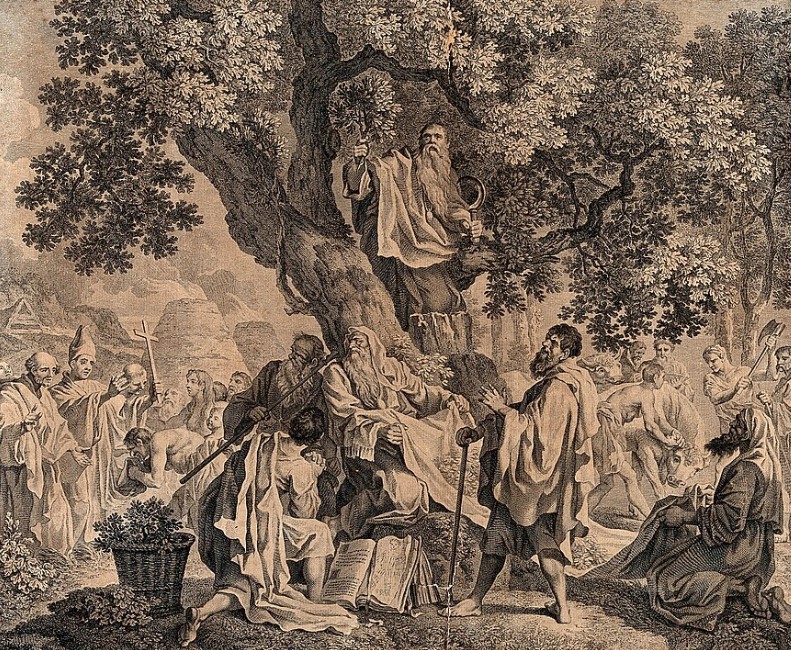
“A priest arrayed in white vestments climbs the tree and, with a golden sickle, cuts down the mistletoe, which is caught in a white cloak… They believe that mistletoe given in drink will impart fertility to any animal that is barren and that it is an antidote to all poisons”. [23]
Brookweed (samolus) likewise had to be picked in very precise conditions. Pliny says it had to be taken with the left hand by somebody who was not allowed to look behind them. [24] Markale suggests that the very careful way in which the druids handled the plants points to their use of homeopathy, in which the slightest interference with their natural qualities could undermine their effect. [25]
As far as trees were concerned, he explains: “The yew, the hazel, the service tree and the oak are druidic trees, used by the druids” [26] – indeed, Maximus of Tyre, a Greek philosopher of the late second century BC, wrote that the druids regarded the oak as a “visible representation of divinity”. [27]
Markale also points us to Cad Goddeu (‘The Battle of the Trees’), a medieval Welsh poem in the Book of Taliesin which tells how the legendary enchanter Gwydion brings the trees of the forest to life so they can fight as his army – a theme later taken up by William Shakespeare in Macbeth. [28]
And he invokes Blodeuwedd (‘Flower-Faced’) the (ultimately tragic) woman from Welsh mythology (The Mabinogion) who was made from the flowers of broom, meadowsweet and oak by Gwydion and another magician. [29]
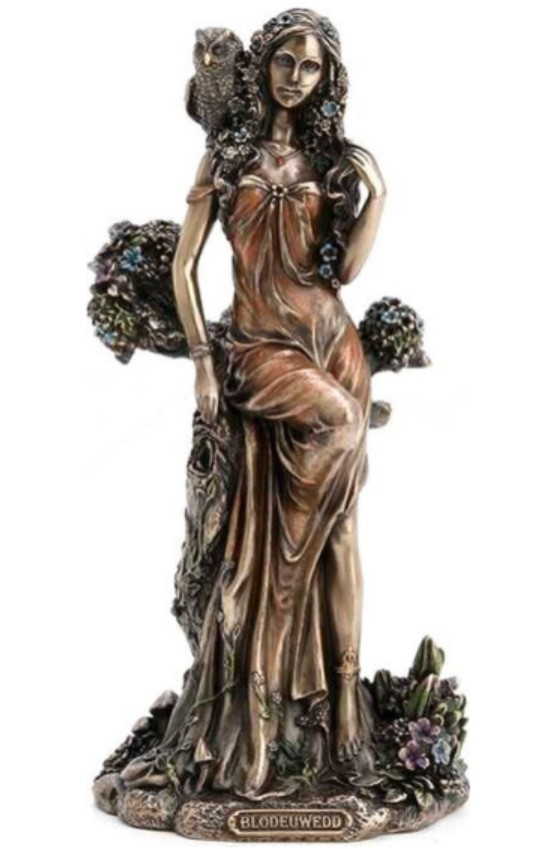
Markale argues: “The ‘fabrication’ of Blodeuwedd, the ‘battle of the trees’, the druids’ vegetal medicine, the care that the druids took in picking certain plants, the relationship between ‘wood’ and ‘knowledge’, druidism’s familiarity with vegetal nature, vegetal ‘magic’ – all of that cannot be the result of idiotic superstitions. There must be something underlying it”. [30]
He has a theory as to what this was about: “The principle of biodynamics is not recent. Traditional alchemy was not only interested in the mineral realm: it is a question of a vegetal stone parallel to the mineral one.
“And to make this vegetal stone, you have to concentrate the vital energy of plants and get rid of the gangue [useless material] which prevents it from being active… The aim is to free the energy contained in the vegetal, which is asleep and thus invisible and impossible to detect in the normal way…
“Are walking and fighting trees not symbolic visual representations of the use of vegetal energy? Is the birth of Blodeuwedd, made from plants, not the representation of the use of energy contained in vegetal matter which is capable, once released, of giving birth to a new being?
“After all, we are what we eat and we are only alive because we borrow vital force from the vegetal (and animal) by ingesting and digesting. Why would there not be methods other than the phenomenon of digestion?” [31]
And he homes in on the special role of mistletoe in the druids’ ancient biodynamical system.
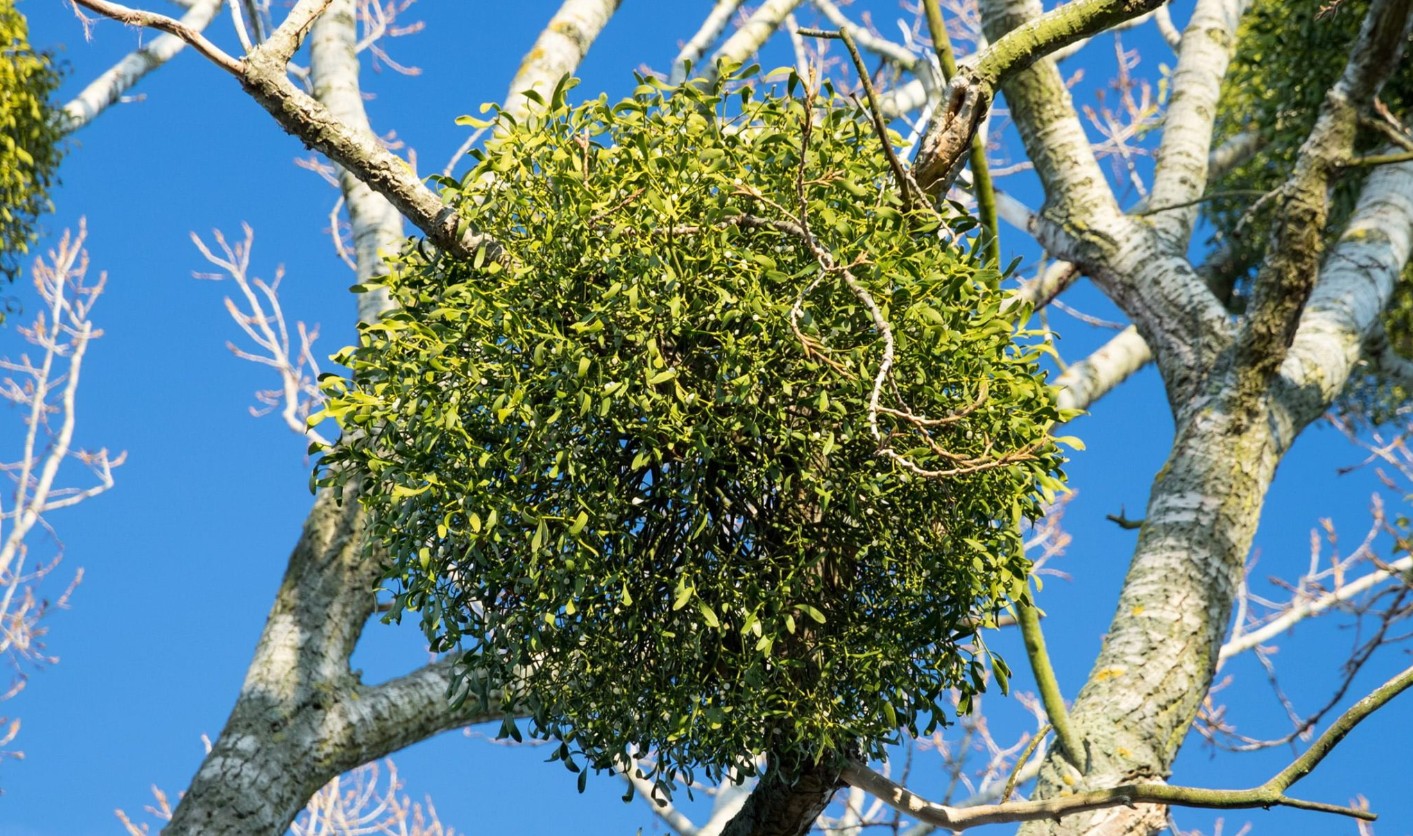
“Mistletoe is, in fact, an extraordinary plant. It is a parasite. It is, in a way, a vegetal vampire which feeds on the blood of others. In truth, it survives by drinking the sap of the tree: it is really an ‘oak-water’. Moreover, we know that mistletoe is one of oldest plants on our planet, perhaps one of the first to have appeared and, in any case, that it is a survivor of a distant era in which conditions of life were not like our own.
“We have to conclude that mistletoe has survived different phases of evolution and that it adapted to new circumstances: it was a matter of life and death. No longer being able to draw its vital energy from the earth, like other plants, it fixed itself to other vegetation and takes that vital energy as its own. In this way, the mistletoe liberates the energy of the oak and makes use of it”. [32]
“Since the oak represents the divine force, cosmic energy, even when it is symbolically replaced by another tree, mistletoe, oak-water, is the very essence of divinity.
“The care with which the mistletoe was picked and what was then made from it, that kind of ‘magical potion’, indicates the druids’ constant search for contact with superior powers, contact which takes the form of an assimilation, a veritable digestion of these powers. It really does amount to integrating divinity into the human, and, in fact, to incarnating god”. [33]
Our connection to nature and its vital energy is thus also our connection to the divine living cosmos and the Great Mystery that guides its becoming.
In the fourth of these five articles exploring Markale’s book, we will look at the way in which ancient Celtic thinking was completely different from the classic Roman and Greek approach – and of course from the modern mindset.
Previously in this series:
For a future inspired by the past
Life: a sacred and heroic mission
[1] Jean Markale, Le druidisme: traditions et dieux des Celtes, (Paris: Payot, 1985), pp. 154-55. All translations are my own and all subsequent page references are to this work, unless otherwise stated.
[2] p. 27.
[3] p. 164.
[4] p. 157.
[5] Lucan, Pharsalia, I, 452 sq, cit. p. 157.
[6] p. 158.
[7] Paul Cudenec, ‘For a future inspired by the past’, https://winteroak.org.uk/2026/07/13/for-a-future-inspired-by-the-past/
[8] p. 117?
[9] p. 158.
[7] Paul Cudenec, ‘Spiritual roots entwined’, https://winteroak.org.uk/2026/07/17/spiritual-roots-entwined/
[10] p. 218.
[11] p. 220.
[12] p. 221
[13] Ibid.
[14] ibid.
[15] pp. 221-22.
[16] p. 225.
[17] Ibid.
[18] Ibid.
[19] pp. 225-26.
[20] Paul Cudenec, ‘Life-rooted thinking’, https://winteroak.org.uk/2026/06/26/life-rooted-thinking/
[21] p. 45.
[22] Marcus Tullius Cicero, De Divinatione I, 40, cit. p. 18.
[23] Pliny the Elder, Naturalis historia, XVI), cit. p. 161, plus https://en.wikipedia.org/wiki/Ritual_of_oak_and_mistletoe#Account_by_Pliny_the_Elder
[24] p. 163.
[25] p. 162.
[26] p. 164.
[27] Maximus of Tyre, Dissertationes, VIII, 8, cit. 164.
[28] p. 166.
[29] p. 167, plus https://en.wikipedia.org/wiki/Blodeuwedd
[30] p. 168.
[31] pp. 169-70.
[32] p. 171.
[33] pp. 171-72.
 winter oak
I was unable to post my comment so I try it here
Thanks again Paul for this interesting article. I can relate to both Druids and Celtics and their achievements regarding Nature. Celtic settlement were found near my Hometown Oberursel in Germany and many more places in the wider area. https://www.altwege.de/roemer-und-kelten/keltische-und-germanische-siedlungsgebiete.html
I’m living in Cambodia and have since learned a lot about the value of nature which of course is under attack around the Globe. But the knowledge of plants remains deep routed making it easier for me to learn. Much here reminds me of the Amazon Tribes regarding their knowledge about the power both medical and spiritual. Neighboring Thailand worships huge old trees by wrapping colorfull fabrics around the stem. People that build a home erect Spirit Houses for the tree that had to be chopped down for the House. The tree spirit is part of the family and gets daily food,drinks and occasionally a cigarette and a shot if rice wine.
I now work a plot of land and planted trees like teak and some which have a canopy that’s 30 meter wide working as a life Aircon. Sweet potatoes and Moringa , a truly magic plant for health https://www.mskcc.org/cancer-care/integrative-medicine/herbs/moringa-oleifera as well as coconuts, mango and sweet small local bananas that always carry seed inside.
The journey I call back to the future became my live engine at 78 years of age. Keep going Paul. Your spirit is truly exceptional
Sent with Proton Mail secure email.
LikeLiked by 1 person
Thanks. Your project sounds magical indeed!
LikeLiked by 1 person
What a great reply to another fascinating piece by the excellent Mr Cudenec, thanks. I’m currently planting lots of native trees on my smallholding here in Southern Brazil, and share your passions.
LikeLike
Interesting as always.
We are what we eat indeed – all that plastic wrapped around food products and now the revelation that our bodies contain plastic has to be related but don’t forget that all modern medicine is derived from petroleum – no thanks to the Rockerfellers war on natural medicines.
I’m about to go into hospital soon, they said it was urgent now I’m just waiting on the call – I dread it but I know the drill and the questions they’ll be asking like are you allergic to anything, to which I shall reply, yes I’m allergic to all petroleum based medicine.
Up on a maintain, old growth forest all around , there’s got to be some mistletoe around here somewhere…
F
LikeLiked by 1 person
Personally, I think I am allergic to modernity!
LikeLiked by 2 people