Number 107
- That murderous mafia
- Our need for heroes
- Anarcho-authoritarians stranded in 2020
- Degrowth: a threat to the system?
- Ernst Friedrich Schumacher: an organic radical inspiration
- Acorninfo

“We are being ruled by sadistic criminals – all of us, the whole world, every nation, OK? A gang of demented psychopaths rule over us and their solution to being caught doing psychopathic things is to murder us”.
So said American podcaster Candace Owens on November 19 2025.
A few days later she made the claim – one of the most extraordinary things we have heard in these surreal times – that Emmanuel and “Brigitte” Macron are actively trying to have her murdered by a crack military unit.
While this may turn out not to be true, the suggestion is not, per se, as ridiculous as some might imagine, as the French presidential couple are very much part of the Rothschildian zio-satanic imperialist mafia, ZIM.
That’s what a mafia habitually does, after all. It “takes out” its opponents.
Owens was getting very close to showing a connection between “Brigitte” and nefarious deep state activities in the USA when her friend Charlie Kirk – who had acted as an intermediary for the Macrons’ demands, via Donald Trump, that she stop investigating them – was assassinated.
Her subsequent investigation of his death and her linking together of paedocriminality, Zionism, political corruption and the military-industrial complex – not to mention the allegedly fake identity of “Brigitte” – would seem to have demanded a more urgent response than that of the lawsuit already launched against her by the Macrons, pictured here with David de Rothschild.

The seriousness of the attempted “hit” against her, if confirmed as genuine, could hardly be more serious for either France or the USA.
But, at the time of writing, we have witnessed a deafening political paralysis which strongly suggests that neither nation-state actually exists in any meaningful sense.
What is happening behind the scenes? Are there senior officials in both countries who feel that the time has now come to act against the global criminal network that really runs their so-called “democracies”?
Or are they all in on it, too? How deep does the rot go? How solid is the mafia’s power? Are we seeing the moment when it finally cracks or will it merely double down on its murderous tyranny?
We are about to find out.

“Destiny is not a divine will that manipulates us, it is the courage to trust and follow that intuition, that deep feeling that traces our path, it is recognising the signs, it is the possibility of weaving it with our own hands when we fulfil our Being”.
These are the words of Italian dissident Silvia Guerini in a powerful new essay, Le lacrime dell’eroe, about heroism and the very non-modern idea of sacrificing oneself for an idea.
She writes: “It is vital to build paths in the union of free spirits to resist the transhuman advance, otherwise, tomorrow, there will be no men and women capable of even understanding a worldview other than that of the laboratory world, and all our words, our ideas, our principles, our values will be lost like sand in the wind.
“When everything is turned upside down, we must have firm points of reference, we must not lose our bearings, we must recognise false critics and storytellers of nothingness in order to counter the advance of the modern world, which continues with new guises and multiple techno-scientific developments that penetrate every dimension.
“A clear line of demarcation and insurmountable ethical limits must be drawn. To give in is to open a crack that becomes a chasm.
“We are reaching the final stage; after this, there will be no rebirth, there will be no more human beings – our very essence is at stake, as well as that of nature and life”.
3. Anarcho-authoritarians stranded in 2020

“Masks required”.
Could this statement really be featured on the website advertising an event due to take place in December 2025?
Yes, unfortunately, it could!
And it was worse still, until the organisers felt obliged to change the wording due to criticism.
The original “COVID PROTOCOLS” diktat for 2025 stated, in capital letters: “DO NOT ENTER IF YOU ARE EXPERIENCING ANY SYMPTOMS OF ILLNESS, have tested positive recently, or know or suspect you may have been exposed prior to the book fair. Please go home and take care of yourself. WEAR A MASK OUTDOORS, WITHIN 15 FEET OF THE VENUE”.
What makes all this even more absurd is that those responsible are pseudo-anarchists who pretend they are fighting for freedom!
The whole theme of The Howard Zinn Book Fair in San Francisco is promoting “actions against authoritarianism” and the site declares, without a whiff of self-awareness: “In the midst of a rising authoritarian tide, millions of people around the world are taking a stand against tyranny”.

Food Not Bombs co-founder Keith McHenry told The Acorn: “I visit San Francisco pretty often and attend concerts that are packed with people and no one wears a mask so this isn’t a liberal San Francisco thing.
“This is an anarchist thing. The Bay Area Anarchist Book Fair also has this same policy.
“The only thing I can think of is the anarchist community was very infiltrated and a massive PSYOPs was implemented because nothing could be farther from the ideas of anarchism than this.
“The authoritarian governments aren’t even forcing them on us now and it must be obvious to anyone that these protocols do nothing to protect anyone.
“Nearly everyone I know who has followed them has contracted COVID. Most of us who smelled a rat when those in power came up with these lame ideas and refused to bend to their crazy rules never contracted COVID or, if they did, it passed like the flu.
“They say they are organizing this in honor of A People’s History of the United States by Howard Zinn, a book I happen to be included in.
“I was also a good friend of Howard Zinn, knowing him from 1976 until his death. I would never submit to such authoritarian stupidity and while Howard would be nice about it he most likely would also be shocked to learn that our fellow anarchists have become more authoritarian than the authoritarians”.
4. Degrowth: a threat to the system?
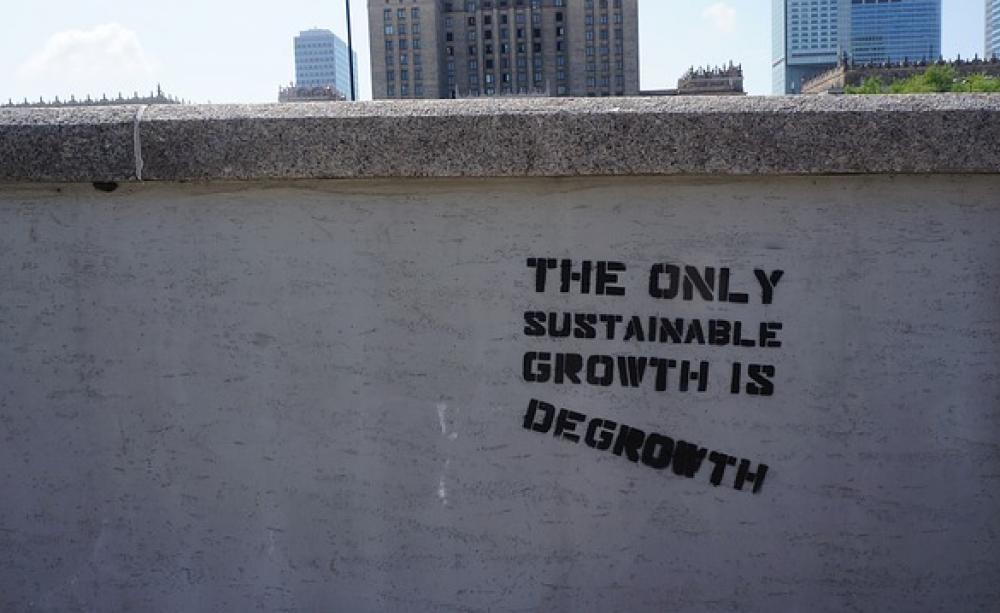
Is the degrowth movement now the greatest single threat to the continuation of the “growth”-obsessed system?
La Décroissance (‘Degrowth’) newspaper in France puts the question to some writers and academics involved in the field in its November-December 2025 edition.
And it explains that the issue has arisen because of the extraordinary amount of rhetoric being deployed against degrowth by the political classes.
President Emmanuel Macron has declared that “we are fighting degrowth”, with one of his ministers calling for degrowth to be “got rid of”.
Another political party even declares in its manifesto: “We are fighting the partisans of degrowth”.
Historian Laure Teulières remarks that this opposition has in the past been condescending – depicting degrowth as being out-moded, unrealistic and cranky.
“But now, it’s undoubtedly rather the figure of ‘the enemy within’ that is being evoked by certain public officials and media personalities”.
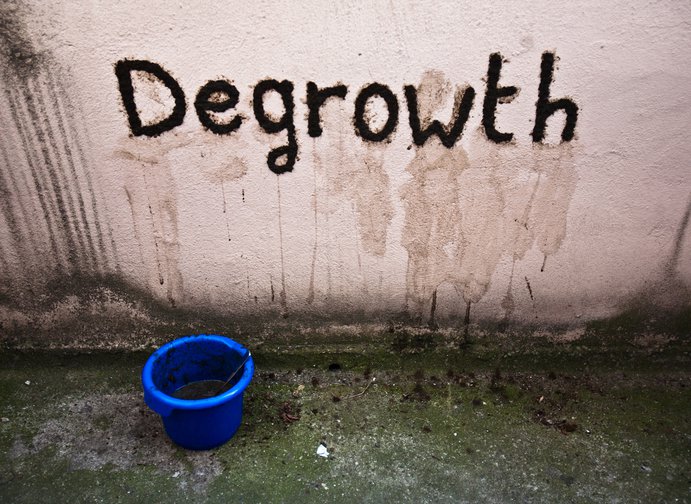
Academic Bruno Villalba says: “We are looking at the fairly classic logic of disqualifying an ideological counter-proposition…
“You are allowed to talk about environmentalism so long as it is not the kind that fundamentally challenges the very organisation of the production-based economic system”.
He says that the authorities do not appreciate initiatives showing that it is possible to live otherwise.
“This is particularly true when these movements use fairly radical approaches, such as civil disobedience, to experiment with these ways of living or to oppose nature-destroying policies.
“In the state’s thinking, this is a threat. Hence the term ‘eco-terrorism’, as used by [minister for justice] Gérald Darmanin, who presents environmental activists as, inherently, a danger to the rule of law, to representative democracy, to the liberal economy and even to the population as a whole…
“The semantic slide (equating environmentalism with terrorism) precedes the legal change”.

“It is easy to designate degrowthers, who adopt a radical position, as being disruptive agents, just like far left groups.
“The authorities do not have to argue or engage in any debate on the actual issue, they just deploy certain stereotypes so as to completely disqualify the whole of a movement’s political proposals on the basis that it has a minority view, that it goes against everything legitimised in the public realm: competition, progress, growth as the bringer of well-being…”
Adrien Plomteux, a researcher at University College in London and editor of Degrowth Journal, comments that it is “inevitable and even a good sign that a movement that sees itself as subversive should be regarded as a public enemy”.
But he is sceptical as to whether the degrowth movement today really represents an enormous threat to the system.
This is partly because it is not really engaged in grassroots resistance, fighting alongside the Gilets Jaunes or defending the ZADs opposing destructive industrial projects.
He also notes, from his experience in the English-speaking world, that the movement has been compromised and partly recuperated.

“Although a caustic criticism of capitalism and its inequalities is always present, other aspects of our societies are less directly attacked – such as productivism, development and Technik”.
Author Philippe Godard points to the way in which the idea of voluntary degrowth is often deliberately confused with the kind of authoritarian austerity imposed by the global system itself.
“In equating degrowth with poverty (in the same way that opposing nuclear power is equated with going back to the candle), our rulers and most of their media are looking at very short term interests, which will lead to the destruction of the planet and the ultra-enrichment of the already ultra-rich”.
He suggests that society needs to start talking to children and young people about the benefits of a simple way of life, outside the infernal trap of consumerism and industry.
“This way of living is in fact written into human beings when they are born. What children need is a healthy, welcoming and attentive environment, not parents stressed out by work, all too frequently absent to the point of neglect and with no time to play with them…
“For 50 years now, radical environmentalism and the idea of voluntary simplicity have hardly been heard in the public debate.
“However, our opponents are playing a tune that is profoundly anti-human, destructive and anti-future. Degrowth is their enemy because it is now the only possible future”.
5. Ernst Friedrich Schumacher: an organic radical inspiration
The latest in our series of profiles from the organic radicals website.

“Infinite growth in a finite environment is an obvious impossibility”
Ernst Friedrich Schumacher (1911-1977) was an economist and political thinker who challenged money-obsessed industrial capitalism and paved the way for the contemporary degrowth movement.
He also called for a metaphysical renewal which would fundamentally change the way people in the Western world saw their existence.
He declared in 1977: “The faith in modern man’s omnipotence is wearing thin. Even if all the ‘new’ problems were solved by technological fixes, the state of futility, disorder and corruption would remain. It existed before the present crises became acute, and it will not go away by itself. More and more people are beginning to realise that ‘the modern experiment’ has failed”. (1)
Schumacher is best remembered for his 1973 book Small is Beautiful: A Study of Economics As If People Mattered and its message that “infinite growth in a finite environment is an obvious impossibility”. (2)

He explained that the idea of unlimited economic growth needed to be seriously questioned on at least two counts: the availability of basic resources and the capacity of the environment to cope.
He wrote: “Economic growth, which viewed from the point of view of economics, physics, chemistry and technology, has no discernible limit, must necessarily run into decisive bottlenecks when viewed from the point of view of the environmental sciences.
“An attitude to life which seeks fulfilment in the single-minded pursuit of wealth – in short, materialism – does not fit into this world, because it contains within itself no limiting principle, while the environment in which it is placed is strictly limited”. (3)
In the face of this we had to look to evolve a new lifestyle, with new methods of production and new patterns of consumption, he said: “a life-style designed for permanence”. (4)
As the title of the book conveys, he also saw it as important to restore a human scale to human self-organisation: “Centralisation is mainly an idea of order; decentralisation, one of freedom”. (5)
Schumacher’s attack on centralisation and the obsession with economic growth went hand in hand with a broader assault on industrial society itself.
He noted in Small is Beautiful that “modern man has built a system of production that ravishes nature and a type of society that mutilates man”. (6)

And he asked: “What is the point of economic progress, a so-called higher standard of living, when the earth, the only earth we have, is being contaminated by substances which may cause malformations in our children or grandchildren?” (7)
He was also very clear in his rejection of techno-fixes which claimed to protect the natural environment but in fact further poisoned or degraded it.
He warned: “Ever bigger machines, entailing ever bigger concentrations of economic power and exerting ever greater violence against the environment, do not represent progress; they are a denial of wisdom”. (8)

Schumacher dismissed critics who assumed that a post-industrial society would necessarily amount to some kind of raw “primitivism”, reminding his readers that the Taj Mahal was built without electricity, cement and steel, as were all the great cathedrals of Europe. (9)
His rejection of industrial capitalism went deeper than its physical infrastructures and challenged the ways of thinking which had allowed it to gain its stranglehold on our lives.
One of these was the obsession with the idea of paid “work” – of any kind, no matter how pointless or harmful – as being an essential bulwark of everyone’s existence.
He explained: “That soul-destroying, meaningless, mechanical, monotonous, moronic work is an insult to human nature which must necessarily and inevitably produce either escapism or aggression, and that no amount of ‘bread and circuses’ can compensate for the damage done – these are facts which are neither denied nor acknowledged but are met with an unbreakable conspiracy of silence – because to deny them would be too obviously absurd and to acknowledge them would condemn the central preoccupation of modern society as a crime against humanity”. (10)

Our separation from nature was, of course, another key problem: “Modern man does not experience himself as a part of nature but as an outside force destined to dominate and destroy it”. (11)
All of this was related to the loss, in industrial capitalist society, of what he referred to as “the traditional wisdom of mankind”. (12)
As well as being inspired by the decentralist, degrowth economic ideas of Mohandas Gandhi and Leopold Kohr, Schumacher was also influenced by the metaphysical critique of modernity voiced by the perennialist tradition.
He explained in A Guide for the Perplexed that he had taken the term “the Reign of Quantity” from René Guénon, “one of the few significant metaphysicians of our time”, (13) and in Small is Beautiful he quoted both Aldous Huxley and Ananda Coomaraswamy.
It was this aspect of Schumacher’s thinking which lay behind his judgement that “while wealth may still be accumulating, the quality of man declines”. (14)
It also informed his criticism of the one-dimensionality of modern thought, in contrast to the “three-dimensional structure” (15) of traditional wisdom.
Contemporary society rejected ideas of “higher” or “lower” degrees of quality in favour of judgements based purely on quantity.
And yet the idea of something being “higher” was almost universally used in traditional ways of thinking across the world, he said: “‘Higher’ always means and implies ‘more inner’, ‘more interior’, ‘deeper’, ‘more intimate’; while ‘lower’ means and implies ‘more outer’, ‘more external’, ‘shallower’, ‘less intimate’. This synonymity can be found in many languages, perhaps in all of them”. (16)

It was also at the root of our ethical judgements, which regarded good as being a “higher” quality than evil, argued Schumacher.
He observed: “The modern world tends to be sceptical about everything that demands man’s higher faculties. But it is not at all sceptical about scepticism, which demands hardly anything”. (17)
The scientific materialist approach to all areas of thought had made our society incapable of grasping the meaning behind things, he said. Its flat and fragmented analysis meant people could only ever see the trees, rather than the wood.
He remarked: “To say that life is nothing but a property of certain peculiar combinations of atoms is like saying that Shakespeare’s Hamlet is nothing but a property of a peculiar combination of letters”. (18)
Schumacher said we needed to make full use of what he called our intellectual senses, adding: “Without them, we should be unable to recognise form, pattern, regularity, harmony, rhythm and meaning, not to mention life, consciousness and self-awareness”. (19)
He insisted that a metaphysical reconstruction was needed to restore our lost wisdom and lead us out of the dead-end of industrialism: “We are suffering from a metaphysical disease, and the cure must therefore be metaphysical”. (20)

In Small is Beautiful he demonstrated the connection between his metaphysical and his political views by proposing “Buddhist economics” as a possible way forward, but made it clear that this was really a question of reactiving universal ancient wisdom, the Old Gnosis as prescribed by Theodore Roszak among others.
The essential point was for humankind to turn its back on “the hollowness and fundamental unsatisfactoriness of a life devoted primarily to the pursuit of material ends, to the neglect of the spiritual” (21) and “the pretence that everything has a price or, in other words, that money is the highest of all values”. (22)
What we needed, said Schumacher, was a “metanoia”, (23) a turning around from the brink of civilizational catastrophe.
Video link: E.F. Schumacher on Buddhist Economics (3 mins)

1. E.F. Schumacher, A Guide for the Perplexed (London: Jonathan Cape, 1977), pp. 152-53.
2. E.F. Schumacher, Small is Beautiful: A Study of Economics As If People Mattered (London: Abacus, 1974), p. 40.
3. Schumacher, Small is Beautiful, p. 23.
4. Schumacher, Small is Beautiful, p. 16.
5. Schumacher, Small is Beautiful, p. 203.
6. Schumacher, Small is Beautiful, p. 246.
7. Schumacher, Small is Beautiful, p. 116.
8. Schumacher, Small is Beautiful, p. 27.
9. Schumacher, Small is Beautiful, p. 182.
10. Schumacher, Small is Beautiful, p. 30.
11. Schumacher, Small is Beautiful, p. 11.
12. Schumacher, Small is Beautiful, p. 250.
13. Schumacher, A Guide for the Perplexed, p. 135.
14. Schumacher, A Guide for the Perplexed, p. 67.
15.Schumacher, A Guide for the Perplexed, p. 20.
16. Schumacher, A Guide for the Perplexed, p. 43.
17. Schumacher, A Guide for the Perplexed, p. 71.
18. Schumacher, A Guide for the Perplexed, p. 29.
19. Schumacher, A Guide for the Perplexed, p. 50.
20. Schumacher, Small is Beautiful, p. 83.
21. Schumacher, Small is Beautiful, p. 31.
22. Schumacher, Small is Beautiful, p. 38.
23. Schumacher, A Guide for the Perplexed, p. 153.

“The ruling class wants us to believe digital ID is inevitable. But inevitability is the language of power. Systems of domination can be resisted, sabotaged, dismantled. The struggle against digital ID is not about nostalgia for the days of paper documents; it is about defending the very possibility of living without being constantly monitored, verified, and reduced to data. What is at stake is not simply privacy, but freedom itself”. A strong and authentically anarchist message from the Aotearoa Workers Solidarity Movement.

* * *
“Nepal, Morocco, Madagascar, Indonesia, Peru… In recent months and weeks, massive demonstrations, riots, and even regime changes have taken place in various countries around the world, breathing new life into our most fervent hopes!” Some encouraging news of resistance against the global system from Mauvais Sang via Tridni Valka.

* * *
“Some might find it strange that the EU (Satanic West) and BRICS members (our multipolar saviors) would work together to integrate their carbon markets. But it is not so strange if you stop and think about it. Turning carbon, an essential element for all life on Earth, into a tradable commodity probably won’t protect the environment or prevent Category 5 hurricanes or whatever, but it’s very profitable for Goldman Sachs, and at the end of the day, isn’t that what really matters?” The Edward Slavsquat blog continues to destroy the BRICS myth. It’s all one big evil empire!

* * *
“The UK is actually a test case for global governance. If they can do it here, they are then going to export that everywhere else” – Ben Rubin in his consistently excellent slot on UK Column News.
* * *
The age-old right to trial by jury is currently under threat in the UK and no more so if you dare to oppose Zionism. As Craig Murray reported on his site, those charged with terrorism for supporting Palestine Action will have no jury in trials limited to 36 minutes each, with prison sentences of up to six months – “Starmer’s Fascist Mass Courts” as he put it.

* * *
“That’s why they don’t want me to say it. I think once you say ‘Jewish supremacy’, you name the actual problem, you name what’s driving it, you name the beneficiaries, you name the direct perpetrators”.
Excellent interview of Dr Rahmeh Aladwan by the Attrition podcast.

* * *
“We now live under ziocracy. The US is occupied and the occupation of Palestine will not end, the Israeli attacks on Palestinians and other neighbors will continue, and Israel will continue to hold us hostage, until the Zionist occupation of America is overthrown”. Michael Rectenwald is not mincing his words.

* * *
“There is a Jewish supremacist billionaire class which is exerting a huge amount of power and muscle – up front and behind the scenes”. Norman Finkelstein in conversation with Candace Owens.

* * *
“If you have a democratic republic whose government is not acting on behalf of the citizens, you don’t have a legitimate government – that’s grounds for overthrowing the government, actually!” Tucker Carlson is, of course, talking about the USA, but this applies to any country occupied by ZIM, the zio-satanic imperialist mafia.

* * *
“MI5+6 ran the entire Irish ‘Troubles’ of 1968-98 as a ‘New Thirty Years’ War’, so as to study terrorism and its media impact, and better prepare the Zionist War of Terror of 2001-20”. Startling analysis from Patrick O’Carroll.

* * *
“For decades, the Zionist entity has been the illicit organ trade’s international nucleus. While Palestinians have long raised alarm over Tel Aviv’s theft of their fallen comrades’ organs, it was not until the early 2000s that the practice was officially admitted. Yehuda Hiss, head of Israel’s Abu Kabir Institute, openly boasted of harvesting skin, bones, and other human materials during autopsies”, writes journalist Kit Klarenberg. He adds: “Grotesquely, organ trafficking might represent one of Tel Aviv’s few dependable profit sources at this stage”.

* * *
“What we do is two-pronged. One is to offer the kind of challenge to the system that, unlike street protests, can fly for a fair bit longer under the radar before the state and the corporations take notice and try to crush us. The other is to start meeting our needs and living in a way that suits our needs and aspirations”. Dave Amis of At the Grassroots spells out what useful resistance might look like.

* * *
“The anti-industrial critique does not deny the class struggle, it preserves and surpasses it and, moreover, class struggle cannot exist in today’s world other than in the form of anti-industrial struggle”.
Miguel Amorós, Elementary Foundations of the Anti-Industrial Critique
(For many more like this, see the Winter Oak quotes for the day blog)
If you like this bulletin please tell others about it. Subscribe by clicking the “follow” button.
—–
Back Issues
Follow Winter Oak on Twitter at @WinterOakPress
 winter oak
Keep your excellent work going, the air is good.
LikeLike
Thanks
LikeLike
Although metaphysics was not one of the topics specifically discussed during the recent jaw-dropping discussion between Santa Fe, Arizona Sheriff David Hathaway and Judge Andrew Napolitano, one suspects Sheriff Hathaway’s philosophical study/knowledge was the impetus which led him to send his hand-written letter of introduction to Judge Napolitano.
See: https://onenessofhumanity.wordpress.com/2025/11/20/sheriff-david-hathaway-venezuela-poses-no-threat-to-the-united-states/
Peace.
LikeLike
Just watched it. Interesting – thanks!
LikeLike