Number 77
- Death to the Metaverse!
- We have forgotten The Feeling of Tribe
- Save Worth Forest!
- Theodore Roszak: an organic radical inspiration
- Acorninfo
by Paul Cudenec
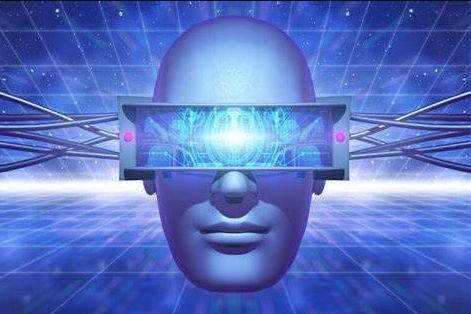
We are increasingly being forced to spend our lives in a virtual reality.
Global power has used Covid to get us all used to online work, to QR codes, to the need for a digital identity in order to access state services and our bank accounts.
This process, aimed at locking us down in a panopticon of constant surveillance and total control, is set to rapidly accelerate in the years to come if we don’t manage to stop it.
We are being pushed towards a Chinese-style social credit system, where everything that we consume and do in life is measured, calculated and evaluated by the authorities, with conformity rewarded and dissidence punished.
This totalitarian nightmare is already being rolled out in Europe with the digital identity wallet championed by European Commission president Ursula Von der Leyen.
The Italian cities of Rome and Bologna are launching a “smart citizen wallet“, based on the supermarket loyalty card model.

And in France, authorities in Sarthe announced that they are going to distribute smart bracelets to all 30,000 middle school pupils under the pretext of combatting sedentary lifestyles.
Yahoo! news reports: “The initiative has already been tried out in a school in Le Mans, where the bracelets in question were given to the children as Christmas presents. Once on their wrists, the bracelets were to stay there for duration of their four years of education in that establishment”.
The global mafia have invented a new word to describe this virtual concentration camp: the Metaverse. Facebook has thus already changed its name to Meta and numerous other big businesses are linked to the project.
According to Bloomberg, the Metaverse market could explode to become twenty times bigger than today by 2024, so in under two years.
Ark Invest and Grayscale estimate that revenues generated by the Metaverse could quickly reach a trillion dollars.
Various capitalists and speculators are saying that investing in the Metaverse today is like buying shares in Apple in 1980.
 But what exactly is the source of all these enormous anticipated profits? What is the product, do you think, that is going to allow the richest and most powerful people in the world to become even richer?
It’s us! It’s our lives, our futures, our children!
We already know that personal data has become the new gold of the digital era: big data makes big money!
In the sinister world of the Metaverse, all our various data will be united within one single digital identity.
From that point on, our existence in the real world will serve only to feed the digital version of our life, our avatar, our virtual twin. It’s this virtual twin, turned into a product, from which the financial parasites want to profit.
They have already invented an “impact” investment system, which consists of privatising all public services, whether that be education, health or social care.
More than that, it allows financiers to speculate on the results of their investments. And note, please, that they might bet not just on their success but also on their failure!
In fact, they have a vested interest in never resolving all the various problems that their investments are supposed to address, because the persistence of these problems guarantees sustainable profits for those who want to sell the “solutions”.
The Metaverse is about reducing people to the status of objects, of casino chips, of human capital exploited by technocrat vampires.
 And even if corporate greenwashing tells us that this world to come will be 100% sustainable, any common sense we still possess will tell us that this is very far from being so and that the production of all the technological infrastructure needed for the Metaverse, as well as the electricity to power it, will cause untold damage to the natural world.
This infrastructure depends on an ubiquitous 5G or 6G network, meaning we are faced with the depressing prospect of an Earth disfigured by masts, of the air polluted by microwaves and the sky cluttered with satellites.
There is no room for nature in the Metaverse.
Nor for reality.
Nor for humankind, our values and our lives.
The Metaverse is a world of artifice, sterility, emptiness and toxicity, built on a pathological craving for ever more wealth, power and control.
The Metaverse means death.
So death to the Metaverse!
2. We have forgotten The Feeling of Tribe
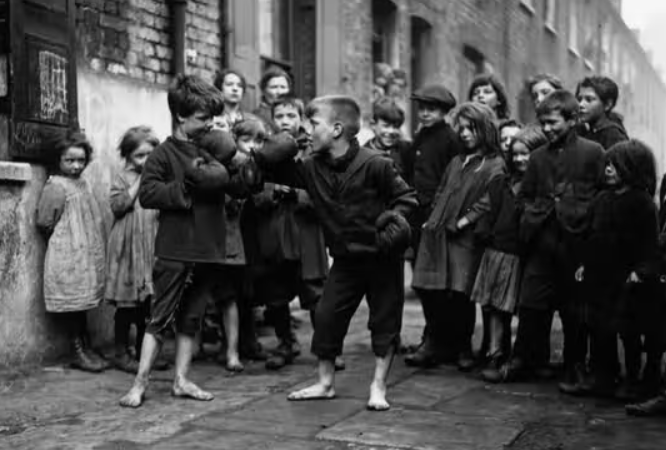
What does it mean to ‘be a tribe´?
It means to share a feeling.
It’s a feeling of connection with each other, a feeling of unity.
It’s how I imagine birds feel when they fly as a flock!
It’s the feeling of knowing and accepting each other, with all of our quirks – and being
known and accepted.
It’s the feeling of being united in a commitment, of being united in creativity, of sharing a common aim.
Sounds great! Why don’t we co-create tribes then?
Yes, there’s the fact we´re all so busy – that we have no time.

Yes, there’s the fact that we moved away to get a better job, and that we lost touch with our childhood friends.
Yes, there’s the fact that we don´t get on with our family, or that we don’t even know our neighbours’ names…
But, in my opinion, the greatest and most fundamental obstacle to co-creating tribes is that we have forgotten The Feeling of Tribe. We have become so accustomed to social fragmentation, so accustomed to individualisation – that we just don’t miss it. We don’t long for it. We don’t long for each other. We don’t long to be close to each other, and travel together through life… We have been dull and disconnected for so long, for so many generations, that we are used to it – we don’t even dream of the happiness of deep connection with each other and the earth and the sky any more.
This is the greatest obstacle to the revolutionary impulse so many of us agree on – the impulse towards decentralised, nature-based, conscious, caring community: we agree on everything intellectually, but we don’t FEEL it! Our guts aren’t churning with longing. We are not desperate for it. And revolutions aren’t driven by the intellect, they are driven by guts that churn!
We can visualise disenfranchised, indigenous peoples, addicted to this and that – uprooted from the deep soulfulness of their ancestral traditions – rotting on reservations. We don’t understand that we are those indigenous peoples, and that the cities are our reservations.
We don’t miss the birdsong at dawn, because we haven’t heard it for generations. We don’t miss the unbreakable bond of brothehood and sisterhood, because it’s been shattered for generations. We don’t feel the need to make a passionate stand for all that says “yes!” to life, because we’ve been living comfortably numb, half dead, for generations.
And yet, and yet – despite it all… Despite the disatrousness of our collective situation –
echoes of The Feeling of Tribe reach us nonetheless. Odd, familiar, long-forgotten scents waft across our consciousness…
Sometimes it’s on the dancefloor… Sometimes we feel the music moving us all – and for a
while, we know we are one. Sometimes it´s in the locker room, getting changed for a sport – we feel part of the team, we belong – and we feel united in a common aim.
Sometimes – haunted by the loss of self – we attend a self-development workshop. The people there are vulnerable. We see ourselves in each other – and we are a community, a tribe, for a weekend.
I´m sure, if you take a moment to let your heart remember, you’ll come up with your own moments of remembering – times when you too, for a while, touched and knew The Feeling of Tribe…
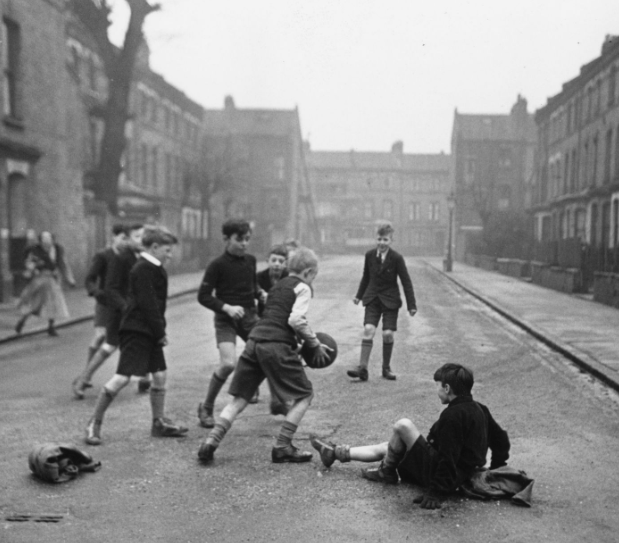
And yes, there are terrible tribes – there are fundamentalist tribes, and fascist tribes, and tribes of all sorts – and we have to carefully consider the quality of the tribes we now craft. But this where it starts: with the remembering. With the longing. With feeling the need.
That tribe is the way – many, many of us already agree. But very, very few of us actually gather and focus and unite and embark on the path of becoming a tribe… We aren’t motivated. We have forgotten the beauty of belonging. We have forgotten the gloriousness, the freedom. We have forgotten the comfort, the sense of security, the love. We have forgotten the joyous feeling of shared meaning and purpose – of how enlivening that is…
So what to do?
Do it!
Form a tribe. Co-create a tribe. Become a tribe.
That, as far as I can see, (dare I say it) is the only way to truly reawaken The Feeling of Tribe: to be in one. That’s the way to bring the memories in the collective heart back to life.
It’s not by talking about the importance of tribe. It’s by acting on those small echoes, those short flashes of homecoming – those intuitions of our birthright – of belonging, and togetherness, and joy!
Catalunya, 2022
www.markthemysticactivist.com
t.me/soultribes
by Jan Goodey
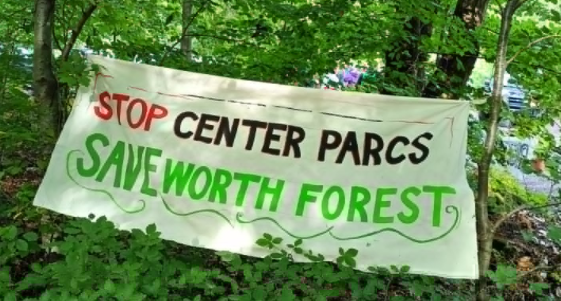
The second mass trespass in two years to take place in Sussex saw around 275 people protecting ancient woodland from a Center Parcs development.
This follows on from the Landscapes of Freedom mass trespass demanding access to, and an end to blood sports on, Brighton and Hove City Council-owned land which attracted more than 300 people back in July 2021.
This time it was on the outskirts of south London, right next to Crawley, where the biggest forest woodland in Sussex lies.
Worth and neighbouring St Leonards Forest are roughly the size of 6,500 acres Ashdown Forest, famed for AA Milne’s Pooh Bear. Only Worth Forest is a fiercely, privately-owned, little-known gem of ancient woodland, harbouring many great, veteran oak and beech pollards.
The evidence of bloodsports is clear for everyone to see, especially the metal high chairs sitting below trees from which deer are killed.
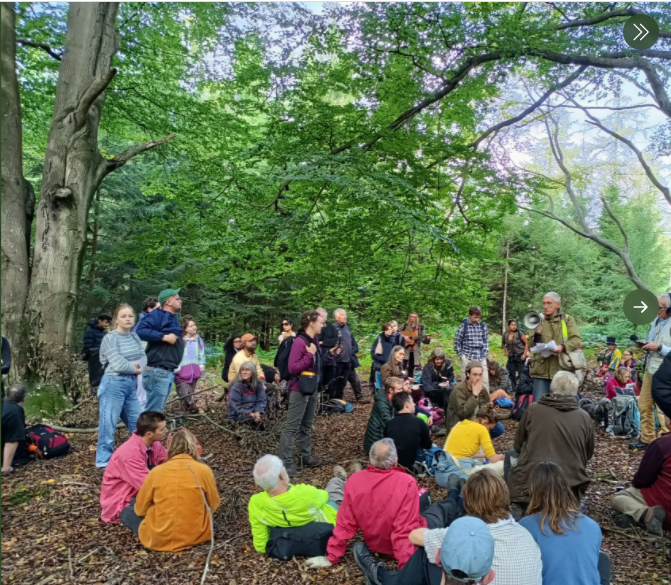
Speakers at the event included Mark from the HS2 protest camps who said: “Trespass is the weapon we use at HS2. They stole our land. The rights of ownership are very, very fragile. Please, please keep trespassing. Make sure you keep our rights and those of our children up there and get us back our land.”
Other speakers included a stand-in for Caroline Lucas MP. In what is essentially an irrelevance, bearing in mind it is direct action alone that will have an effect here with the current government stance on the environment being deregulation, she has tabled a Right to Roam Bill in parliament which seeks to extend current Countryside Rights of Way legislation, making England more like Scotland where rights of way covers the whole of the country not just 8%.
To drive home this last point, Dave Bangs, a leading Sussex botanist and author of The Land of the Brighton Line (containing instructive chapters on Worth Forest) told the assembled gathering:
“60% of Oldhouse Warren [where Centre Parcs wants to build] is forbidden to the public. Yet if you do not know the forest and do not know its beauty and its wildlife we will not know how to fight and defend it. We cannot champion its rare, beautiful, important, weird wildlife and landscape if we’re not permitted to know it, to fall in love with it or to feel we own it. We cannot fight for nature if we do not know it. What the eye doesn’t see the heart will not grieve and that’s why we’re here because if we don’t spend our time in this place and know it and love it we’ll be unable to fight for it in a meaningful way.”

Center Parcs wants to site a 553-acre holiday town of 900 lodges, a ‘subtropical swimming paradise’, a variety of restaurants, shops and a spa; trailed by CEO, Martin Dalby, as: “really exciting”.
Not so exciting for the local ecology, and in the words of Sussex Planning for Nature Group it “would tear the heart out of [this] irreplaceable ancient woodland”.
According to this coalition of conservation groups – Sussex Wildlife Trust, the Woodland Trust, RSPB, the Council for the Protection of Rural England (CPRE) and Sussex Ornithological Society – Oldhouse Warren is home to a number of rare birds including Goshawk, Lesser Spotted Woodpecker and Firecrest – one of Britain’s tiniest. Its ground nesting birds, like Woodcock and Nightjar, have some of their last Sussex refuges here.
The site is also a habitat rich with nationally rare archaeological and ecological features, including a network of ancient rabbit warrens and mound lands, as well as a neighbouring Site of Special Scientific Interest (SSSI), an ancient ghyll woodland.
“It is for this reason that we are asking Center Parcs to reconsider developing here,” the conservation groups have reiterated in an open letter to Center Parcs.
“Ancient woodland is irreplaceable; it takes centuries, more often millennia, for ancient woodland soils to accumulate and the rich connections between soils, plants, animals, and other organisms to develop and evolve.”
Henri Brocklebank is the Director of Conservation Policy & Evidence at Sussex Wildlife Trust. She said: “At this time of [ecological] crisis, it is imperative that places that are recognised through national policy as irreplaceable, such as ancient woodlands, are protected and restored, not dug up to make lodges and concrete swimming pools, let alone all the associated infrastructure, such as new road junctions and utilities that will be required. Allowing Center Parcs to create a new site here goes against all the relevant local policies and plans, not least the [Johnson] Government’s own [lying] commitment to protect 30% of UK land by 2030.”
The leaders of both Mid Sussex District Council, the Tory-controlled planning authority, and Crawley’s Labour-controlled District Council have early on expressed their blind support for the project… citing the local economy and a shift away from the Gatwick jobs monopoly, presumably for one based on ecocide instead.
 According to Dave Bangs: “This forest should be open and free to us all and a haven for nature, like Epping Forest and the New Forest.
“Countryside which should be ours to enjoy for free will be lost, whilst much visitors’ cash will flow into the owners’ coffers.”
He went on to explain how the landowners are members of the Pearson family, descendants of the first fat cat, Viscount Cowdray.
The 6,000 acres plus Paddockhurst Estate was split equally among its remaining seven trustees on Jan 1 2018. Each trustee got an 800 acres plus tranche, plus house. There was a five year moratorium on sales and development.
In terms of timescale this would fit in with the current plans which are slated to be in front of Mid Sussex District Council by 2023.
Center Parcs has already bought an option on Oldhouse Warren for £400,000 plus, although it doesn’t currently own the site.
There is however eco-survey work visibly going on in the area.
This would have to take in the plethora of flora and fauna that Bangs describes thus: “Glow Worms still shine on midsummer nights on the Warren’s open ground. Golden Ringed Dragonflies – the biggest in Britain – and the rare Brilliant Emerald Damselfly…
“Gorgeous spreads of pink Bog Pimpernel and blue Ivy Leaved Bellflower, purple heathers and yellow Tormentil and Marsh Buttercup, Spearwort, survive along the forest rides from the ancient vegetation of the medieval forest. Even the rare native Lily of the Valley – different from our garden variety – survives there.
“The tiny springtime candles of Bog Beacon fungi glow against the black of little swamps and bogs, like the flickering ‘will ‘o the wisp’ that led travellers astray across the moors.
“Fierce-looking Green Tiger Beetles, iridescent Dumble Dor beetles, and Sabre Wasps as big as a child’s hand survive there. All are harmless. All are beautiful.”
You can go to grassroots campaigns Right to Roam and Landscapes for Freedom here and here and watch a short video here.
A version of this article has appeared on the Ecologist website
4. Theodore Roszak: an organic radical inspiration
The latest in our series of profiles from the orgrad website.

“Anarchism has always been, uniquely, a politics swayed by organic sensibility”
Theodore Roszak (1933-2011) was a passionate critic of industrial civilization who called for its domination to be urgently countered by the resurgence of metaphysically-sourced organic radicalism.
He wrote in Where the Wasteland Ends that urban-industrialism had to be regarded as an experiment and, as science told us, experiments could fail: “When they do, there must be a radical reconsideration, one which does not flinch even at the prospect of abandoning the project”. (1)
Roszak acknowledged that because of the scale and domination of industrialism, it seemed unthinkable that it could ever slow down or come to an end.
He continued: “Unthinkable, yes. Almost as unthinkable as it would have been only four generations ago to imagine that we could have created the monster in the first place. But it was of our making. And it is yet ours to unmake and replace”. (2)
 The problem for those trying to challenge the industrial system, and thus prevent environmental catastrophe, was that it had defined itself as the only possible reality.
He explained: “Assured by the experts that the system is technically infallible, morally permissable, and politically realistic, we accept it as a prospectively permanent feature of our lives”. (3)
An important aspect of the system’s propaganda, said Roszak, was technological optimism, “the snake oil of urban-industrialism”, which with each new application rubbed the “addiction to artificiality” (4) deeper into the collective psyche.
This had now reached the stage where people were not only physically distanced from nature, but were no longer even aware that their existence depended on it.
He wrote: “The more artifice, the more progress; the more progress, the more security. We press our technological imperialism forward against the natural environment until we reach the point at which it comes as startling and not entirely credible news to our urban masses to be told by anxious ecologists that their survival has anything whatever to do with air, water, soil, plant, or animal”. (5)
 Roszak noted that the effect of urban-industrialism on our tastes was to convince us that artificiality was not only inevitable, but in fact better than nature.
He even seemed to be predicting the arrival of naturaphobic transhumanist ideology, in 1972, when he asked: “How many members of our own culture would not trade in their natural body tomorrow for a guaranteed deathproof counterfeit?” (6)
Roszak identified a general underlying failure in modern thinking, which had jettisoned any aspiration to holistic understanding and adopted a flattened-out, fragmented, sterile pseudo-scientific approach.
He wrote in The Making of a Counter-Culture: “We learn what one learns by scrutinizing the trees and ignoring the forest, by scrutinizing the cells and ignoring the organism, by scrutinizing the detailed minutiae of experience and ignoring the whole that gives the constituent parts their greater meaning. In this way we become ever more learnedly stupid”. (7)
Unfortunately, this stupidity had even affected political philosophies which were supposedly opposed to the capitalist system which had created industrialism.
Roszak argued that Marxism, the orthodox radicalism of the 20th century, had failed to take issue with the machine-society itself, ultimately serving the needs of technocratic politics. “Marxism is the mirror image of bourgeois industrialism: an image reversed, and yet unmistakably identical”, (8) he judged.
“Marx laid a deadly critical edge against bourgeois social values, but his blade barely scratched the mindscape of science and industrialism”. (9)

Roszak pointed out in The Voice of the Earth that the Marxists displayed the same hostility to the primitive and the traditional as the colonial profiteers.
He wrote: “From Marx’s viewpoint, the goal of progressive politics was to abolish ‘the idiocy of rural life’ and all that predated it in favor of industrial progress.
“Among the political philosophers of the industrial period, only sentimental anarchists like William Morris or Peter Kropotkin held out against this ideological consensus, harking back like the Romantics before them to a legendary state of nature when village democracy and tribal egalitarianism reigned”. (10)
All of this separation from nature, and the sad lack of a movement seeking to change this sorry state of affairs, had led to a deep sense of despair felt both collectively and individually.
Argued Roszak: “Only those who have broken off their silent inner dialogue with man and nature, only those who experience the world as dead, stupid, or alien and therefore without a claim to reverence, could ever turn upon their environment and their fellows with the cool and meticulously calculated rapacity of industrial society”. (11)
“We conquer nature, we augment our power and wealth, we multiply the means of distracting our attention this way and that… but the despair burrows in deeper and grows faster; it feeds on our secret sense of having failed the potentialities of human being”. (12)

The response to this dire situation, in which our experience of life had become “poor in quality”, (13) was to rekindle our sense of belonging to nature: a sense often described as spirituality.
Roszak stressed that what Martin Buber called a You-and-I relationship was not restricted to our dealings with people. We had to establish “a transactional bond with the natural” (14) and rediscover respect for “the sacramental dimension of nature”, (15) because “if the spirit within us withers, so too will all the world we build about us”. (16)
This process of “spiritual regeneration” (17) was also a question of allowing nature – the greater organic entity of which we are all part – to act through us.
In order to reaccess our “inborn ecological wisdom” (18) we had to allow ourselves to be moved and guided by the requirements of the Earth “as if it were our own most private desire”, (19) he said.
“A hypothesis that contends that the great biofeedback system of planet Earth acts upon all its cargo of life in ways that seek homeostasis must at some point weigh the possibility that Gaian politics, including its ecofeminist and mystic ‘extremes’, is among the ways such action finds expression in our species“. (20)
 This radical ecological thinking, channelled into human thought from the needs of the planetary organism itself, would have to “vastly transcend the issues of conventional social justice with which the radicalism of former times filled its now obsolete ideologies”. (21)
Taking a similar historical overview to Charlene Spretnak, Roszak identified Romanticism as “the first significant antitoxin generated within the body of our society” to counter the industrial poison. (22)
Another antitoxin was Deep Ecology, which was an “expression of nature mysticism, based on an alternate, essentially animistic mode of experience”. (23)
This movement had, in the 1970s, been “outflanked” by the ecofeminist movement, he said: “No one could have predicted when Women’s Liberation began in the middle sixties that it would, within a decade, become a principal force in environmental politics”. (24)
For Roszak, only one long-established political ideology had the potential of fuelling the “new radicalism” (25) we so badly needed, in which “quality and not quantity becomes the touchstone of social value”. (26)
 He wrote: “Anarchism has always been, uniquely, a politics swayed by organic sensibility; it is born of a concern for the health of cellular structure in society and a confidence in spontaneous self-regulation”. (27)
Roszak described the 1960s counter-culture as arising from many different sources, including depth psychiatry, “the mellowed remnants of left-wing ideology”, oriental religions, Romantic Weltschmerz, anarchist social theory, Dada and American Indian lore. (28)
He also noted the influence of the perennial philosophy developed by René Guénon, Ananda Coomaraswamy, Frithjof Schuon, Seyyed Hossein Nasr and others.
Indeed, as well as writing about “the perennial wisdom” (29) in Where the Wasteland Ends, he quoted both Coomaraswamy (30) and Nasr. (31)
The importance of this movement was its identification of “a sacramental vision of being” which could be regarded as “the wellspring of human spiritual consciousness” (32) and had given rise to a diversity of traditions across the world.
Added Roszak: “The differences between these traditions – between Eskimo shamanism and medieval alchemy, between Celtic druidism and Buddhist tantra – are many; but an essentially magical world view is common to them all”. (33)
 He used the term “Old Gnosis” to describe this ancient way of knowing and thinking, explaining: “It is a visionary style of knowledge, not a theological one; its proper language is myth and ritual; its foundation is rapture, not faith and doctrine; and its experience of nature is one of living communion”. (34)
The resurrection of “this supposedly defunct tradition” could be seen as “an urgent project of the times”, (35) he suggested.
Roszak held out the vision of a post-industrial future which would involve “a graceful symbiosis of people and nature, an organic community”. (36)
Although it was very distant from our current society, and would be furiously resisted by the “anti-organic fanaticism of western culture”, (37) this other world was by no means impossible.
Roszak reminded us: “All revolutionary changes are unthinkable until they happen… and then they are understood to be inevitable”. (38)
Video link: Theodore Roszak: Towards an Eco-Psychology (11 mins)
1. Theodore Roszak, Where the Wasteland Ends: Politics and Transcendence in Postindustrial Society (New York: Doubleday, 1972), p. xxix.
2. Roszak, Where the Wasteland Ends, p 415.
3. Roszak, Where the Wasteland Ends, p. 58.
4. Roszak, Where the Wasteland Ends, p. 65.
5. Roszak, Where the Wasteland Ends, p. 11.
6. Roszak, Where the Wasteland Ends, p. 97.
7. Theodore Roszak, The Making of a Counter-Culture: Reflections on the Technocratic Society and its Youthful Opposition (London: Faber and Faber, 1971), p. 251.
8. Roszak, The Making of a Counter-Culture, p. 100.
9. Roszak, Where the Wasteland Ends, p. xxv.
10. Theodore Roszak, The Voice of the Earth: An Exploration of Ecopsychology (New York: Touchstone, 1993), pp. 222-23.
11. Roszak, Where the Wasteland Ends, p. 168.
12. Roszak, Where the Wasteland Ends, p. xxviii.
13. Roszak, Where the Wasteland Ends, p. 215.
14. Roszak, The Voice of the Earth, p. 79.
15. Roszak, Where the Wasteland Ends, p. 215.
16. Roszak, Where the Wasteland Ends, p. xxiii.
17. Roszak, Where the Wasteland Ends, p. 460.
18. Roszak, The Voice of the Earth, p. 300.
19. Roszak, The Voice of the Earth, p. 47.
20. Roszak, The Voice of the Earth, pp. 157-58.
21. Roszak, Where the Wasteland Ends, pp 72-73.
22. Roszak, Where the Wasteland Ends, p. 280.
23. Roszak, The Voice of the Earth, p. 232.
24. Roszak, The Voice of the Earth, p. 233.
25. Roszak, The Making of a Counter-Culture, p. 205.
26. Roszak, The Making of a Counter-Culture, pp. 206-07.
27. Roszak, Where the Wasteland Ends, p. 424.
28. Roszak, The Making of a Counter-Culture, p. xiii.
29. Roszak, Where the Wasteland Ends, p. 154.
30. Roszak, Where the Wasteland Ends, p. 139.
31. Roszak, Where the Wasteland Ends, p. 406.
32. Roszak, Where the Wasteland Ends, p. 118.
33. Ibid.
34. Ibid.
35. Ibid.
36. Roszak, Where the Wasteland Ends, p. 416.
37. Roszak, Where the Wasteland Ends, p. 96.
38. Roszak, The Making of a Counter-Culture, p. 44.
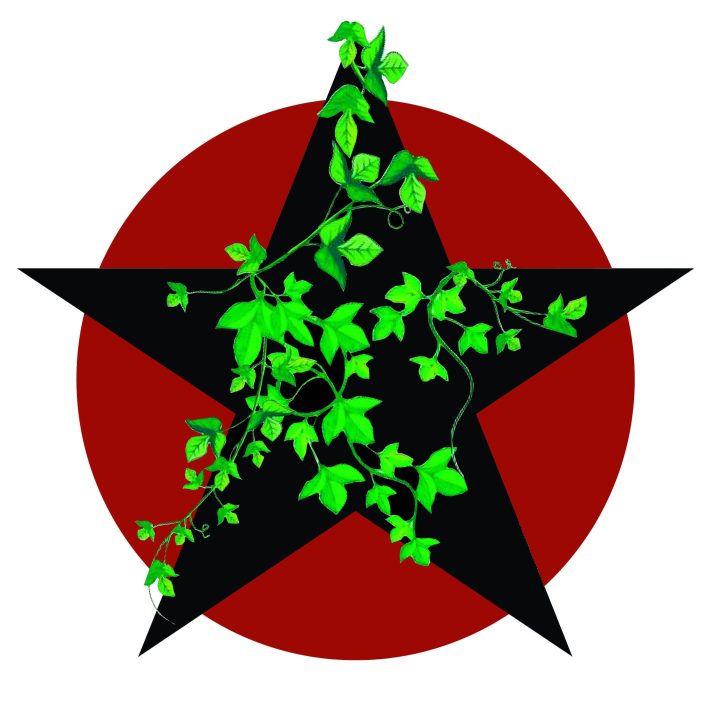
Iain Davies and Whitney Webb have produced a splendid article on “sustainable debt slavery” which they describe as “a global strategy to extend the reach of global financial institutions into every corner of the economy and society. Policy will be controlled by the bankers and the think-tanks that infiltrated the environmental movement decades ago”.

* * *
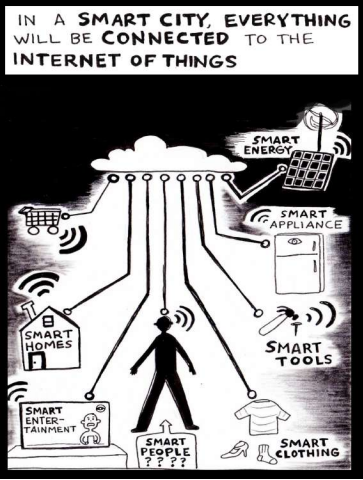
A wonderful comic-format introduction to the Great Reset and its newnormalist world, by talented artist Eve, can be downloaded from the Wrench in the Gears website. Highly recommended!
* * *
“The Mavericks won’t conform. Think of us as the resistance”. Some useful insights from Michael Driver as he urges us “to unite against the madness” on the TCW website.

* * *
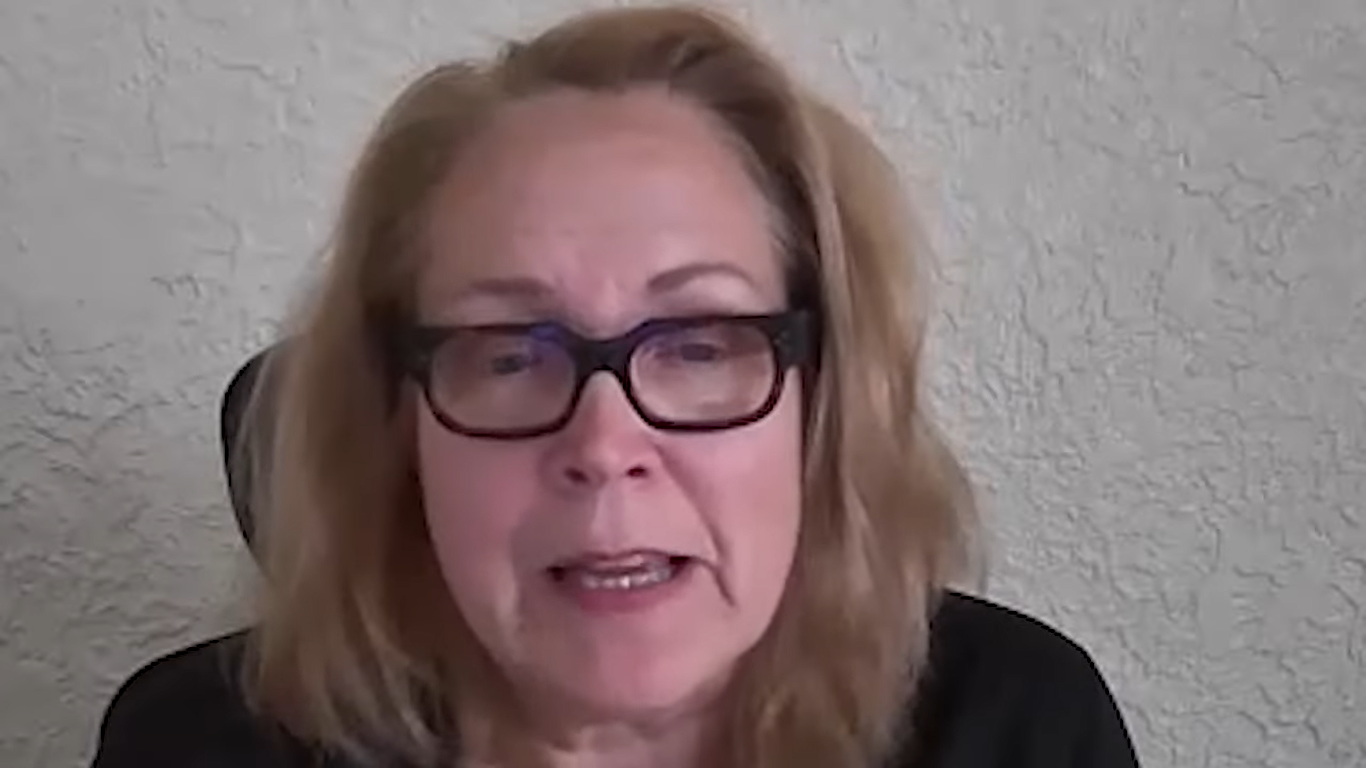
In this video interview, investigative reporter Jennifer Bilek explores the vitaphobic big money agenda and propaganda behind the trans industry: both transgenderist and transhumanist.
* * *
“This assault on ‘naturalism’, ‘essentialism’, and ‘vitalism’ is organised, political, and extremely well-funded; it may not be entirely unjustified to view it as a war on your own soul”. So writes Luke Dodson in a thought-provoking article entitled ‘Queering the Pitch’.

* * *
The work of Bob Moran, the dissident cartoonist ditched by The Daily Telegraph for being too good at his job, is celebrated in an eminently watchable documentary.

* * *
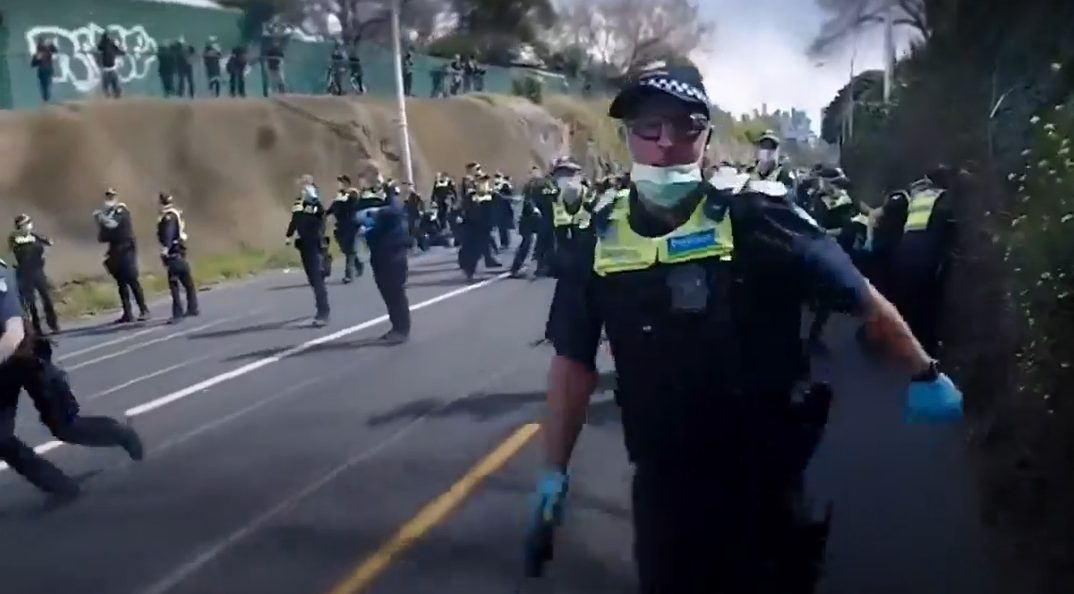
The Big Reset is the English version of a very informative two-hour video, originally in Spanish, described as “the uncensored documentary about the truth of the pandemic”. It can be seen here.
* * *
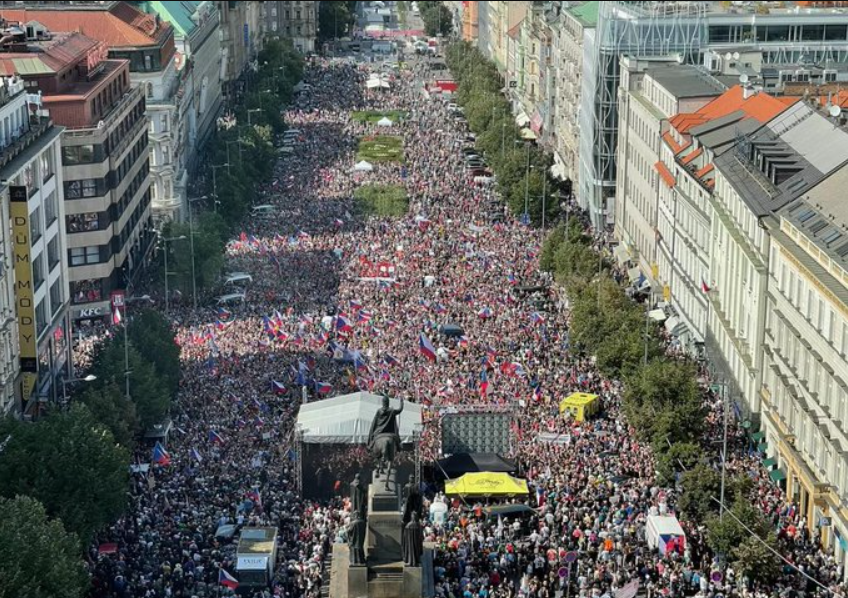
As the system ratchets up its full-spectrum assault on our lives and our freedom, protests and uprisings are breaking out all over the world and against all the various aspects of the Great Reset, whether rising bills and prices, draconian laws or land grabs. This unprecedented popular revolt has confused some journalists, with one report on a massive demo in Prague claiming that “the far right and far left joined forces to rally against the country’s pro-Western Czech government”. But in reality, everywhere, we are simply seeing the people rising up against global plutofascism!
* * *
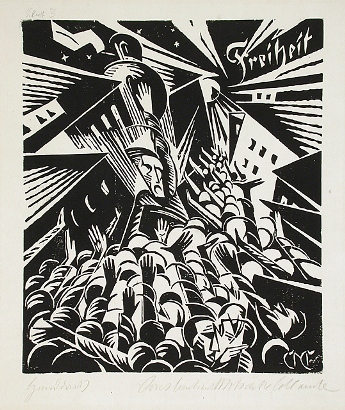
“Only the man who makes freedom real to himself meets destiny”. Martin Buber
(For many more like this, see the Winter Oak quotes for the day blog)
If you like this bulletin please tell others about it. Subscribe by clicking the “follow” button.
—–
Back Issues
Follow Winter Oak on Twitter at @WinterOakPress
</p”the>
 winter oak