
by Paul Cudenec (who reads the article here)
Our ancestors enjoyed not just a very different way of living to ours today but also a very different way of being.
Morris Berman writes of the supposedly “primitive” human being: “He may often be frightened by his environment or by things in it, but he is never alienated by it.
“There are no Sartres or Kafkas in such cultures any more than there were in medieval Europe.
“The ‘primitive’ is thus in touch with what Kant called the Ding an sich, the thing in itself, in the same way as was the denizen of ancient Greece”. [1]
Our pre-modern predecessors felt part of a greater whole, in the context of which their lives were not random or absurd but filled with the magic of meaning.
Berman explains: “The view of nature which predominated in the West down to the eve of the Scientific Revolution was that of an enchanted world.
“Rocks, trees, rivers, and clouds were all seen as wondrous, alive, and human beings felt at home in this environment.

“The cosmos, in short, was a place of belonging. A member of this cosmos was not an alienated observer of it but a direct participant in its drama.
“His personal destiny was bound up with its destiny, and this relationship gave meaning to his life”. [2]
“This metaphysic was preserved through the Middle Ages, an age noted (from our point of view) for its extensive symbolism.
“Things were never ‘just what they were’, but always embodied a nonmaterial principle that was seen as the essence of their reality”. [3]
Berman says that this type of “participating” consciousness, as he terms it, involved a “psychic wholeness” that we do not encounter in industrial society [4] and in which the individual feels embodied, vital, even enchanted. [5]
The New Zealander ethnographer Elsdon Best (1856-1931) declares: “When the Māori walked abroad, he was among his own kindred.
“The trees around him were, like himself, the offspring of [the great god] Tane; the birds, insects, fish, stones, the very elements were all kin of his, members of a different branch of the one great family.

“Many a time when engaged in felling a tree in the forest, have I been accosted by passing natives with such a remark as ‘Kei te raweke koe I to tipuna i a Tane‘ (‘You are meddling with your ancestor Tane’)”. [6]
This quotation came to me via Marshall Sahlins in his posthumously-published 2022 work The New Science of the Enchanted Universe.
There is much of interest in Sahlins’ book, so I am going to extensively draw upon it in this essay, despite my serious disagreement with one particular position he takes, which I will explain in the endnotes. [7]
He cites, for instance, Stanley Walens’ finding that for the Kwakiutl people of North America, “the prime agency of causality is not human action but spirit-power action”. [8]
And these spirits are not regarded as being elsewhere but totally enmeshed with everyday physical life, like the fairies of the Hindu Kush [9] or the dancing spiders of southern Italy. [10]
Sahlins writes: “Humans are essentially spirit-beings, even as spirits are essentially human”. [11]
“For all their usual invisibility, the spirits are co-present with humans in the same reality. The spirits may be invisible to the people, but the people are visible to the spirits”. [12]
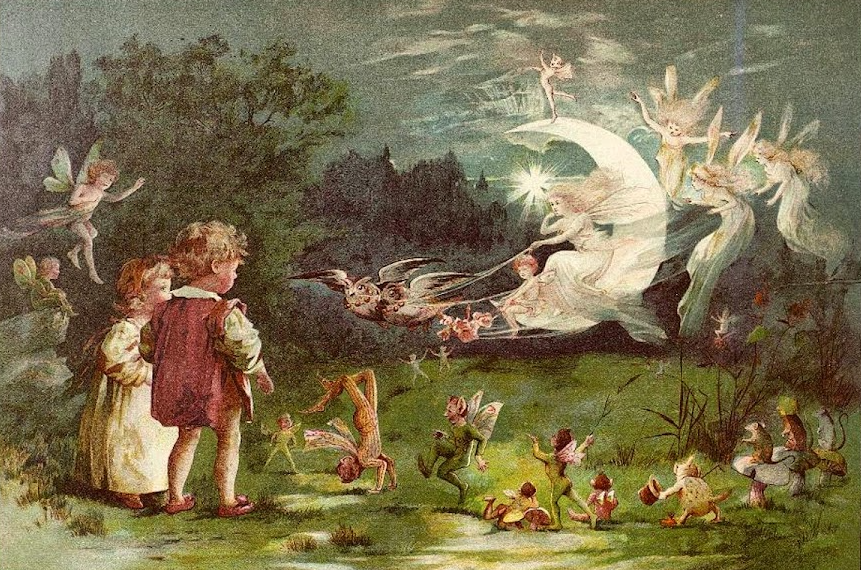
“The cultures of immanence, enspirited cultures, know only one world in which people interact with the myriad of nonhuman subjects, from the deities to the dead.
“These species of meta-persons may have their own habitats, from the heavens to under the ground or the sea, but they are co-present, visibly or invisibly, with human beings in one great cosmic polity. There is no ‘other world'”. [13]
“In an enchanted universe, the natural/supernatural distinction becomes meaningless”. [14]
An “enchanted” universe is one in which humans are infused with the knowledge of belonging to a greater whole.
It is one in which we are not spiritually numbed, but alert and attentive to the messages and guidance being sent to us by the vast organism of which we are part – messages that we can see as being delivered by intermediaries such as fairies or spiders.
We are connected to what the Sioux people of North America term Wakonda, described by ethnographers Alice Fletcher and Francis la Flesche as “the permeating life of invisible nature – an invisible life and power that reaches everywhere and everything, and can be appealed to by man to send him help”. [15]

British anthropologist Edward Evan Evans-Pritchard relates how the East African Nuer people see the various spirits of the air, the ancestors and other powers as just so many “refractions” of their deity Kwoth.
“Nuer do not conceive of lion-spirit as something separate from God… Lion-spirit is thought of as Spirit in tutelary relationship to a particular social group. It and God are the same thing different regarded”. [16]
In an enchanted world of belonging, we are not trapped within the confines of our own personal ego.
Missionary-ethnographer Hermann Strauss explains the idea of soul held by the Mount Hagen people of Papua New Guinea.
“This concept is not the individual soul in the sense in which we understand it, but the individual’s share or participation in the communal life-force and spiritual power, and every member of the group shares it some way or other…
“The min, or [clan] ‘soul’, is tied to its individual bearer, the self, but it comes to him as something else. It is something greater than the individual, for it is simply his participation in the power and the spiritual life of the community”. [17]
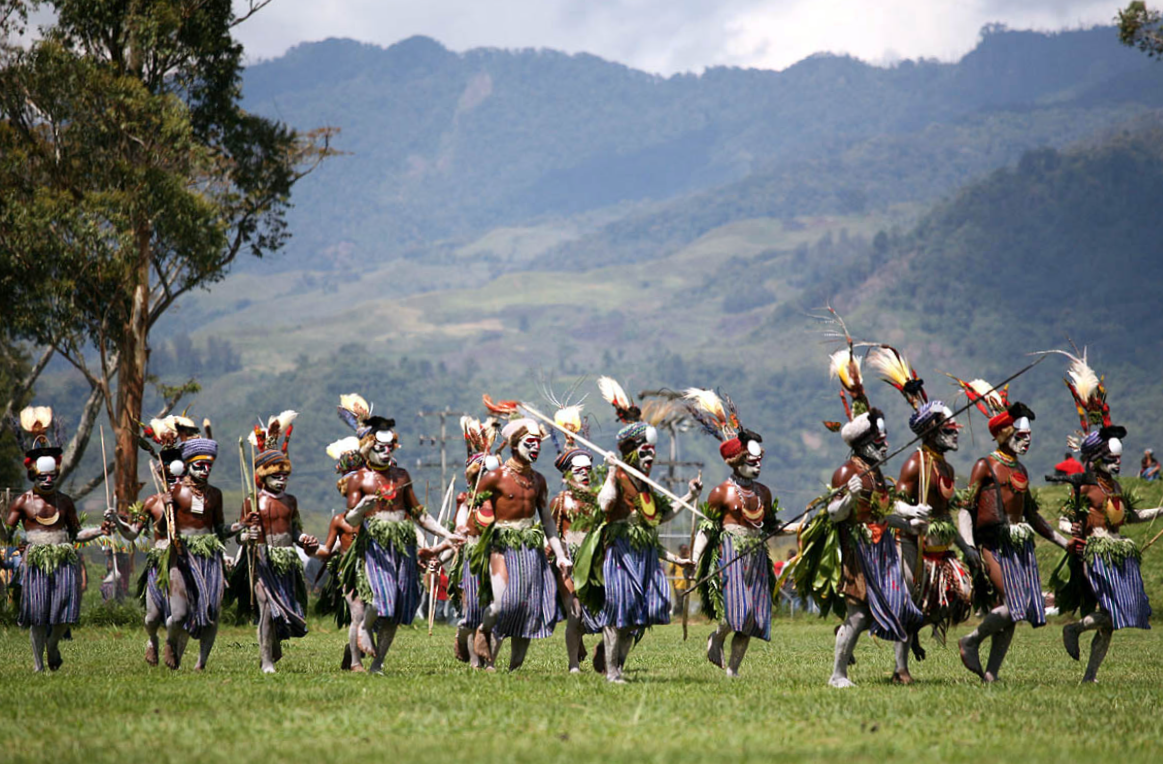
This sense of supra-individual identity can also extend across time.
Mark Mosko says that for the Trobriand Islanders in Papua New Guinea “living people are their ancestors embodied. Thus when humans act magically, their incorporated spirit predecessors as kin are invisibly but effectively acting also”. [18]
For non-modern people, time is usually not linear – the assumption used to justify the relentless and supposedly inevitable advance of industrial “progress”.
Instead it is cyclical, revolving and pulsating to the rhythms of the earth and the universe.
This rotation is not flat and the circle is never closed, as the great becoming of the cosmos gradually unfolds in the form of a spiral.
But from the perspective of the ephemeral individual – whose experience of the daily, monthly and yearly cycles is itself extended into three-dimensional spirality by the advance of his or her life – the greater world appears stable, self-renewing and essentially timeless.
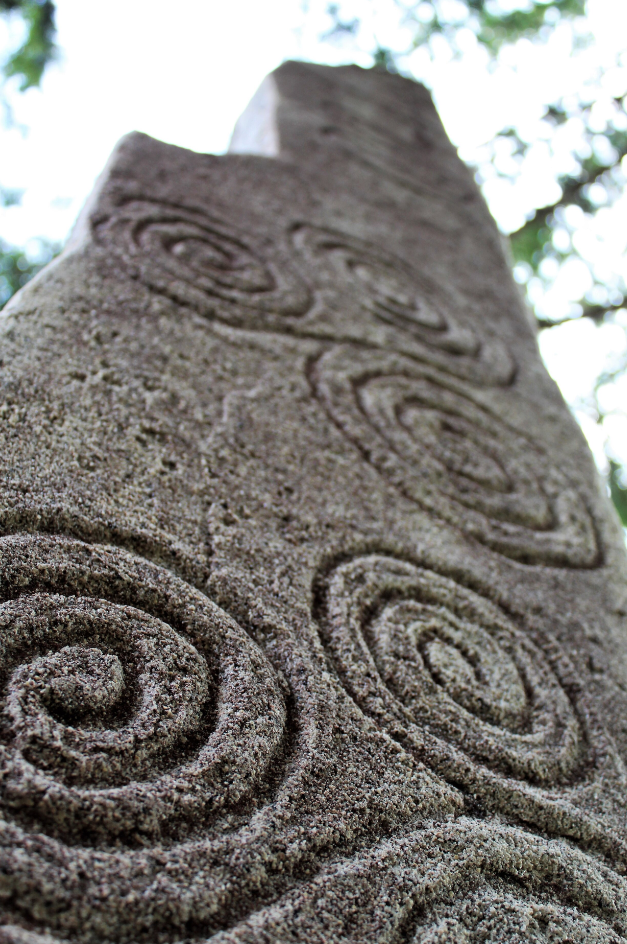
Until very recently in our species’ history, the reality we were born into was also the reality that we left behind at our death.
Berman writes: “For the people of the Middle Ages, the seasons and events of life followed one another with a comforting regularity.
“The notion of time as linear was experientially alien to this world and the need to measure it correspondingly muted”. [19]
“Our notions of growth and expansion would have made little sense in this static and self-sufficient world”. [20]
A “static and self-sufficient world”!
Am I alone in feeling, as we plummet ever faster into a deranged global techno-totalitarian hell, that this sounds very much like a paradise lost?

[1] Morris Berman, The Reenchantment of the World (Ithaca and London: Cornell University Press, 1981), p. 142.
[2] Berman, p. 16.
[3] Berman, p. 28.
[4] Berman, p. 16.
[5] Berman, p. 19.
[6] Elsdon Best, The Maori (Wellington: Harry H. Tombs, 1924), pp. 128-29, cit. Marshall Sahlins, with the assistance of Frederick B. Henry Jr, The New Science of the Enchanted Universe: An Anthropology of Most of Humanity (Princeton and Oxford: Princeton University Press, 2022), p. 118.
[7] Incredibly, for someone long considered part of the anarchist milieu (https://fifthestate.anarchistlibraries.net/library/370-fall-2005-the-original-affluent-society), Sahlins claims that “something like the state, the cosmic state, is the general condition of humankind – even in the state of nature” (p. 137) and that “the state is a universal human institution” (p. 138). He confuses universal belonging with “universal governance” (p. 140) and regurgitates the age-old authoritarian line that the notion of a metaphysical cosmic hierarchy somehow justifies tyranny in the human world. I really have to wonder if these opinions formed part of the text as he wrote it, or whether there was some kind of editorial interference after his demise.
[8] Stanley Walens, Feasting with Cannibals: An Essay on Kwakiutl Cosmology (Princeton: Princeton University Press, 1981), p. 24, cit. Sahlins, p. 23.
[9] Paul Cudenec, ‘Rooted in our living world’, https://winteroak.org.uk/2025/06/23/rooted-in-our-living-world/
[10] Paul Cudenec, ‘Dancing on the web of being’. https://winteroak.org.uk/2025/07/07/dancing-on-the-web-of-being/
[11] Sahlins, p. 44.
[12] Sahlins, p. 41.
[13] Sahlins, pp. 37-38.
[14] Sahlins, p. 36.
[15] Alice Fletcher and Francis la Flesche, The Omaha Tribe, 2 vols (Lincoln: University of Nebraska Press, 1992), p. 599, cit. Sahlins, pp. 114-15.
[16] E.E. Evans Pritchard, Nuer Religion (Oxford: Oxford University Press, 1956), p. 93, cit. Sahlins, p. 109.
[17] Hermann Strauss, The Mi-Culture of the Mount Hagen People, Papua New Guinea, trans. by Brian Shields, ed. by Gabriele Stürzenhofecker and Andrew Strathern, Pittsburgh Enthnology Monographs no 13 (Pittsburgh: Department of Anthropology, University of Pittsburgh, 1991), p. 99, cit. Sahlins, p. 50.
[18] Mark Mosko, Ways of Baloma: Rethinking Magic and Kinship from the Trobriands (Chicago: University of Chicago Press, 2017), p. 57, cit. Sahlins, p. 94.
[19] Berman, p. 56.
[20] Berman, p. 52.


This article reminds me of the moles coming super close to my pool, thinking how evil nature can be for me to be bothered by them as I swim in a soup of chemicals and costs and think about how dare I feel such a way. The desert has been my playground for many years and we need to look outward and not be drawn into the new AI Technocracy or we will all be doomed to change forever and not notice the moles ever again.
LikeLike
No, you are not alone, we are literally hurtling towards a cliff – I try to catch the odd persons arm as they rush by but…. I am a tickling breeze in a manufactured hurricane. This article is timely as I drove to Sligo yesterday. There is a part of the journey where one passes close to the Glencar waterfall and there is something so old about the landscape that I often feel almost a memory, of ancient times, a very deep connection that always brings a tear and sometimes a deep sob of grief.
LikeLike