Death and Poetry (The Myth of Philosophy 7)

by W.D. James Heroes are willing to give their lives, and in the old tales usually do, to protect their homes and loved ones. Their deaths are literally salvific. Beowulf suffering his mortal wounds acquired in destroying the dragon saves the people of his homeland. Of course, the archetype here is Jesus Christ whose death … Continue reading Death and Poetry (The Myth of Philosophy 7)

The Invisible College and the plan for our enslavement

by Paul Cudenec (who reads the article here) Over recent centuries we have, as Mircea Eliade points out, witnessed a "gigantic transformation of the World taken on by industrial societies and made possible by the desacralisation of the Cosmos under the effect of scientific thought and, above all, by sensational discoveries in physics and chemistry". … Continue reading The Invisible College and the plan for our enslavement

The “scientific” war on our freedom

by Paul Cudenec (who reads the article here) If it was a certain kind of religious thinking that paved the road to this modern hell, then it was a certain kind of scientific thinking that pushed us on the bus that brought us here. Morris Berman writes of his conviction that "the fundamental issues confronted … Continue reading The “scientific” war on our freedom

Socrates’ Demon (The Myth of Philosophy 6)

by W.D. James Socrates had a demon. Or, to avoid misunderstanding, he had a daemon, to stick to the Greek which does not have the negative connotation that the English word derived from it carries. Socrates and the divine In this series we have been tracking how Socrates, as the representative of philosophy, is portrayed … Continue reading Socrates’ Demon (The Myth of Philosophy 6)

The disgodding of nature and our hearts

by Paul Cudenec (who reads the article here) Max Weber, the subject of my last essay, was not alone in suspecting that certain religious beliefs - or the lack of them - had played a key role in shaping modern industrial society. Indeed, a century before Weber wrote about "die Entzauberung der Welt" - the … Continue reading The disgodding of nature and our hearts

Socrates’ Doctrine (The Myth of Philosophy 5)

by W.D. James From what we have learned of Socrates thus far in this essay series, it might sound odd to speak of ‘Socrates’ doctrine.’ After all, he had claimed that any wisdom he possessed was knowing that he did not know very much, if anything. Further, he insisted he was not a teacher. He … Continue reading Socrates’ Doctrine (The Myth of Philosophy 5)

Jacques Camatte (1935-2025): a lifetime of struggle against the global racket

We have just (belatedly) learned of the death of French dissident philosopher Jacques Camatte, at the age of 90, and by way of tribute are sharing this profile from the Organic Radicals website. Jacques Camatte (1935-2025) was a political philosopher who rejected both marxism and industrial capitalism and influenced the green anarchist movement in the … Continue reading Jacques Camatte (1935-2025): a lifetime of struggle against the global racket

Combat (The Myth of Philosophy 4)

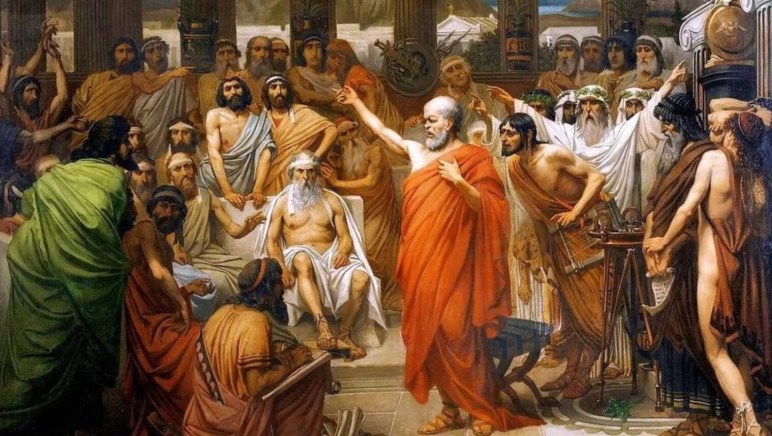
by W.D. James In this series we have been exploring how in his Apology, Plato presents his mentor Socrates as a new sort of hero. Heroes fight monsters and previously we looked at who the monsters in this case were: those who subordinate truth to power. This time we’ll look at Socrates’ trial itself; the … Continue reading Combat (The Myth of Philosophy 4)