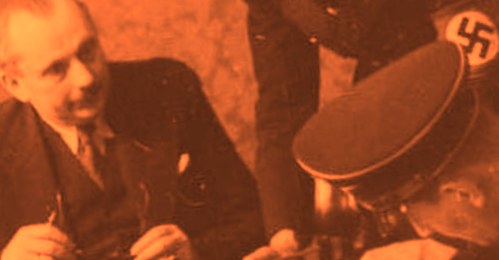
by Paul Cudenec (who reads the article here)
Hannah Arendt’s book Eichmann in Jerusalem: A Report on the Banality of Evil was published in 1963, the year in which I was born.
Until very recently I had not read it – we are all submerged with such a flow of factual and fictional accounts of the Nazis and what they did to the Jews that her account never appeared particularly important to me.
I have now caught up with it as part of my ongoing quest to understand the real lesson that we can learn from the events known as the Holocaust.
It’s an interesting volume, although before going any further into its contents – and then finally down a fascinating related rabbit hole – I would like to address a position of Arendt’s that I find problematic.
She notes that former SS officer Eichmann had been kidnapped from Argentina in 1960 by what Israel’s prime minister David Ben-Gurion described as “the Israeli Secret Service” [1] and then flown to Israel to be tried.
I think she is probably correct to judge that his defence’s challenge to the legitimacy of this act under international law should be viewed in the context of Eichmann’s own flagrant contempt for such niceties in organising the deportation of Jews across Europe. Eichmann himself (pictured at his trial) was certainly not somebody whose rights are worth belatedly defending!
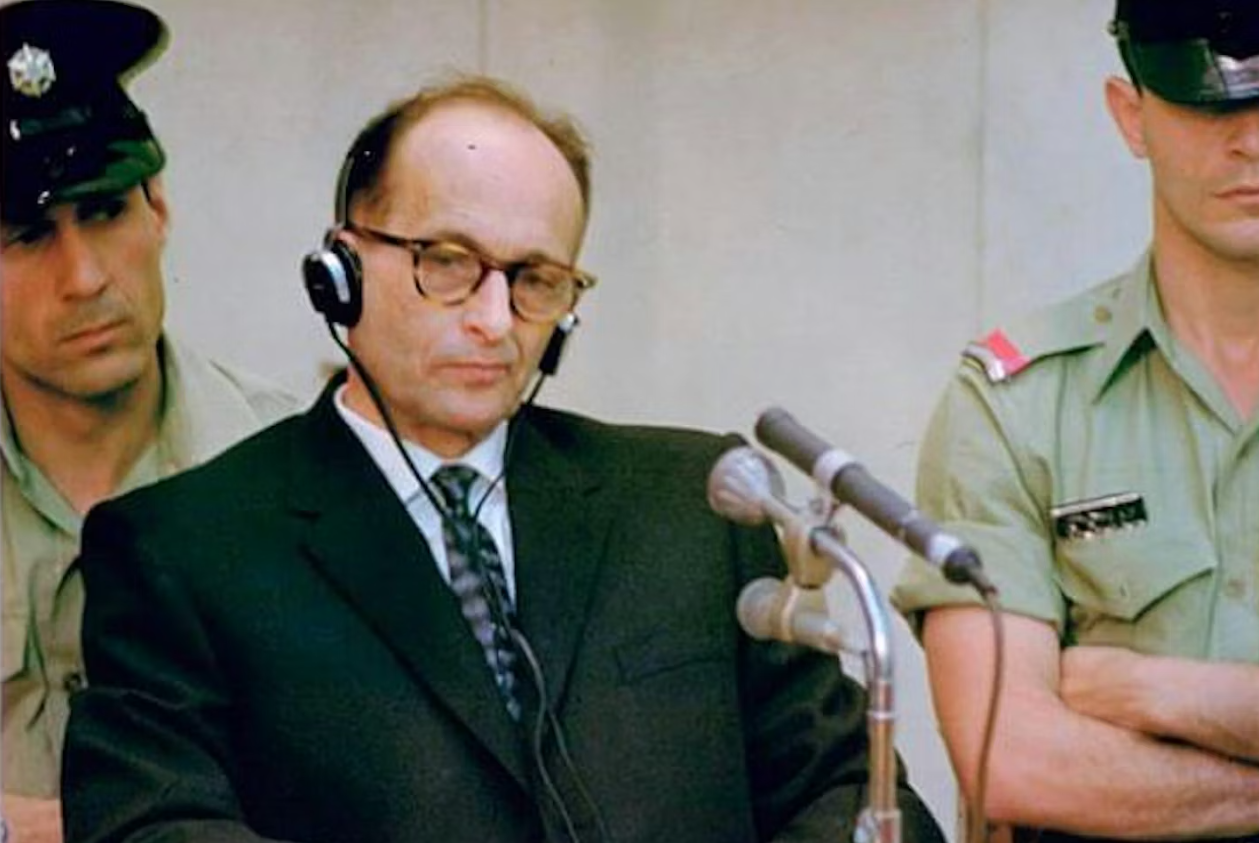
But what I find worrying is Arendt’s comment that “the judges were quite right when they stressed in their verdict that ‘the State of Israel was established and recognized as the State of the Jews’, and therefore had jurisdiction over a crime committed against the Jewish people”. [2]
This seems to me to be declaring unconditional global jurisdiction for Israel of a kind unthinkable for any other country.
Can we imagine an Islamic state like Iran or Saudi Arabia getting away with kidnapping a killer of Muslims from their new home in Europe, the USA or Israel?
Or the Pope dispatching a crack team of Vatican City commandos to another continent to grab someone who had committed a crime against “the Christian people”?
Arendt (1906-1975) here seems to be endorsing a Jewish exceptionalism which really amounts to a veiled form of supremacism – an automatic Jewish subjectivism that seems to unconsciously shape the assumptions of too many of her co-religionists, including anti-Zionists.
It is this assumption of a kind of unchallengeable moral Jewish global jurisdiction that has paved the way for the attempted imposition of the Noahide Laws, which I described in a recent article. [3]
Having said that, Arendt (pictured), as an astute political philosopher, is well aware of the dangers of embedded Jewish religious prejudice and the mistaken belief that “all Gentiles were alike”.
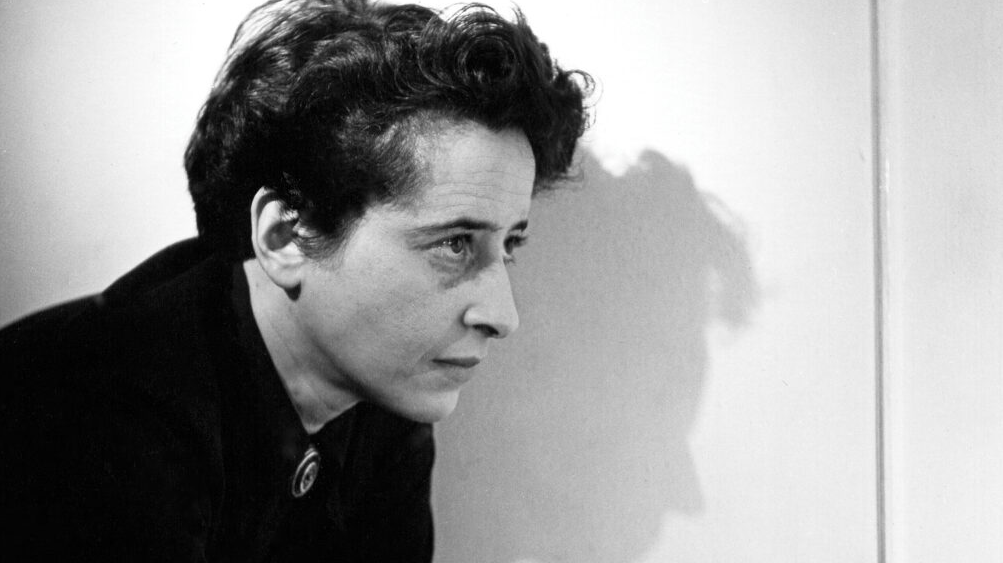
She writes: “If Prime Minister Ben-Gurion, to all practical purposes the head of the Jewish State, meant to strengthen this kind of ‘Jewish consciousness’, he was ill advised; for a change in this mentality is actually one of the indispensable prerequisites for Israeli statehood, which by definition has made of the Jews a people among peoples, a nation among nations, a state among states, depending now on a plurality which no longer permits the age-old and, unfortunately, religiously anchored dichotomy of Jews and Gentiles”. [4]
And her report of Eichmann’s trial provoked a storm of abuse from Zionists, as she notes in the second edition: “I allegedly had claimed that the Jews had murdered themselves. And why had I told such a monstrously implausible lie? Out of ‘self-hatred’, of course”. [5]
Arendt did not play along with the script regarding the persona of the Nazi who was judged and hanged in Jerusalem.
She had seen a mediocre German bureaucrat, a man who spoke in clichés, with an “extraordinarily faulty memory” [6] and “rather modest mental gifts”. [7]
“Despite all the efforts of the prosecution, everybody could see that this man was not a ‘monster’, but it was difficult indeed not to suspect that he was a clown”. [8]
Her book does not shy away from addressing the obviously propagandistic purpose of the proceedings, with an atmosphere “not of a show trial but of a mass meeting, at which speaker after speaker does his best to arouse the audience”. [9]
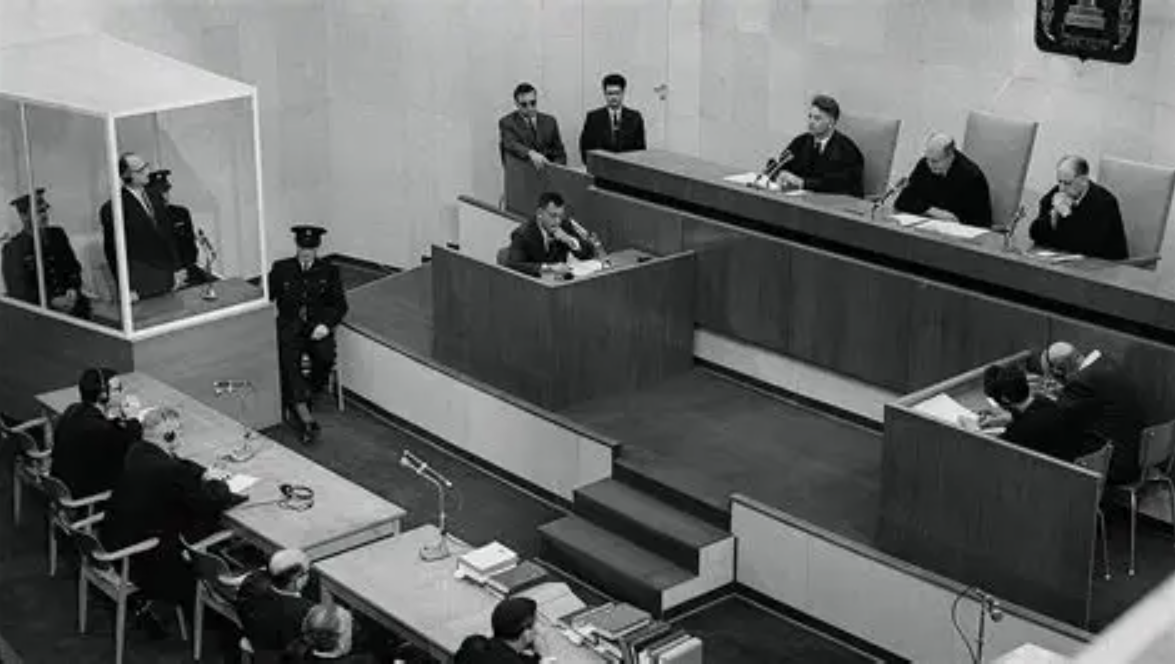
It was in part a Zionist message aimed at the world’s Jews: “The trial was supposed to show them what it meant to live among non-Jews, to convince them that only in Israel could a Jew be safe and live an honorable life”. [10]
“In Ben-Gurion’s own words… the Jews in the Diaspora were to remember how Judaism, ‘four thousand years old, with its spiritual creations and its ethical strivings, its Messianic aspirations’, had always faced ‘a hostile world’, how the Jews had degenerated until they went to their death like sheep, and how only the establishment of a Jewish state had enabled Jews to hit back”. [11]
But the much-publicised trial was also, of course, part of the project to stigmatise and effectively outlaw “anti-semitism” – including the modern expanded definition which embraces any challenge to Zionism and judeo-supremacism.
Arendt remarks: “Anti-Semitism has been discredited, thanks to Hitler, perhaps not forever but certainly for the time being, and this not because the Jews have become more popular all of a sudden but because, in Mr. Ben-Gurion’s own words, most people have ‘realized that in our day the gas chamber and the soap factory are what anti-Semitism may lead to'”. [12]
“It was history that, as far as the prosecution was concerned, stood in the center of the trial. ‘It is not an individual that is in the dock at this historic trial, and not the Nazi regime alone, but anti-Semitism throughout history’.
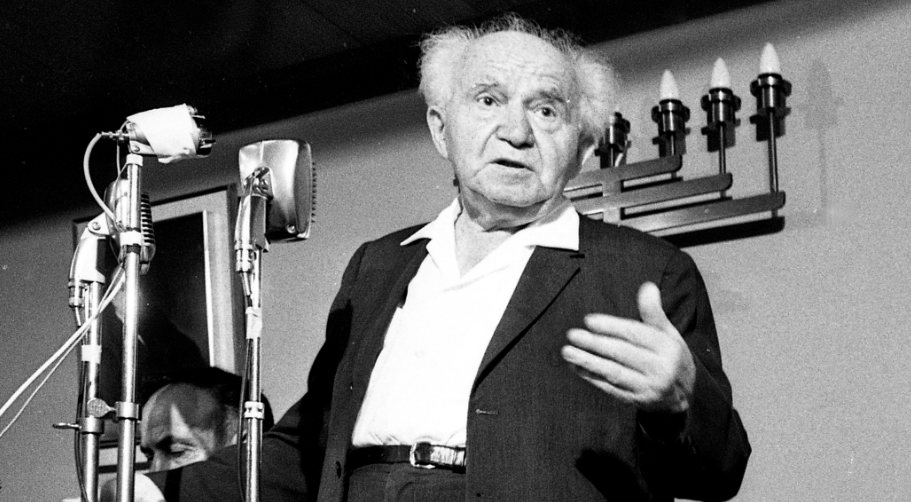
“This was the tone set by Ben-Gurion (pictured) and faithfully followed by Mr. Hausner, who began his opening address (which lasted through three sessions) with Pharaoh in Egypt and Haman’s decree ‘to destroy, to slay, and to cause them to perish’.
“He then proceeded to quote Ezekiel: ‘And when I [the Lord] passed by thee, and saw thee polluted in thine own blood, I said unto thee: In thy blood, live,’ explaining that these words must be understood as ‘the imperative that has confronted this nation ever since its first appearance on the stage of history’.
“It was bad history and cheap rhetoric; worse, it was clearly at cross-purposes with putting Eichmann on trial, suggesting that perhaps he was only an innocent executor of some mysteriously foreordained destiny, or, for that matter, even of anti-Semitism, which perhaps was necessary to blaze the trail of ‘the bloodstained road traveled by this people’ to fulfill its destiny”. [13]
We now know, although you will not hear it on the TV, that the Nazi regime was manufactured and manipulated by the global Zionist mafia. [14]
I was interested to learn from Arendt that the Egyptian deputy foreign minister Hussain Zulficar Sabri had pointed to this forbidden truth in his country’s National Assembly a few weeks before the trial, saying that Hitler had been used by Zionists who had “compelled him to perpetrate crimes that would eventually enable them to achieve their aim – the creation of the State of Israel”. [15]
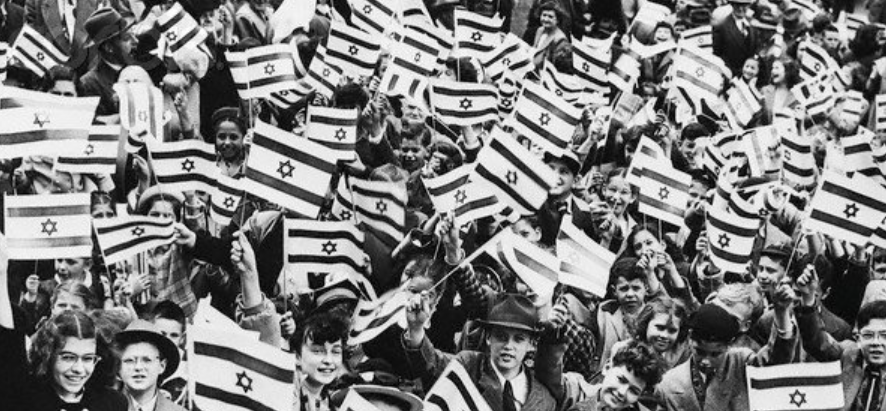
In the light of this, it is not too surprising to note a certain similarity between the two ideologies.
Arendt points out, for instance: “Israeli citizens, religious and nonreligious, seem agreed upon the desirability of having a law which prohibits intermarriage….
“There certainly was something breathtaking in the naiveté with which the prosecution denounced the infamous Nuremberg Laws of 1935, which had prohibited intermarriage and sexual intercourse between Jews and Germans”. [16]
Eichmann himself seems to have had a somewhat ambiguous relationship with Jewish people – Arendt says that “in Vienna, where he was so extraordinarily successful in arranging the ‘forced emigration’ of Jews, he had a Jewish mistress, an ‘old flame’ from Linz.
“Rassenschande, sexual intercourse with Jews, was probably the greatest crime a member of the SS could commit”. [17]
This apparent inner conflict also affected his ideological outlook, Arendt explains. His work for the SS “required him to read Theodor Herzl’s Der Judenstaat, the famous Zionist classic, which converted Eichmann promptly and forever to Zionism”. [18]
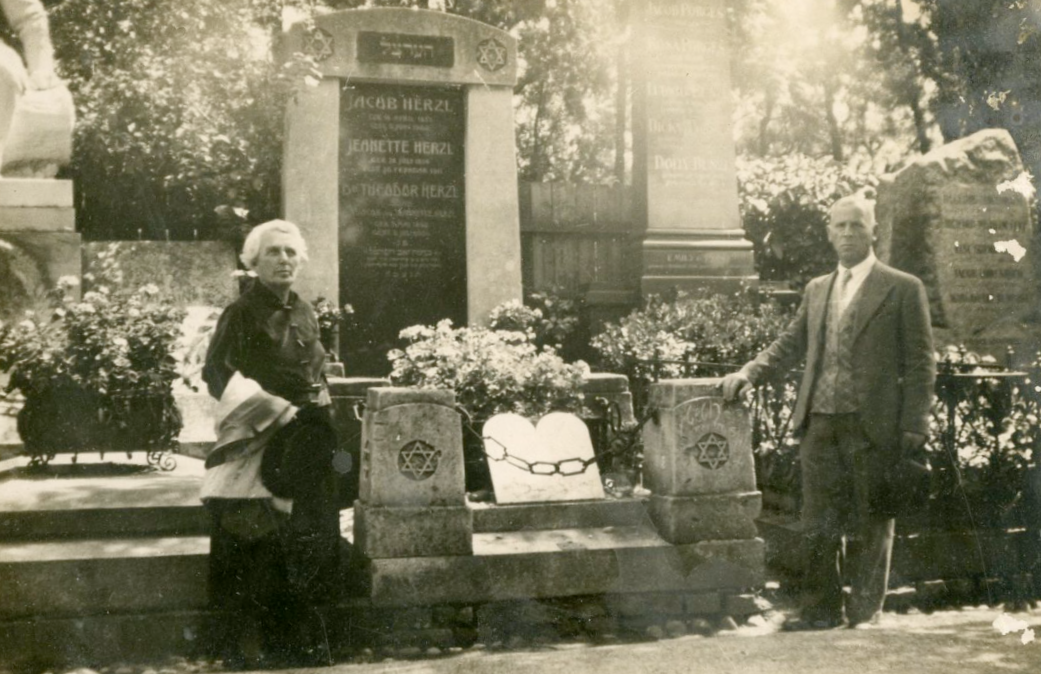
She adds: “It may be worth mentioning that, as late as 1939, he seems to have protested against desecrators of Herzl’s grave in Vienna (pictured), and there are reports of his presence in civilian clothes at the commemoration of the thirty-fifth anniversary of Herzl’s death.
“Strangely enough, he did not talk about these things in Jerusalem…” [19]
He did, however, allude to the obvious overlap in Nazi and Zionist aims: “The Jews ‘desired’ to emigrate, and he, Eichmann, was there to help them, because it so happened that at the same time the Nazi authorities had expressed a desire to see their Reich judenrein [free of Jews]”. [20]
Eichmann even visited Zionist settlers in Palestine, an official trip that was to be reframed by the Israeli court as “an espionage mission”. [21]
Obviously, public knowledge of the close links between Nazism and Zionism would have been fatal to the message that the spectacle in Jerusalem – and the whole Holocaust history – was trying to convey.
With this in mind, I would say that Arendt is aiding and abetting that obfuscation when she takes at face value the notion that by 1939 “the Nazi regime had abandoned its pro-Zionist attitude”. [22]
I would say that it was simply time for this affinity to be rendered invisible to the public.
But she does wonder out loud why Eichmann’s defence lawyer, Dr. Robert Servatius (pictured), did not make more of his client’s Zionist connections.
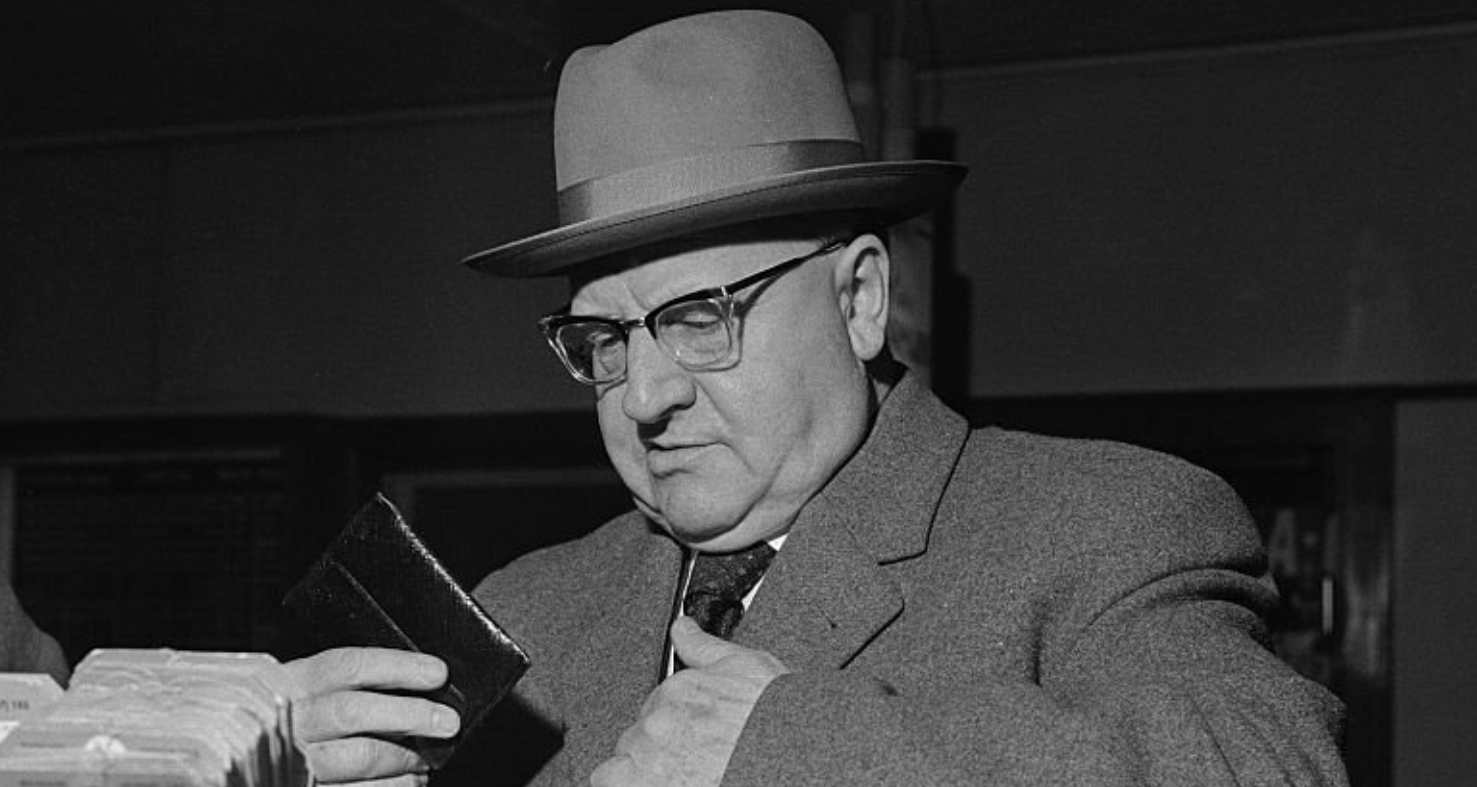
“For ‘it is indisputable that during the first stages of their Jewish policy the National Socialists thought it proper to adopt a pro-Zionist attitude’ (Hans Lamm), and it was during these first stages that Eichmann learned his lessons about Jews.
“He was by no means alone in taking this ‘pro-Zionism’ seriously; the German Jews themselves thought it would be sufficient to undo ‘assimilation’ through a new process of ‘dissimilation’, and flocked into the ranks of the Zionist movement.
“There are no reliable statistics on this development, but it is estimated that the circulation of the Zionist weekly Die Jüdische Rundschau increased in the first months of the Hitler regime from approximately five to seven thousand to nearly forty thousand, and it is known that the Zionist fund-raising organizations received in 1935-36, from a greatly diminished and impoverished population, three times as much as in 1931-32.
“This did not necessarily mean that the Jews wished to emigrate to Palestine; it was more a matter of pride: ‘Wear it with Pride, the Yellow Star!’, the most popular slogan of these years, coined by Robert Weltsch, editor-in-chief of the Jüdische Rundschau, expressed the general emotional atmosphere”. [23]
She adds: “Dr. Servatius could have called as witnesses for the defense the former agents of Aliyah Beth, as the organization for illegal immigration into Palestine was called; they certainly still remembered Eichmann, and they were now living in Israel”. [24]
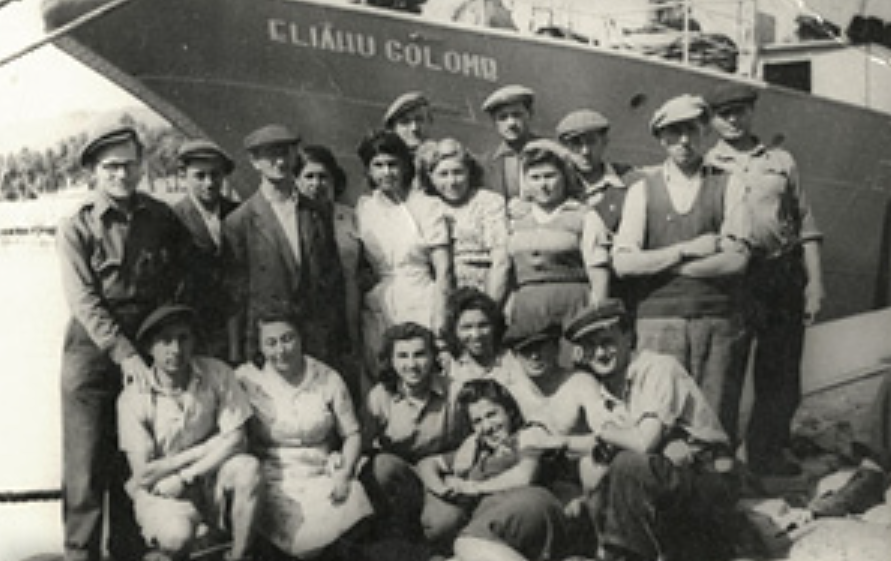
Arendt also notes that, although it was not something the Nazis or the Zionists liked to talk about in public, “there existed in those first years a mutually highly satisfactory agreement between the Nazi authorities and the Jewish Agency for Palestine – a Ha’avarah, or Transfer Agreement, which provided that an emigrant to Palestine could transfer his money there in German goods and exchange them for pounds upon arrival”. [25]
She further mentions that “Hitler himself is said to have known three hundred and forty ‘first-rate Jews’, whom he had either altogether assimilated to the status of Germans or granted the privileges of half-Jews.
“Thousands of half-Jews had been exempted from all restrictions, which might explain [Reinhard] Heydrich’s role in the SS and Generalfeldmarschall Erhard Milch’s role in Göring’s Air Force, for it was generally known that Heydrich and Milch were half-Jews”. [26]
The principal reason for the hysterical Zionist reaction to Arendt’s book undoubtedly lies in her many references to Jewish collaboration with Hitler’s regime.
She states plainly: “Wherever Jews lived, there were recognized Jewish leaders, and this leadership, almost without exception, cooperated in one way or another, for one reason or another, with the Nazis”. [27]
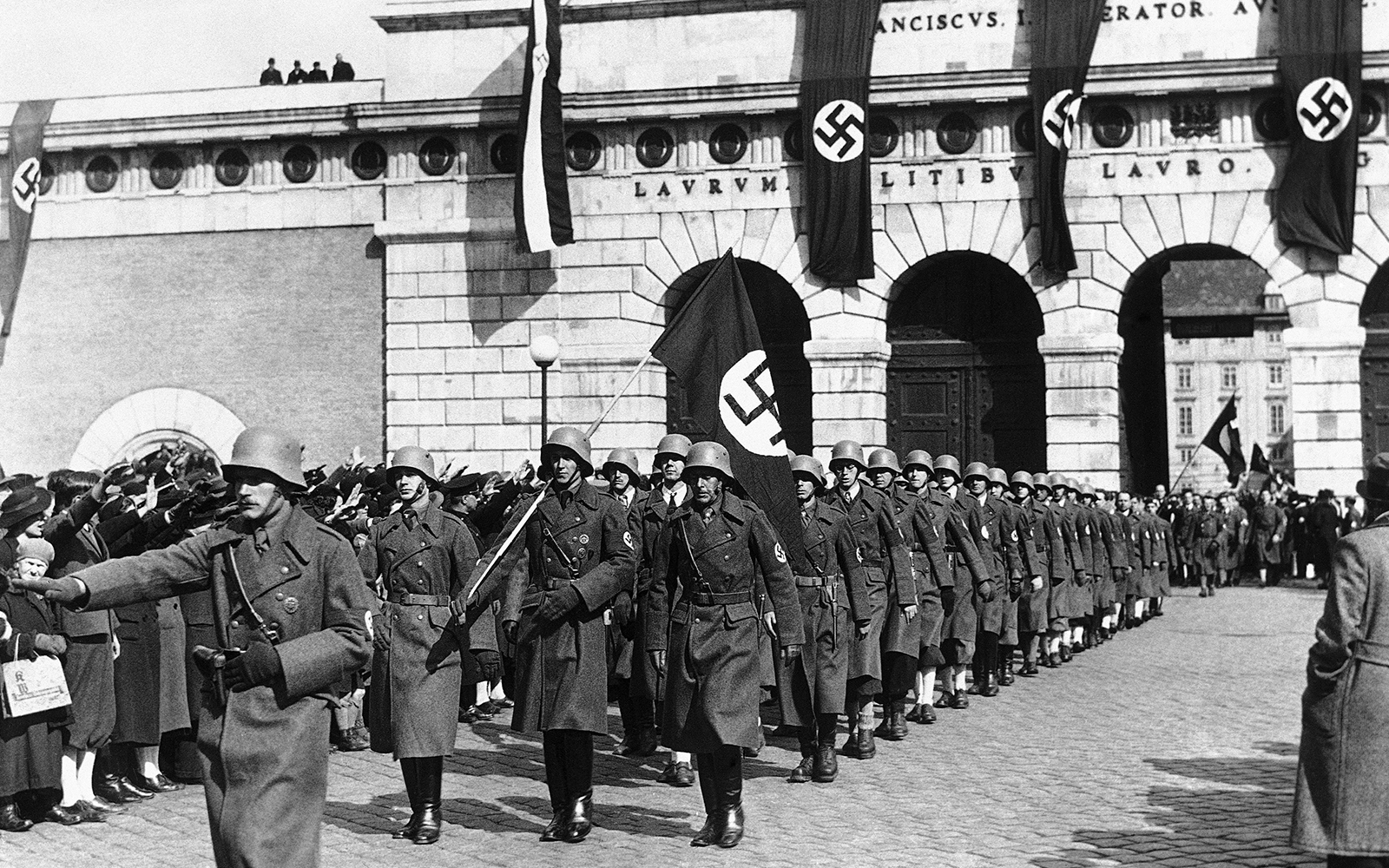
Arendt describes “the emissaries from Palestine, who would approach the Gestapo and the SS on their own initiative, without taking orders from either the German Zionists or the Jewish Agency for Palestine.
“They came in order to enlist help for the illegal immigration of Jews into British-ruled Palestine, and both the Gestapo and the SS were helpful”. [28]
These people negotiated with Eichmann in Vienna, where “he even provided them with farms and facilities for setting up vocational training camps for prospective immigrants”. [29]
She relates that on one occasion, he expelled a group of nuns from a convent to provide a training farm for young Jews.
The aim of these Zionist recruiting gangs was not the humanitarian one of rescuing Jews from the threat of extermination, Eichmann had explained.
“‘That was not their job’. They wanted to select ‘suitable material’, and their chief enemy, prior to the extermination program, was not those who made life impossible for Jews in the old countries, Germany or Austria, but those who barred access to the new homeland; that enemy was definitely Britain, not Germany”. [30]
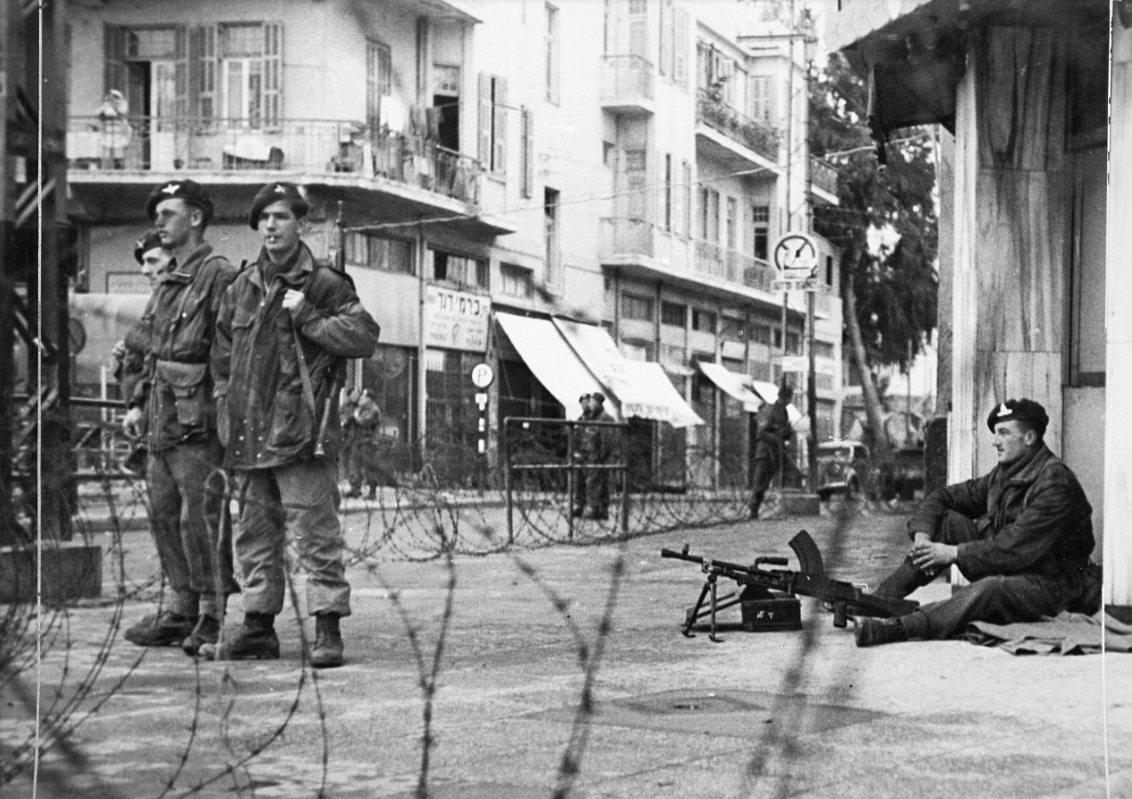
“The greatest ‘idealist’ Eichmann ever encountered among the Jews was Dr. Rudolf Kastner, with whom he negotiated during the Jewish deportations from Hungary and with whom he came to an agreement that he, Eichmann, would permit the ‘illegal’ departure of a few thousand Jews to Palestine (the trains were in fact guarded by German police) in exchange for ‘quiet and order’ in the camps from which hundreds of thousands were shipped to Auschwitz.
“The few thousand saved by the agreement, prominent Jews and members of the Zionist youth organizations, were, in Eichmann’s words, ‘the best biological material’.
“Dr. Kastner, as Eichmann understood it, had sacrificed his fellow-Jews to his ‘idea’, and this was as it should be”. [31]
Some of the Jewish “emigration” activities with which Eichmann was involved seem very close to the kind of human trafficking and profiteering carried out by organised crime networks.
Arendt tells us: “Eichmann therefore sent Jewish functionaries abroad to solicit funds from the great Jewish organizations, and these funds were then sold by the Jewish community to the prospective emigrants at a considerable profit – one dollar, for instance, was sold for 10 or 20 marks when its market value was 4.20 marks.
“It was chiefly in this way that the community acquired not only the money necessary for poor Jews and people without accounts abroad, but also the funds it needed for its own hugely expanded activities”. [32]
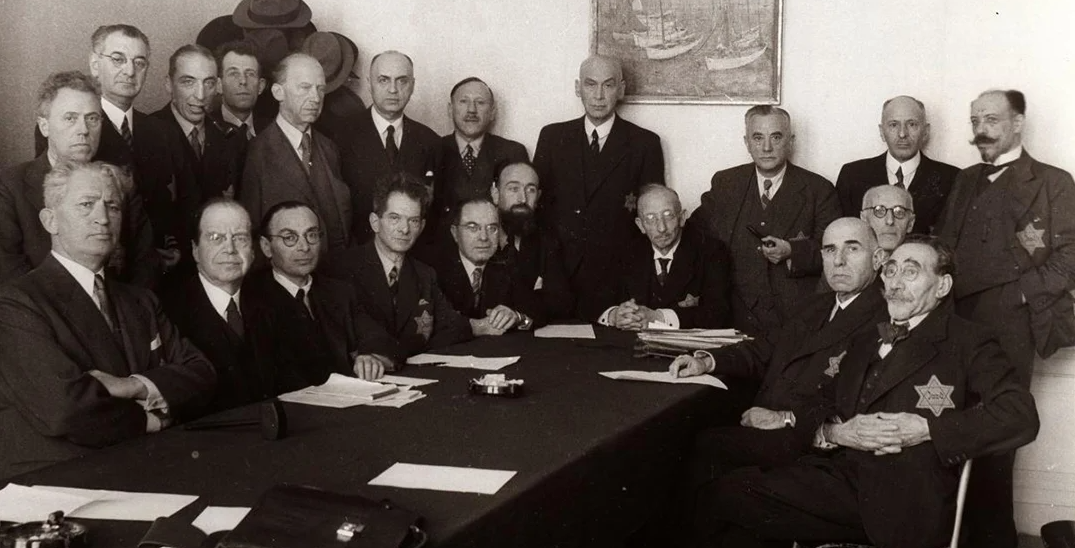
“In Amsterdam as in Warsaw, in Berlin as in Budapest, Jewish officials could be trusted to compile the lists of persons and of their property, to secure money from the deportees to defray the expenses of their deportation and extermination, to keep track of vacated apartments, to supply police forces to help seize Jews and get them on trains, until, as a last gesture, they handed over the assets of the Jewish community in good order for final confiscation.
“They distributed the Yellow Star badges, and sometimes, as in Warsaw, ‘the sale of the armbands became a regular business; there were ordinary armbands of cloth and fancy plastic armbands which were washable'”. [33]
Arendt comments that the prosecution in Jerusalem had a clear interest in not dwelling too much on Jewish collaboration as its “general picture of a clear-cut division between persecutors and victims would have suffered greatly”. [34]
But she again questions why Dr Servatius, defending Eichmann, did not go deeper into this area.
“He could have pointed to the fact that Eichmann, immediately upon being transformed from an expert in emigration into an expert in ‘evacuation’, appointed his old Jewish associates in the emigration business – Dr. Paul Eppstein, who had been in charge of emigration in Berlin, and Rabbi Benjamin Murmelstein (pictured), who had held the same job in Vienna – as ‘Jewish Elders’ in Theresienstadt”. [35]
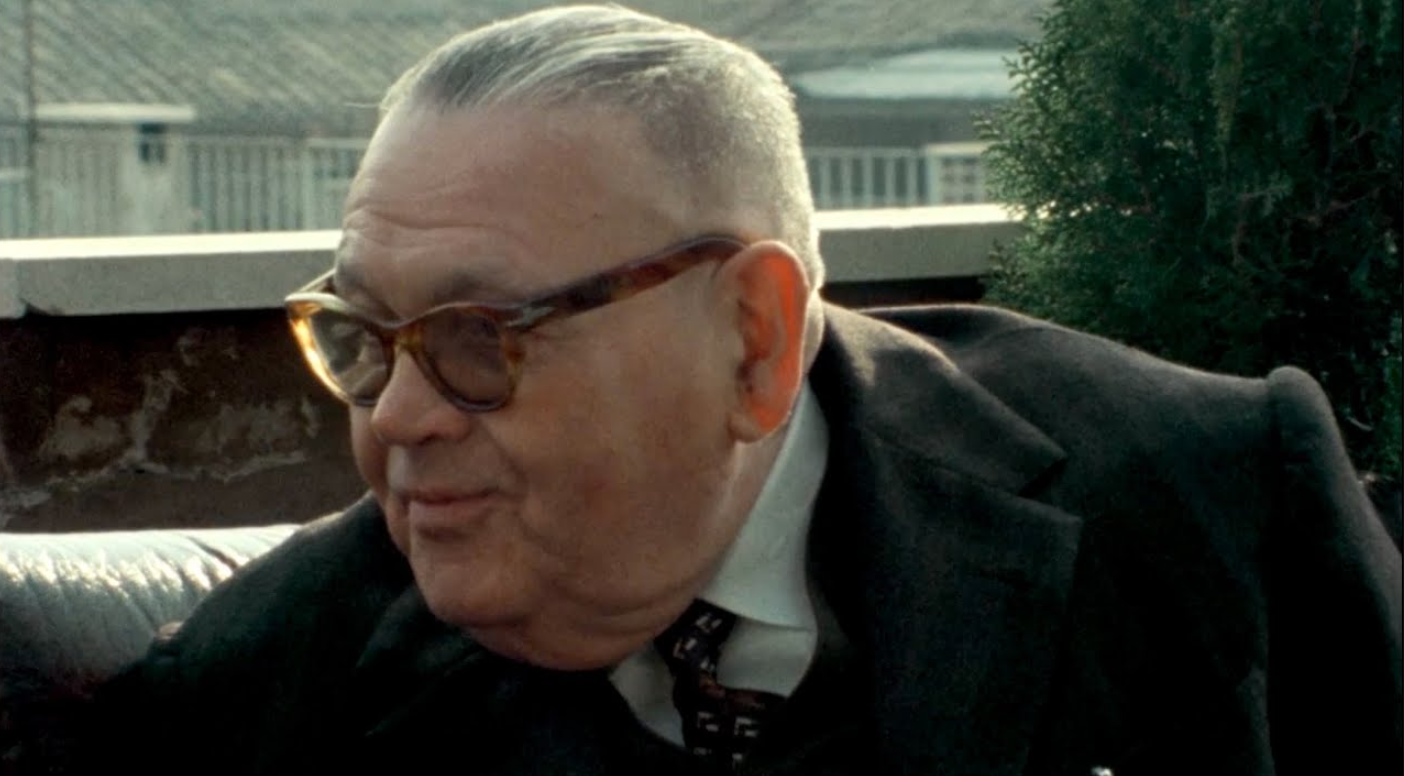
She continues: “The prosecution called witness after witness to testify to the rising in the Warsaw ghetto and to the similar attempts in Vilna and Kovno – matters that had no connection whatever with the crimes of the accused.
“The testimony of these people would have contributed something to the trial if they had told of the activities of the Jewish Councils, which had played such a great and disastrous role in their own heroic efforts”. [36]
“Thus, the gravest omission from the ‘general picture’ was that of a witness to testify to the cooperation between the Nazi rulers and the Jewish authorities, and hence of an opportunity to raise the question: ‘Why did you cooperate in the destruction of your own people and, eventually, in your own ruin?’
“The only witness who had been a prominent member of a Judenrat was Pinchas Freudiger, the former Baron Philip von Freudiger, of Budapest, and during his testimony the only serious incidents in the audience took place; people screamed at the witness in Hungarian and in Yiddish, and the court had to interrupt the session”. [37]
“The matter of cooperation was twice mentioned by the judges; Judge Yitzak Raveh elicited from one of the resistance witnesses an admission that the ‘ghetto police’ were an ‘instrument in the hands of murderers’ and an acknowledgment of ‘the Judenrat’s policy of cooperating with the Nazis’; and Judge Halevi found out from Eichmann in cross-examination that the Nazis had regarded this cooperation as the very cornerstone of their Jewish policy”. [38]
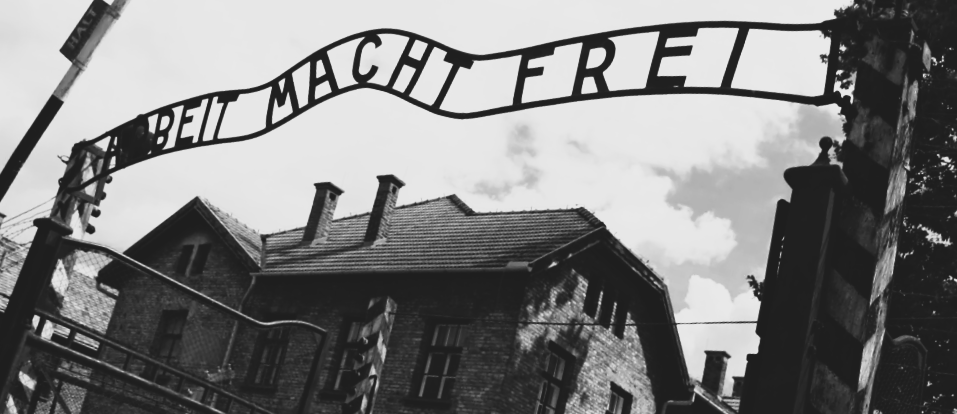
Arendt says that Jewish collaboration in the camps themselves was revealed in the trial.
“The well-known fact that the actual work of killing in the extermination centers was usually in the hands of Jewish commandos had been fairly and squarely established by witnesses for the prosecution – how they had worked in the gas chambers and the crematories, how they had pulled the gold teeth and cut the hair of the corpses, how they had dug the graves and, later, dug them up again to extinguish the traces of mass murder; how Jewish technicians had built gas chambers in Theresienstadt, where the Jewish ‘autonomy’ had been carried so far that even the hangman was a Jew”. [39]
Those Jewish collaborators who survived the war were not treated harshly by the Israeli authorities, as laws had been drawn up with clauses excusing those who committed crimes “to avert consequences more serious than those which resulted” or “in order to save themselves from the danger of immediate death”. [40]
There is a lot of intriguing detail in Eichmann in Jerusalem.
For instance, Arendt tells how in Nazi-occupied and generally Nazi-friendly Croatia, 30,000 Jews had been deported to the camps by late 1943.
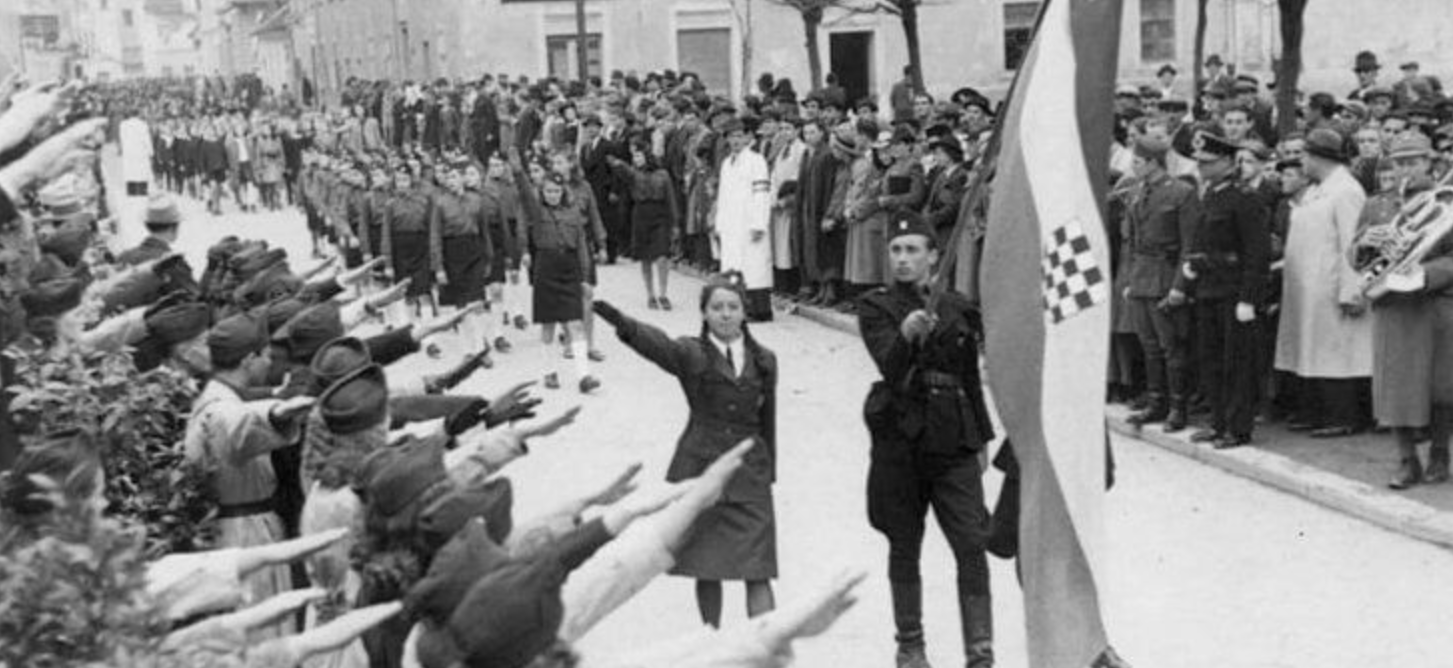
But many Jews remained, because a legal loophole had been introduced, bestowing the status of “honorary Aryans” on those Jews who had made contributions to “the Croat cause”.
“The number of these Jews had of course greatly increased during the intervening years. The very rich, in other words, who parted voluntarily with their property, were exempted”. [41]
She adds that SS Intelligence “discovered that nearly all members of the ruling clique in Croatia, from the head of the government to the leader of the Ustashe, were married to Jewish women”. [42]
And I was rather taken aback by this description of a meeting in Austria in February 1939.
“Eichmann had summoned the leaders of German Jewry to Vienna to explain to them his new methods of ‘forced emigration’. And there he was, sitting in a large room on the ground floor of the Rothschild Palais”. [43]
Checking with the Rothschild family archives, I found that after the Anschluß of Austria to Nazi Germany in March 1938, Louis von Rothschild of Vienna was arrested and later held under house arrest.
“Louis was released only after lengthy negotiations between the family and the Nazis and upon payment of $21,000,000, believed to have been the largest bail bond in history for any individual. On his release in July 1939, Louis headed for the USA, where he eventually became an American citizen.
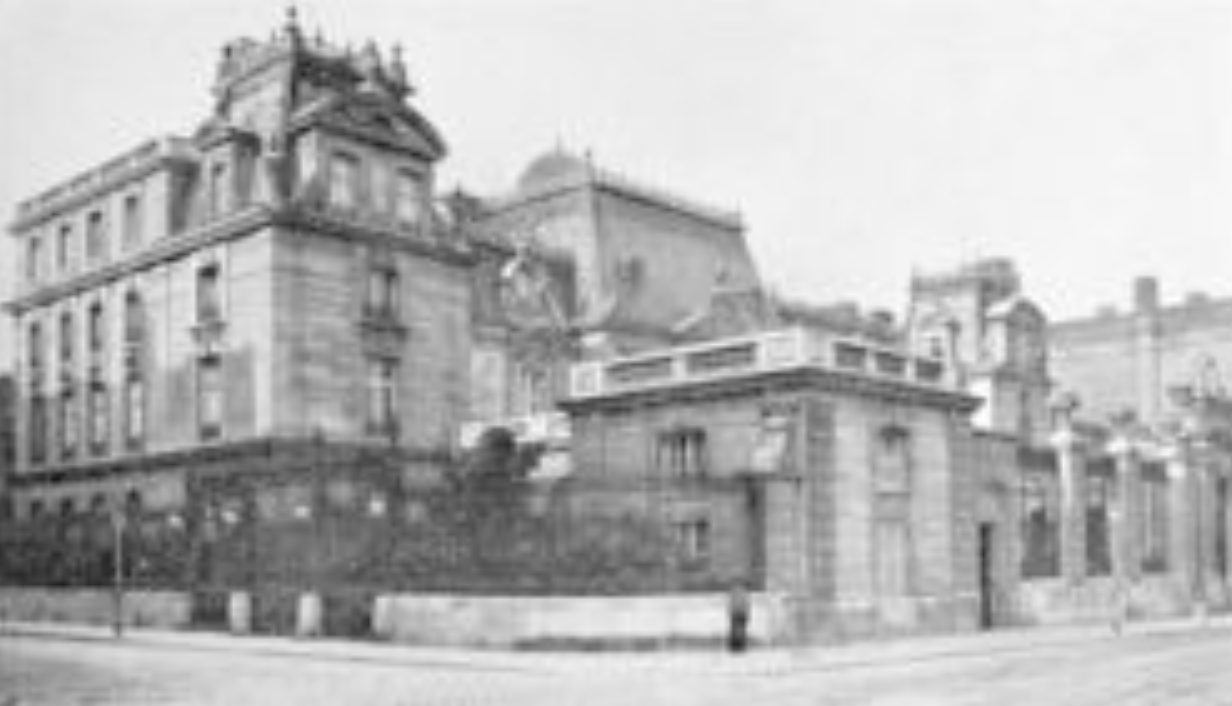
“Adolf Eichmann moved into the Palais Albert Rothschild (pictured) and set up the infamous Central Agency for Jewish Emigration in Vienna, the purpose of which was to organise the ‘emigration’ of Jews from Austria”. [44]
This reminds me a 1968 article by Malcolm Muggeridge that I quote in ZIM Unzipped. [45]
Here he writes: “My liaison duties took me to Algiers and then to Paris, where I lived in the Rothschild mansion in the Avenue de Marigny, requisitioned for the purpose by Lord Rothschild, also serving in Paris as a British Intelligence officer.
“The house had been occupied during the German occupation by a Luftwaffe officer who, rather to my surprise, had left everything intact.
“When I mentioned this to M. Felix, in charge in the Avenue de Marigny establishment under all regimes, he smiled and remarked that no doubt the general had reflected that Hitlers come and go but Rothschilds go on forever”. [46]
But the strangeness does not end there.
Arendt reveals that Eichmann worked closely with Dr. Josef Löwenherz (1884-1960), head of the Vienna Jewish community, who “became one of his favorite Jews”. [47]
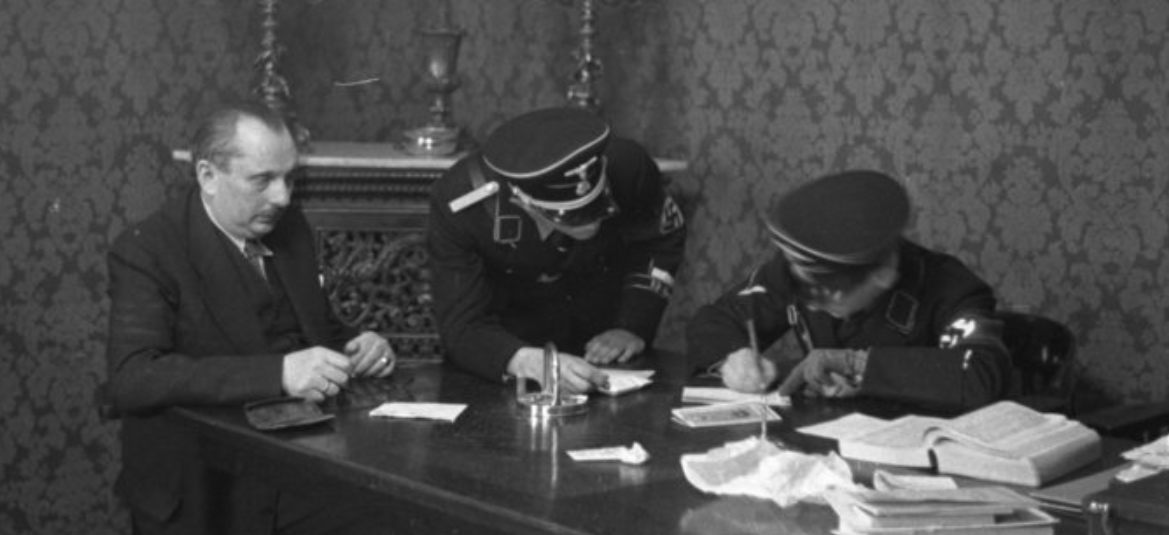
She says Eichmann’s “beloved Dr. Löwenherz” [48] “was the first Jewish functionary actually to organize a whole Jewish community into an institution at the service of the Nazi authorities”. [49]
What a claim to fame!
“And he was one of the very, very few such functionaries to reap a reward for his services – he was permitted to stay in Vienna until the end of the war, when he emigrated to England and the United States; he died shortly after Eichmann’s capture, in 1960”. [50]
Löwenherz, I have discovered, had been an active Zionist since his student days at the University of Lviv, now in Ukraine. [51]
In Vienna, he was “forced” to work with Eichmann to draw up plans for the emigration of Austrian Jews, leading to the establishment in 1938 of the Zentralstelle für jüdische Auswanderung (Central Office for Jewish Emigration).
The Center for Jewish History in New York states: “With official German authorization, Joseph Löwenherz visited Lisbon (apparently in 1940 or 1941) to meet with representatives of the World Jewish Congress, including Dr. Parlas, secretary to Chaim Weizmann”. [52]
Interestingly, I learned from a German-language website: “Löwenherz was considered an accomplished organizer and was in contact with the Joint Distribution Committee [JDC] in the USA and Paris”. [53]
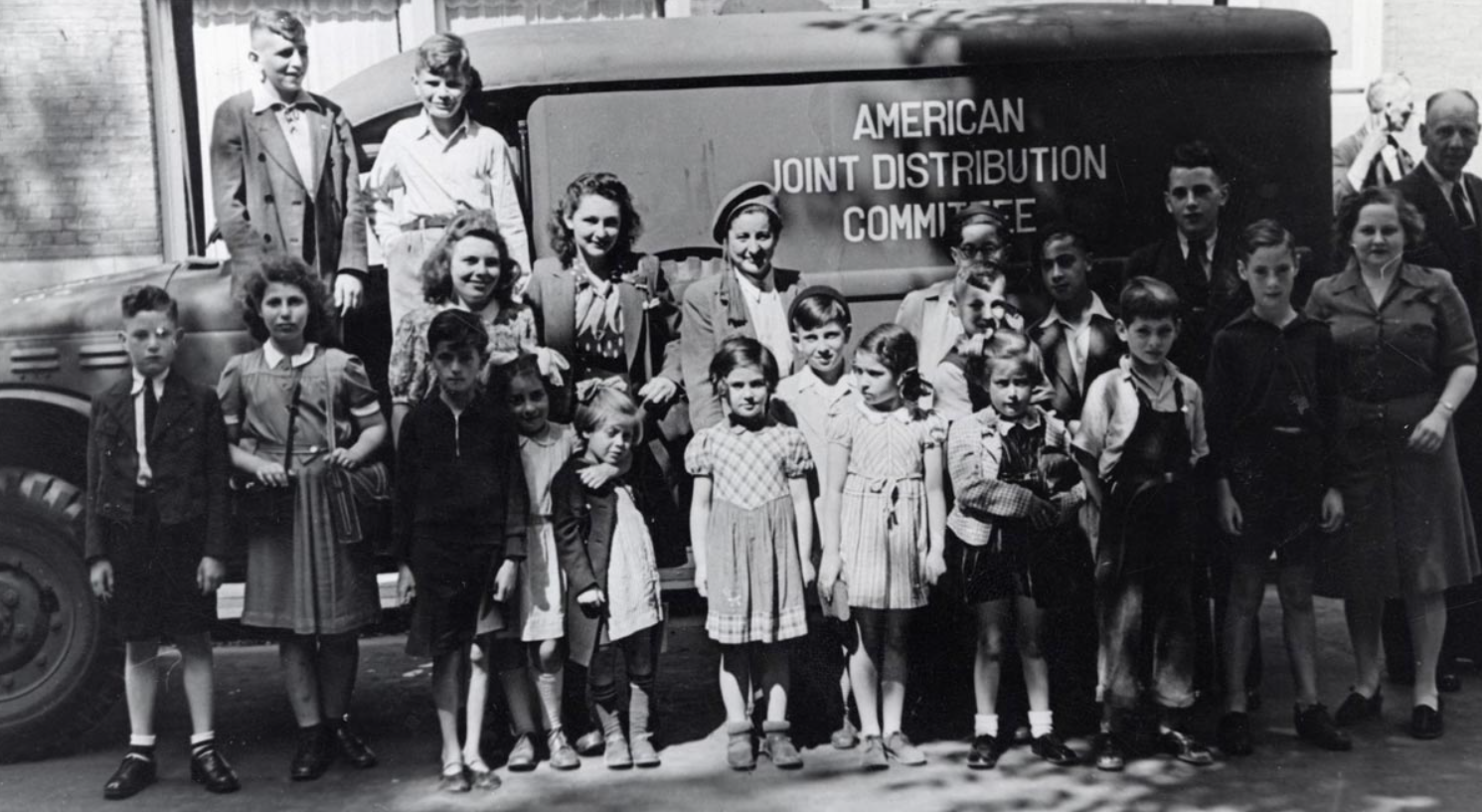
This organisation still exists today. “The Joint” terms itself “the largest Jewish humanitarian organization in the world”, boasting a $373 million annual budget, and declares: “We cultivate a Jewish future, because the Jewish part of Jewish life is worth fighting for”. [54]
It was founded in New York City in 1914 by the banker Jacob Schiff, along with fellow banker Felix Warburg and Louis Marshall, who was joint founder with Chaim Weizmann of the Extended Jewish Agency. [55]
Schiff of Kuhn, Loeb & Co is named by historians Jim Macgregor and Gerry Docherty as a Rothschild agent, [56] part of “a cosy cartel, behind which the House of Rothschild remained hidden but retained immense influence and power”. [57]
It was this cartel that plotted to manufacture and prolong the First World War and, as Macgregor and John O’Dowd explain in their important 2025 book, went on to create the Nazi regime in order to bring about the Second World War and all that went with it (although Schiff himself was dead by then). [58]
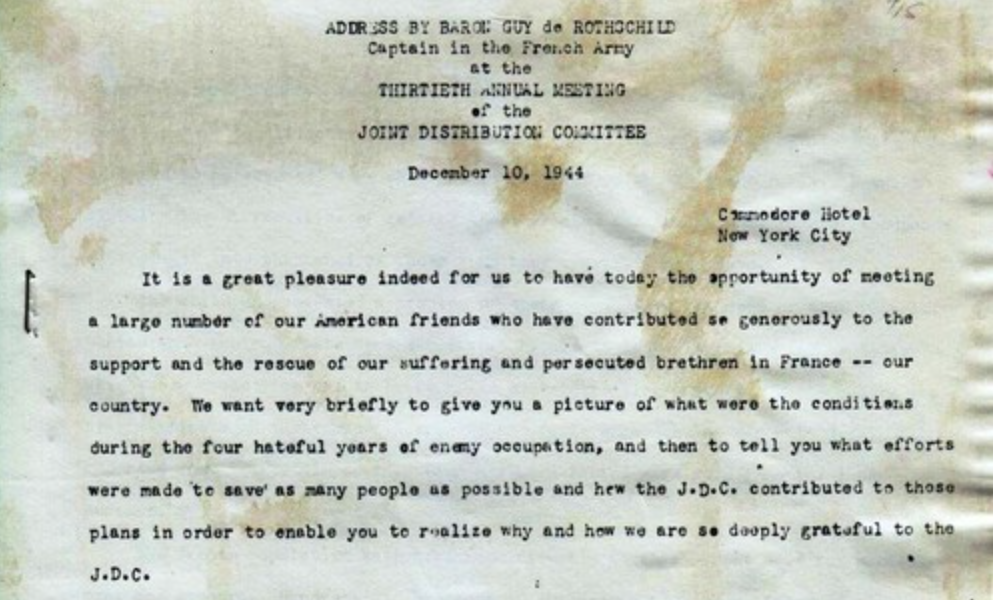
I see that at the JDC’s 30th annual meeting in New York in December 1944, a speech was given by Baron Guy de Rothschild, which was published in printed form, though I have been unable to track down the full text. [59]
The Rothschilds of course played a central role in creating the state of Israel, as they are always proud to relate. [60]
The exact nature of the JDC’s activities over the last 112 years is not clear to me.
As I wrote in ‘Wars, Resets and the global Criminocracy’, so-called humanitarian relief “is often a convenient cover for massive and highly dubious transfers of money”. [61]
This is not necessarily the case here, I should stress, but I noticed that Arendt mentions a peculiar proposed Jewish deal with the Nazis “through which [Kurt] Becher and [Heinrich] Himmler hoped to obtain twenty million Swiss francs from the American Joint Distribution Committee, for the purchase of merchandise of all sorts”. [62]
The JDC was also one of a number of private organisations – alongside the World Jewish Congress, the Jewish Agency for Palestine, The Joint Foreign Committee of the Board of Deputies of British Jews and the Anglo-Jewish Association, the New Zionist Organization and the Royal Institute of International Affairs (Chatham House) – to have attended the Evian Conference in France in 1938. [63]
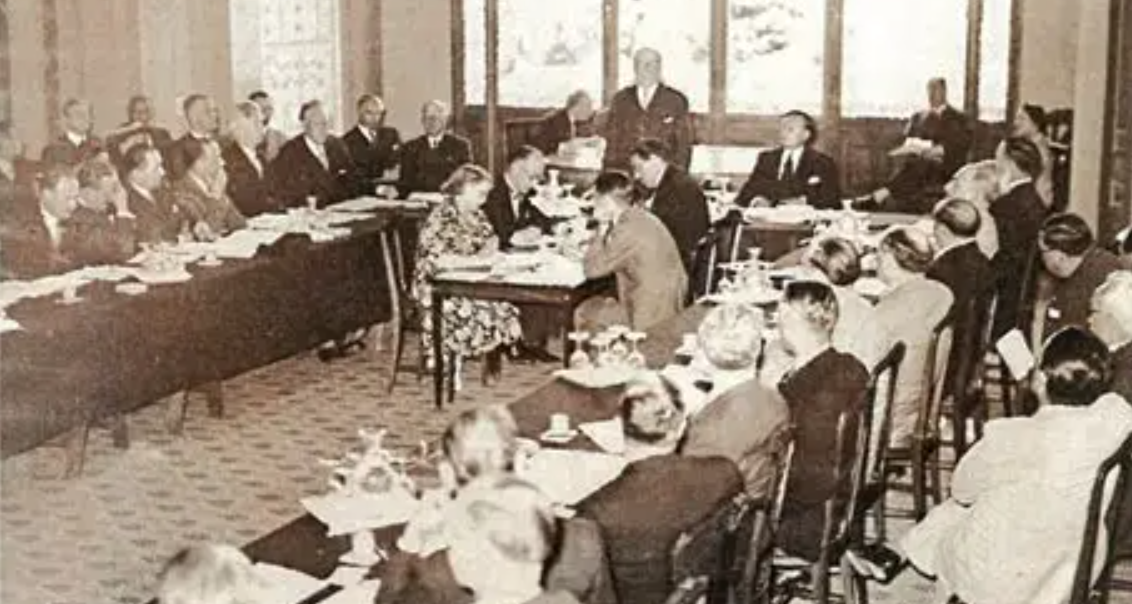
This gathering represented probably the last pre-war chance to prevent the mass loss of Jewish lives under the Nazi regime and could have potentially resulted in the 32 participating nations agreeing to accept Jewish refugees fleeing the Third Reich.
One can imagine that governments, and non-Jewish populations, across the world might have been hesitant to open their doors to large numbers of new arrivals.
But that is not where we need to look for the source of the opposition that scuppered the proposed rescue, rendering the conference a failure and condemning millions of Jews to remain trapped in Hitler’s empire.
It was Jewish groups, including “The Joint”, that were primarily opposed to Jewish emigration!
In his 2019 book The Jewish Choice: Unity of Anti-Semitism, Michael Laitman writes that Rabbi Jonah. B. Wise, national campaign chairman of the JDC (pictured), was one of certain Jewish participants who “avoided any action in favour of the Jewish refugees in Germany and Austria” and “praised the American government policy of inaction”. [64]
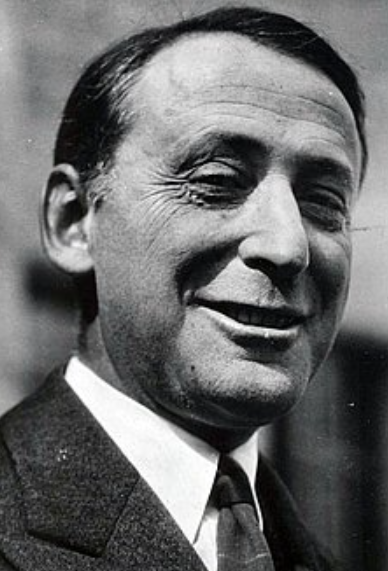
“Following the conference all he offered was accolades to the head of the US delegation, Myron. C. Taylor. According to the Jewish Telegraphic Agency (JTA), Wise ‘attributed the conference’s success [as he put it] to the personal efforts of Myron C. Taylor…” [65]
“Success”!
“When reading these praises, it is easy to forget that the conference, in fact, decided not to do anything for the Jews… Rabbi Wise declared: ‘There is no expectation of furthering mass emigration from Germany. Rather, the conference seemed to be resolved that Germany should be made to understand that nations of the world cannot expect to absorb a mass exodus from that country'”. [66]
Edward Turnour, who led the British delegation, recalled the “stubbornly unrealistic approach” of some leading Zionists who insisted on Palestine as the only option for the refugees. [67]
And Yoav Gelber, professor of history at the University of Haifa, has concluded that “if the conference were to lead to a mass emigration to places other than Palestine, the Zionist leaders were not particularly interested in its work”. [68]
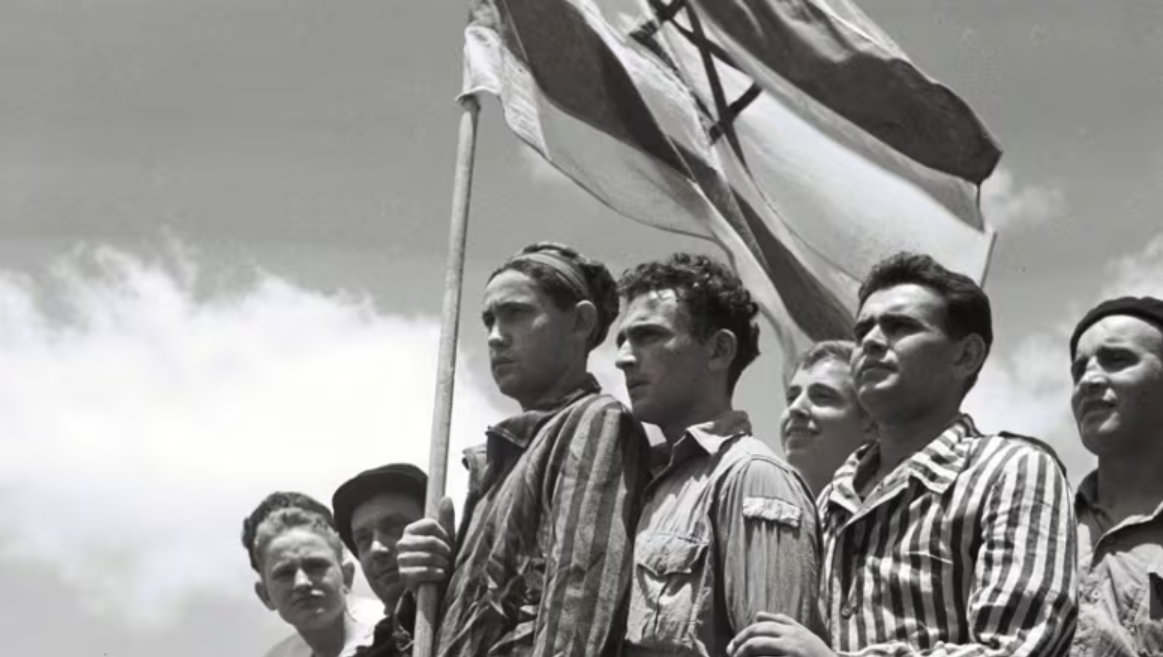
We should not forget that hatred of Jews, even murderous hatred, did really exist in Germany and elsewhere in Europe.
But, like experts in the martial arts, Zionists used the weight and momentum of attacks against Jewish people and interests to their own advantage.
They created the Nazi regime so as to encourage their enemies to take part in evil acts that would ensure the creation of the state of Israel.
As we have seen, they blocked attempts to rescue their fellow Jews from death, collaborated with the Nazis in saving a select few that would be most useful for their post-war cause and actively participated in the extermination programme.
The spectre of The Holocaust also served to morally disallow criticism of Zionism and Israel – and even any suggestion that judeo-supremacism could actually exist – for many decades.
Today, legislation is being rushed through everywhere to stop us talking about any of this – online at least.
But, frankly, it is too late.
After 80 years, the dark sorcerer’s spell has been broken by the Gaza Holocaust and millions upon millions of us across the world now see Zionism for what it always really was.

[1] Hannah Arendt, Eichmann in Jerusalem: A Report on the Banality of Evil (New York: Viking, Second Edition, 1964), p. 111. I worked from a pdf version and the page numbers cited are of that document. All subsequent page references are to this work unless otherwise stated.
[2] p. 133.
[3] Paul Cudenec, ‘Hate, supremacism and the satanic world order’, https://winteroak.org.uk/2026/01/05/hate-supremacism-and-the-satanic-world-order/
[4] p. 10.
[5] p. 132.
[6] p. 29.
[7] p. 65.
[8] p. 29.
[9] p. 59.
[10] p. 8.
[11] p. 9.
[12] p. 10.
[13] p. 14.
[14] Paul Cudenec, ‘Adolf Hitler and the zio-imperialist mafia’, https://winteroak.org.uk/2025/05/08/adolf-hitler-and-the-zio-imperialist-mafia/
[15] p. 14.
[16] p. 8.
[17] p. 19.
[18] p. 23.
[19] Ibid.
[20] p. 26.
[21] p. 33.
[22] Ibid.
[23] p. 31.
[24] p. 32.
[25] Ibid.
[26] p. 65.
[27] p. 61.
[28] p. 32.
[29] Ibid.
[30] Ibid.
[31] p. 24.
[32] pp. 25-26.
[33] p. 58.
[34] p. 59.
[35] Ibid.
[36] Ibid.
[37] p. 60.
[38] p. 61.
[39] p. 60.
[40] p. 46.
[41] p. 87.
[42] Ibid.
[43] p. 34.
[44] https://family.rothschildarchive.org/estates/58-palais-rothschild-24-26-heugasse
[45] Paul Cudenec, ZIM Unzipped: Investigating and Opposing the Zio-Satanic Imperialist Mafia (2025), p. 148, https://winteroak.org.uk/wp-content/uploads/2025/11/zuonline.pdf
[46] Clipping in Victor Rothschild’s MI5 file.
https://archive.org/details/kv-2-4533/KV-2-4533_1/
[47] p. 26
[48] Ibid.
[49] p. 33.
[50] Ibid.
[51] https://de-academic.com/dic.nsf/dewiki/2434820
[52] https://archives.cjh.org/repositories/5/resources/18507
[53] https://de-academic.com/dic.nsf/dewiki/2434820
[54] https://www.thejoint.org.il/en/
https://forward.com/news/454554/infighting-turnover-buffet-the-joint-distribution-committee-american/
https://www.jdc.org/our-work/cultivating-a-jewish-future/
[55] https://en.wikipedia.org/wiki/American_Jewish_Joint_Distribution_Committee
https://en.wikipedia.org/wiki/Louis_Marshall
[56] Gerry Docherty and Jim Macgregor, Hidden History: The Secret Origins of the First World War (Edinburgh & London: Mainstream Publishing, 2013), p. 216, cit. Paul Cudenec, The Great Racket (2023). p. 294.
[57] Docherty and Macgregor, Hidden History, p. 216, cit. Cudenec, The Great Racket, p. 295.
[58] See Cudenec, ‘Adolf Hitler and the zio-imperialist mafia’, op. cit.
[59] https://www.ebay.com/itm/135392348561?msockid=2938acc583476abd1006b85a820e6b85
[60] https://www.thejc.com/news/features/a-family-that-helped-build-a-new-nation-kkakggbe
[61] https://winteroak.org.uk/2024/06/10/wars-resets-and-the-global-criminocracy/
[62] p. 69.
[63] https://en.wikipedia.org/wiki/%C3%89vian_Conference
[64] Michael Laitman, The Jewish Choice: Unity of Anti-Semitism: Historical facts on anti-Semitism as a reflection of Jewish social discord (Toronto & New Yok: Laitman Kabbalah Publishers, 2019), p. 155, https://books.google.fr/books?id=mhnGDwAAQBAJ&pg=PA156&redir_esc=y#v=onepage&q&f=false
[65] Laitman, p. 156.
[66] Ibid.
[67] Edward Turnour Winterton (6th earl of), Orders of the Day (London: Cassell, 1953), p. 238, https://en.wikipedia.org/wiki/%C3%89vian_Conference
[68] Yoav Gelber (8 August 2011). ‘Zionist Policy and the Fate of European Jewry (1939-1942)’, in Michael Robert Marrus (ed.), The Nazi Holocaust. Part 8: Bystanders to the Holocaust. Vol. 2. Walter de Gruyter, p. 582, https://en.wikipedia.org/wiki/%C3%89vian_Conference
 winter oak
The Holocaust, means, The Great Silencing…
…….
The Holocaust, as a commemoration solely of Jewish experience, did not exist ’til the mid-1960s when it began to be hammered into popular consciousness… Prior to that the holocaust (lower case) included all non-jews who underwent the same experience… Today The Holocaust acts as a Great Silencer, no surprise Arendt wrote before, and probably her writings contributed to, the need for a Great Silencer…
The mid-1960s was also when The Big Bang hypothesis, via Scientific Consensus, began its life as A Scientific Fact, and began to take root in popular consciousness…
LikeLike