“You’ve gotta punch the clock, why don’t you punch your boss? You just punch the clock, too scared to punch your boss.” – Dead Kennedys, “Well-Paid Scientist”
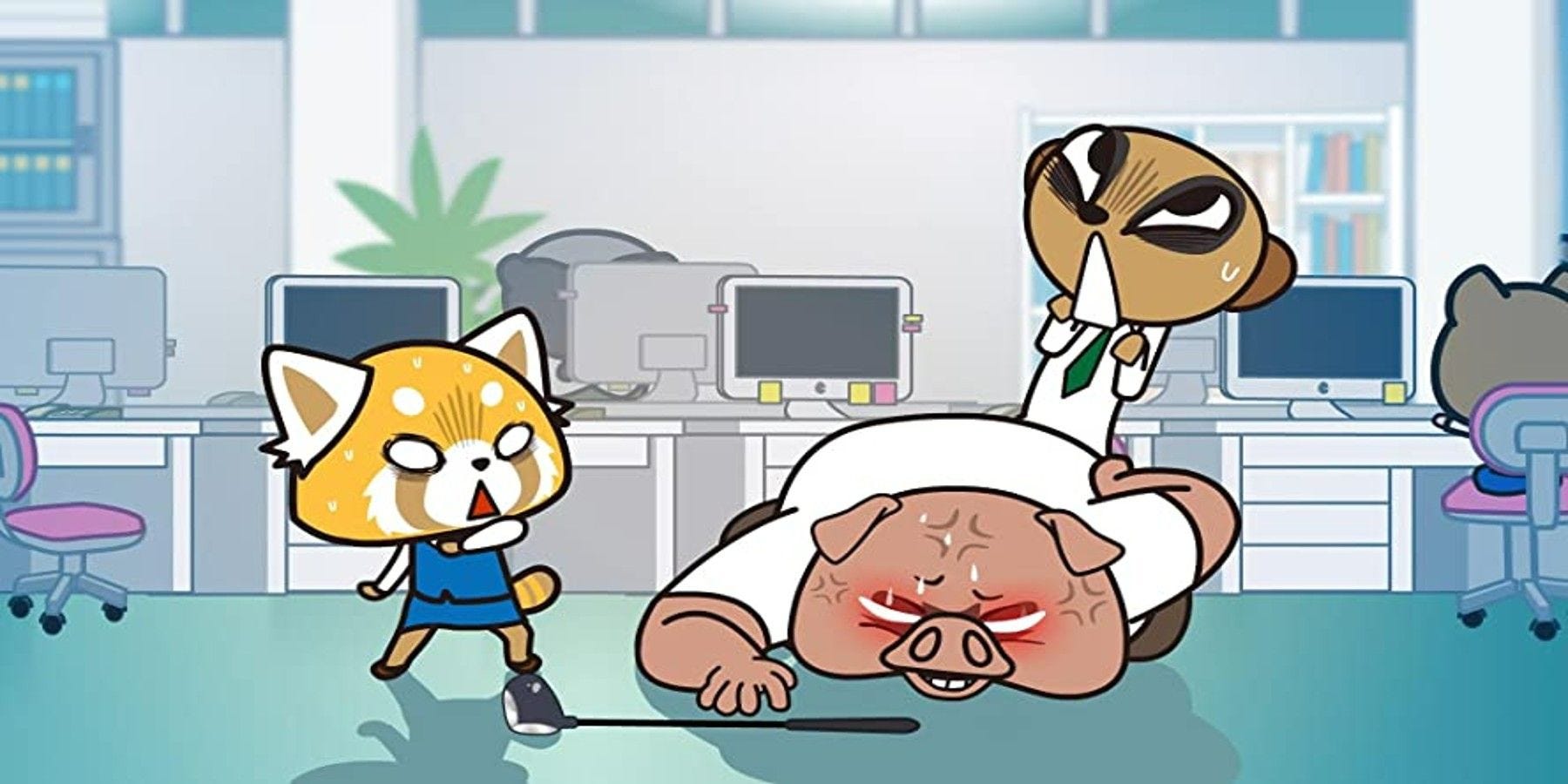
Aggretsuko beating the shit out of the patriarchy and her boss simultaneously. It’s fun to think about.
We ended Part 1 of our discussion on self-respect with some questions:
Why be a chameleon? Why not respect your own values and beliefs? What is the freedom blockage here that prevents us from respecting ourselves in our actions and behaviors?
The basic answer, psychopolitically, is survival. We are all living a world of power relations that are intentionally not taught to us as power relations. You have to dig to get this information in a real, non-YouTube summary sense. You will learn about these in social work or psychology or political philosophy classes, but outside of the academy, pop psychology generally glazes over the complex trauma and psychological systems that prevent us from experiencing freedom and self-respect. Malcolm Gladwell is not talking about the revolution, and Jordan Peterson (may he and his followers all leave earth) is about as much of a “psychologist” as Ayn Rand was a “philosopher.” Some causes of people not having or sometimes even recognizing their need for self-respect:
Childhood abuse: emotional putdowns are extremely common, as the adults reproducing often are not emotionally centered or self-aware themselves, and they perpetuate the cycles of emotional abuse or misdirected anger. They grow up bullied or hurt due to abuse, they grow into adulthood, and then they must take the pain out somewhere.
From a physical abuse standpoint, physical violence is still disturbingly common, despite the demystification of it since the mid-20th century, at least in the West. Most domestic violence comes from the fact that proper conflict resolution is intentionally not taught in our society. There are, of course, plenty of terrible, abusive people out there, which has nothing to do with interpersonal dynamics. But there are structural reasons why the number stays high despite awareness of most people that it is bad and not okay physically to harm family members so you feel better.
It makes sense that conflict resolution is not really taught to us. Why would it be, when you can hire a private police force to crack the skulls of all your enemies? You need a stupid, illiterate-ish, animalistic populace, who are way easier to exploit than smart, deep, rooted people who live in accordance with their values.
The ideology is: let’s make the lumpenproletariat beat other into submission, then we have some fresh bodies to fill our private prisons. Structural violence is clearly perpetuated in this way, causing traumatized children to grow into traumatized and traumatizing adults, lacking the conflict resolution skills to be safe and mutually beneficial with others. But surely these scared children that grow into our puffy adults (I’m thinking about that fucking fat baby Kyle Rittenhouse, and yes I will savagely body shame that murderer until he dies of a heart attack) will make excellent future police officers of the AI gods’ privatized brownshirts of new. If our future ICE officers can get over their high-fructose guts long enough to tie their boot laces.

Hey look, a murderer who got off scot-free, who is also a future domestic abuser (almost guaranteed, I would say) who also looks like a giant fucking baby.
Emotional abuse can be examined in a variety of ways, but I think most interesting is through the lens of achievement and the psychic violence of neoliberalism, even for the most privileged children. Emotional violence is certainly almost infinitely ubiquitous in this society, particularly for the perfectionistic, self-optimizing neoliberal subject child—you know, the kid of professor and lawyer who has all the opportunities but acts out by doing coke and partying because they are constantly in a state of psychological stress and pressure, and are just seeking something to make them feel human, or at least, disconnect from this version of humanity of expectation and destruction of choice and self-respect inherent in celebrity consumer culture hell. See: every single child and teen actor, ever. I wouldn’t be surprised if Taylor Swift’s life ends tragically, because capitalism chews you up and spits your psyche out when it’s done, even when you performatively seem to have it all together.
Self-optimization becomes a form of psychic violence in which real desires and feelings must be sublimated into the productivity of “Select” sports, scholarships, creepy fraternity/sorority rape-cults preparing the achievement subject for a career as the next Epstein, salaries, abstractions, and of course, stocks and bonds, the only true drivers of value now that God is dead and we killed him (well, we can bring him back for a sequel, if it makes us profit).
So, we see that abuse can be defined in a variety of ways that provide a variety of trauma responses, in which it would make sense survival-wise for a child, now an adult, to hide their true nature, to be able to get by in a world that is constantly threatening one’s spiritual and psychic peace.
As the Dead Kennedys put it in their classic “Well-Paid Scientist”:
Dead Kennedys – “Well-Paid Scientist” from the Plastic Surgery Disasters / In God We Trust Inc. EPs (adblocker friendly link)
Company cocktails, gotta go
Say the right thing
Don’t fidget, jockey for position
Be polite
In the pyramid you hate
Sip that scotch
Get that raise
This ain’t no party at all
Cringe and tense up
Grind your teeth
And wipe your sweaty palms
Close your windows driving past
The low-life company bar
They’re making fun of you
You’ve gotta punch the clock
Why don’t you punch your boss?
You just punch the clock
Too scared to punch your boss
Pull up to your sterile home, you’re drained
Bite the heads off of your kids
Chew them well; they taste like you
Just slam the door.
“Chew them well, they taste just like you.” And, the cycle continues, as the next “Well-Paid Scientist” submits to the system, taking his rage out on his children and family. Are these an example of the “externalities” the economists are always claiming don’t exist? Are externalities also psychological?
In addition to childhood abuse, quite common is childhood emotional neglect. The world of capitalism demands an intensity of effort at work. Regardless of how alienated one feels, one can imagine how it is very difficult for millions of parents to even be able to meet their child’s needs because they are unable to meet or understand their own, often due to lack of resources or psychological understanding. There is very little emotional space left after capitalism and all of the pressures of life have sucked the life force out of most adults. Well-meaning parents try to do their best, but may not have the skills or abilities emotionally to co-regulate with their children or give them the attention and emotional support they need to grow into successful, connected, rooted, centered people. We see the results as the trauma goes from generation to generation.
The fact that all the “self-help” out there is a product to be sold does not help alleviate the pressure that leads to cycles of emotional neglect or distance. Even my favorite neuroscience podcast Trauma Rewired stinks of neoliberal “coaching” services to rich people to discuss childhood neglect. I understand the intent is positive and helps lots of intelligent people. I also understand it can be (and should be, in my opinion) conceptualized as an instrumental weaponization of neuroscience for hypercapitalist means. This is a typical paradox in our current society where ideological purity or full freedom is blocked — even with the appropriate and helpful embodied solutions, the cancer of neoliberalism is ever-present in our world, always providing the disease and the cure simultaneously.
Inconsistent affection can also lead to a loss of self-respect. A parent who is bipolar or has other mental health symptoms (probably from growing up in this hell we are discussing today) is not always going to be able to give their children what they need. These children grow up not knowing which inputs will result in love and praise. So, they hide the parts of themselves that they think will reduce the love of adults and others in their hearts. This leads to self-censorship and willingness to cross boundaries they would not normally cross in an attempt to get that connection that is inconsistent and unpredictable, like the slot machine or the Instagram tag notification.
They carry this burden with them into adulthood and have to relearn and repattern how to connect with others safely and be themselves and develop self-respect, rather than trying to accommodate the inconsistent emotional responses of those around them, which could lead to pain, or could lean to connection, occasionally. In more intentionally (or sometimes subconsciously) manipulative situations, parents or caregivers may triangulate or otherwise create dynamics that make a coherent sense of self for the child next to impossible, as a coherent sense of self would lead the then-child now-adult individual to reject or distance themselves from a problematic relationship with a toxic person, even if it is their original caregiver. The manipulation allows the caregiver to maintain control, at the psychic expense of both parties. The winner I guess is the two therapists they eventually go to and those therapists’ billable hours. Until of course that therapist can become an “executive coach” and cash in big-time on this psychological knowledge.
Institutions (waddup Foucault) of course punish self-expression outside of the prescribed hegemonic behavioral paths. Whether it’s the pants-drawing silliness we started with, or things that “offend” others that are relatively innocuous, or whatever, institutions are built to control and dominate. The internal institutions now are also in our heads, as Deleuze describes with his “control society” of internalization of these institutional rules that are reified through mostly social control and bullying, although there is also a more “positive” push as we will have to explore with Byung-Chul Han further in the future.
Self-respect is thus eroded in many, many corners, and we could go on all day if we wanted to. To regain our sense of self-respect, in this context of oppression, there are some things we can do. If we are aware of this domination, and are aware of the benefits of living in accordance with one’s values, we can find some paths forward and stop feeling so god damn crazy all the time (a highly scientific description of my inner state most days).
Paths Forward to Regain Psychopolitical Control and Self-Respect
- Emotional honesty with yourself, and with safe people you trust to share how you feel, who will not judge or belittle you, but will understand where you’re coming from, why you’re coming from that place, and can emotionally co-regulate with you to help process these feelings.
- Pride based on internal satisfaction, instead of putting oneself above others or trying to tell people what they “should” do as a false form of pride.
- Authentic connection to others and nature.
- Embodiment and being yourself instead of trying to act like like Jesus or Mohamed or the Buddha or one of those creepy tech CEOs or whoever else.
- Making choices that fit with your values. Refusing to submit to choices that are unethical to you.
- Trusting your intuition and “gut” feelings. Physical sensations combined with emotions are signals that something is not in sync between the world out there and your brain and body. Be curious and follow your intuition and body until you find the answer for yourself — not what the guru or meditation guide said you should feel, but what works for you, in your body, in your spirit, in your soul.
- Revealing the “forbidden” parts of yourself without censorship that you choose to, to safe people, in safe contexts.
- Accepting and perhaps even embracing and encouraging paradox and beauty over perfection.
- Feedback is information you choose to act or not act on, based on your values, not on the hegemonic reward system into which we are forced, or the notification schemes of the evil lizard people in Silicon Valley.
We will have to talk about shame and self-abandonment next time, as shame is the ultimate weapon of psychopolitics, even more powerful than the positive inducements of tech hell. Shame in fact is probably one of the major reasons we are in this quagmire we are in, at least from an emotional mapping of neoliberalism. It is so powerful in inducing behavior and increasing compliance with tech hegemony.
With shame, we will be exploring questions such as:
- What are the associated social-community expectations?
- Why do they exist?
- Who really benefits?
- How does shame manifest itself in the body?
- How does it constrict political or autonomous decision-making in a culture of infinite mediated spiritual violence? Is there escape, or are we gonna be grumpy like Theodor Adorno, hating jazz forever and in desperate need of an edible or two?
I leave you with a classic Kodan Armada track, “Death Wears a Necktie” (adblock friendly link). Hard to live in accordance with your values when you have to pay the bills, but we will try!
EVERYONE: Nine to five, we’re just trying to survive. We’re so calm, just like sheep. Close your eyes.. Shh-
BRENT: There’s only one word for this. Nine to five, you’re dead
ADAM: I gave you, I gave them everything
CORY: Line your casket, live the lie
RYAN: I can’t keep up with it
DAN: I don’t wanna have to work, I don’t want to have to do this. Wasting my life… This is bullshit!
 winter oak

Psychosis of Whiteness and White Malice. Deep in the DNA.
Gosh, outsized influenced on psychology and education and medicine and banking and bombing and tech and AI: The Story of Trauma is that, well, chosenness:
https://paulokirk.substack.com/p/merry-jewish-xmas-israel-has-turned
But I’ll listen to Cuntology 101:
LikeLike