by W.D. James
Simple stories are often the best stories.
The Christmas story itself is quite simple and about simple characters: a young mother, her baby, some shepherds and angels and a manger. Most of the good stories it has inspired are likewise simple, dealing with a few human essentials. Christmas seems to be a time we can accept dealing with basic truths.
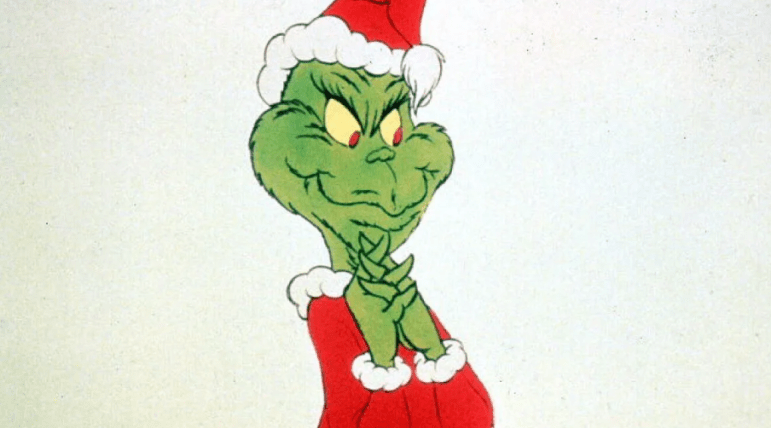
One of my favorites is Dr. Seuss’s How The Grinch Stole Christmas! (1957).
Almost everyone is familiar with the basic plot of the envious green Grinch creature and his faithful dog Max as they try to steal Christmas from the Whos who live in nearby Who-ville. It is commonplace to call someone who does not seem to get the spirit of the season a ‘Grinch.’
Here I’d like to look a little deeper at who a Who is and what sort of person the Grinch is, to uncover a bit more of the depth of the tale.
Who-ville
Whos are who the Grinch loves to hate, in no small part because Whos love Christmas.
Who are Whos? Not that Seuss was intentionally thinking about this (but he could have been), but I think the etymological depth of the word still shows through in our ordinary usage. The word derives from the Old English hwā meaning ‘what person.’ A who is not just a what and not some nondescript them. The word bears traces of the ontological insight that we humans are distinct, unique, persons. From little Cindy-Lou Who to tall J.P. Who, all Whos are equally persons. As we are taught in the earlier tome by the Master, Horton Hears a Who, “A person is a person, no matter how small!”
Hence, Who-ville, where all the unique persons live in harmonious community is one image of the American ‘beloved community’ of our imaginations and aspirations.
His head wasn’t screwed on quite right
Among the first things we are told about the Grinch is that “his head wasn’t screwed on quite right” and that his heart was “two sizes too small.” He is pretty much a loner, thinks a good bit, and lives on a cold mountain just North of Who-ville.
Indisputably, the Grinch is a German philosopher of the rationalist variety, occupying the barren heights of cold reason.
He hates noise, feasting, and singing – the joys of the embodied existence of Whos like us.
They’d sing
Yes, Whos love all those things and they love Christmas. I think Christmas is a very Who, very personalist, holiday. It’s quite important that the baby Jesus is not some archetype – he’s a fragile little person born to humble parents in a very particular place. They are there so that they may be taxed. God and the taxman care about us as individual persons (I think archetypes have some sort of tax loophole).
Of the many joys of the Whos, it is the singing, we are told, that the Grinch especially hates. Singing represents individual persons carried along into community through an expression of beauty (that sounds rather fancy and rare, but we can all sing together whenever we like – utopia, the kingdom, is within you and at hand).
Santy Claus
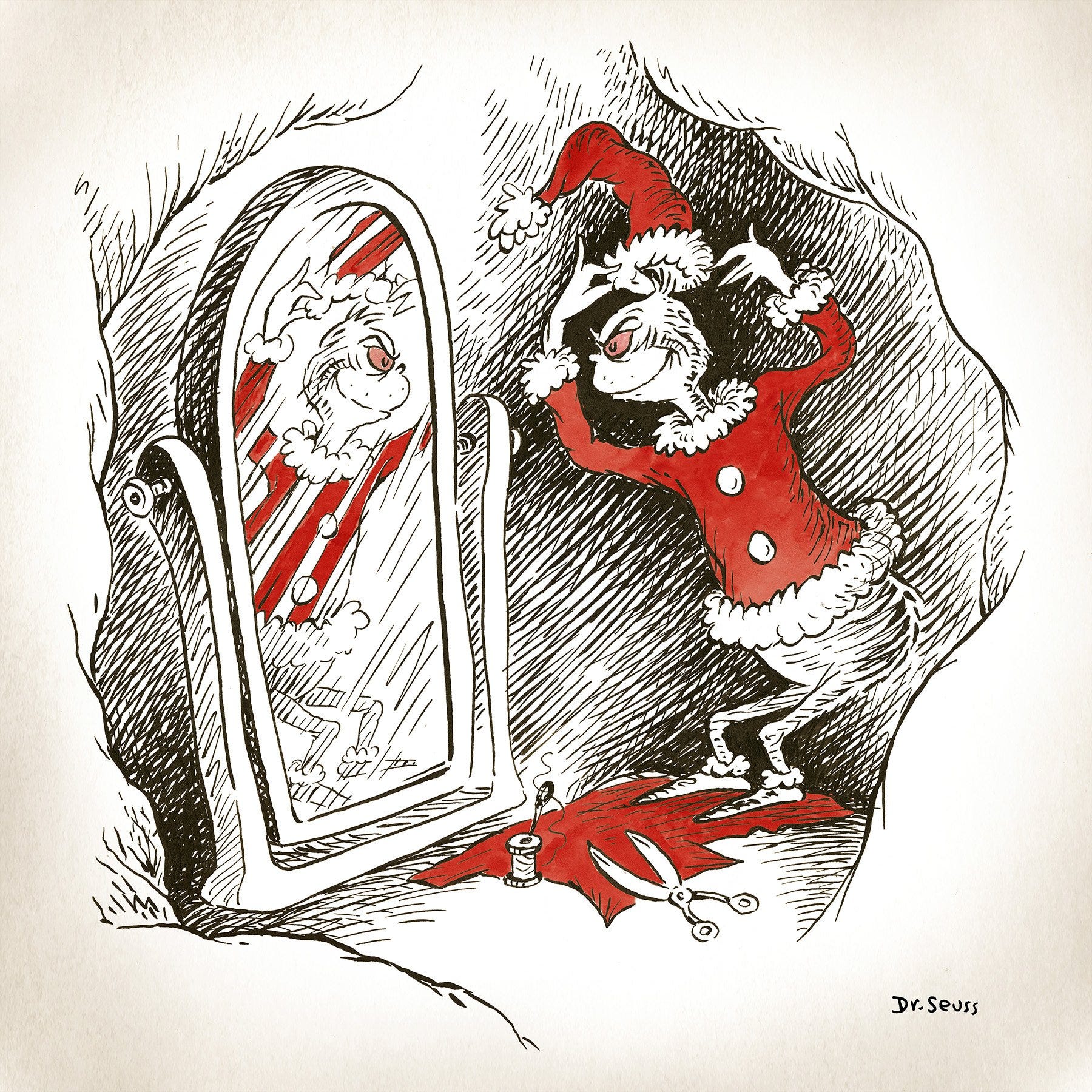
To facilitate his plan to ‘steal Christmas,’ the Grinch puts on a ‘Santy Claus’ suit and dresses his dog Max as a reindeer. He is not only a fake Santa, he is an anti-Santa – he comes to take, not to give.
Clearly, the Grinch does not get or ‘believe’ in Christmas. He impersonates that which he does not believe in, to take away what he does not think exists.
As a person who has rubbed elbows with many an academic ‘philosopher,’ that sounds like a nearly perfect description to me. There are no shortage of shysters who will gladly destroy the few beliefs, hard won through millennia, of their young pupils. Do they replace those with true wisdom, whose name they bear in their title (philosopher = lover of wisdom)? No, they are quite adept at tearing down, but pitifully impecunious in the goods they have to distribute.
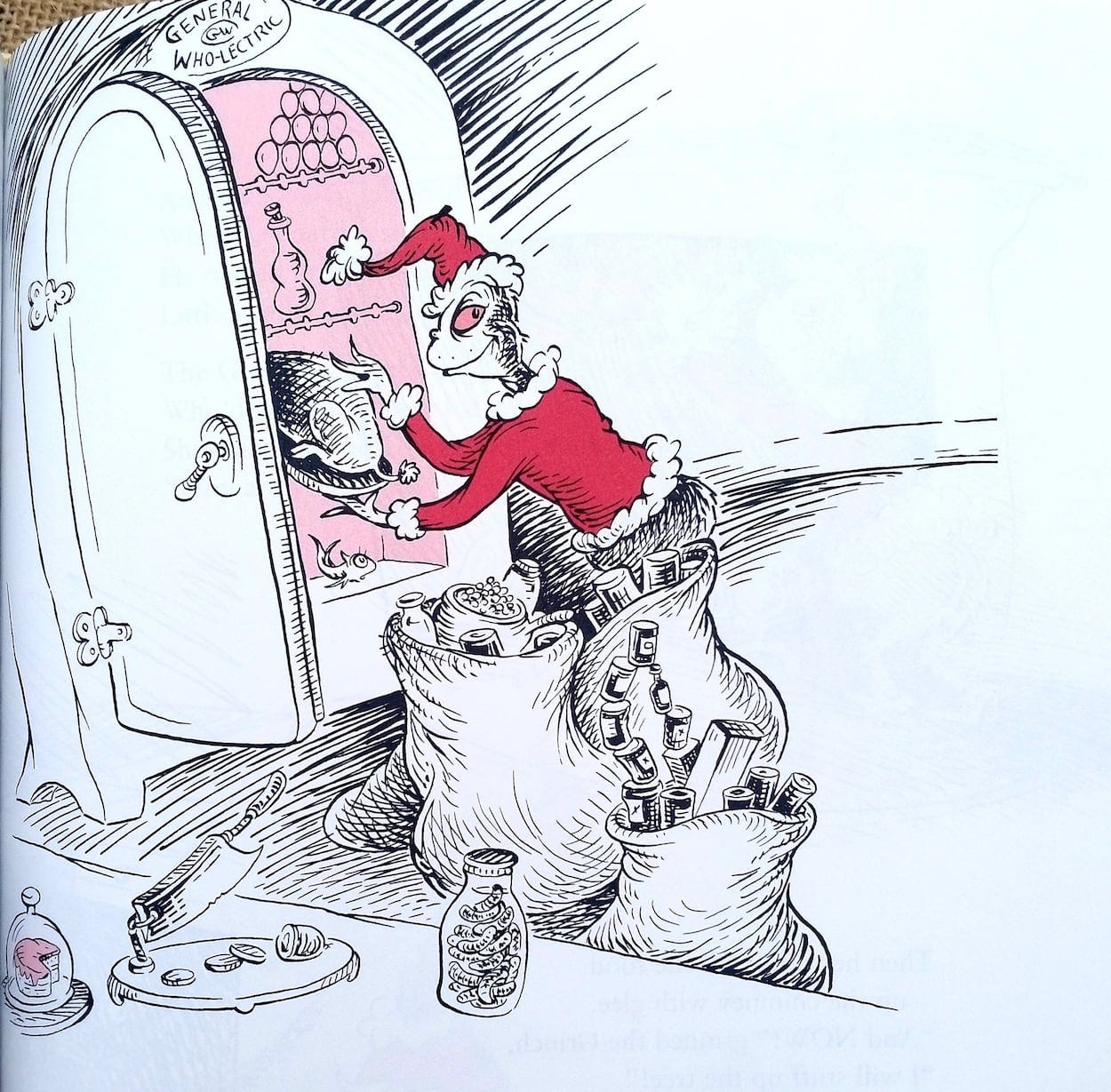
The Grinch takes the Whos’ presents, trees, food, and decorations, leaving only “crumbs much too small for the other Whos’ mouses.” Not even enough for a mouse to subsist on. Rationalism.
His puzzler was sore
Having stolen their Christmas (or their Christmas goodies), the Grinch expects to hear moans of “Boo Hoo” echoing up from Who-ville on Christmas morning. And he longs for it. The joy of miseries wrought.
But what he hears instead is merry singing rising up his mountainside from the villagers below. How, with no presents?
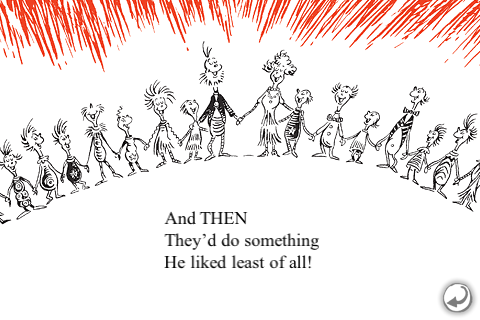
“He HADN’T stopped Chrismas from coming! IT CAME! Somehow or other, it came just the same!”
He just stood there “puzzling and puzzling,” with his feet in the cold snow, “until his puzzler was sore.” Poor philosopher. It’s all just puzzles. Except, it isn’t.
In addition to the deeper lessons Seuss is seeking to teach us, he has a specific message about the commercialization of Christmas he is wishing to convey (we are told in the lore of the Sage’s life that he was particularly distraught at this particular time by such commercialization).
“It came without ribbons! It came without tags!
It came without packages, boxes, or bags!”
The Grinch’s cold rationality can’t comprehend it. Nor can the cold calculation of the Christmas profiteer.
Perhaps, he realizes, it “means a little bit more.”
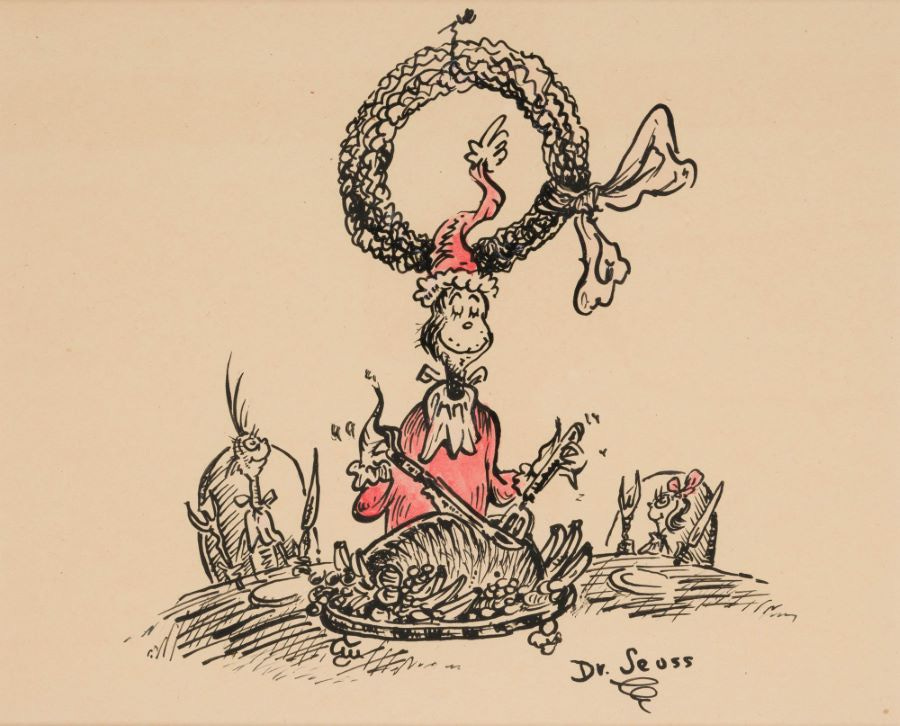
Roast beast
We are told that with that realization his ‘‘heart grew three sizes that day.”
In response, he returns all the presents to the Whos (getting the Santa – and divine – directionality correct).
The second to last line of Seuss’s modern fable is: “… HE HIMSELF…!” The Grinch has become a distinct person, a HIM, a Who! He came down form his lonely mountain to the welcoming village.
He has been transformed, his heart has grown, and perhaps his head is screwed on a bit more right.
He joins the community and participates in the sacred holiday ritual: “The Grinch carved the roast beast!”
So ends Seuss’s story.
May we all be a bit more Who-ish this holiday season, and find some folks to be noisy with, feast with, and sing with.
One of my favorite film Christmas scenes, from White Christmas. Amongst the mechanized impersonal slaughter of war, personal relationships develop- and Rosemary Clooney of Maysville, KY, is one of the stars of the movie. Even people from Kentucky are Whos.
It is also my daughter’s favorite holiday film.
If you would like a little more holiday themed reading, check out my previous Christmas posts here on Winter Oak:
Father Christmas is Part of the Resistance! from 2024.
Charlie Brown: Christmas as Social Practice from 2023.

 winter oak
YouTube blocked your video on this post. Might want to try Odysee or rumble for future videos. Keep up the good work. Love your content.
Terry ________________________________
LikeLike
Strange. Works ok here.
LikeLike
Meanwhile in the East merry Xmas Thai style
Defence Ministry: Thai T-50TH Fighter Jets Drop Four Bombs in Srei Snam, Siem Reap at 11:00 a.m.
Created: 24 December 2025Hits: 59
(Phnom Penh):Cambodian Defence Ministry reported continued armed aggression by Thai military forces along the Cambodia–Thailand border, targeting Cambodian sovereign territory in the 4th Military Region at the area of Srei Snam district, Siem Reap province, on 24 December 2025.
At 11:00 a.m., the Thai military deployed T-50TH fighter jets to drop four bombs in the area of Srei Snam district, Siem Reap province.
The situation in some frontlines is calm, while in other areas, the Thai military continues to carry out its attacks on Cambodian sovereign territory. However, Cambodian forces continue to retaliate fiercely and monitor the situation closely and remain highly vigilant.
The brutal actions above are indiscriminate attacks by the Thai military, a serious violation of international law. =FRESH NEWS
LikeLike