by Paul Cudenec (who reads the article here)
“The only hope, or so it seems to me, lies in a reenchantment of the world”, writes Morris Berman in his book thusly titled. [1]
“Some kind of holistic or participatory consciousness and a corresponding socio-political formation have to emerge if we are to survive as a species”. [2]
We have seen how this process might be encouraged by nurturing our connection – our withness – to place, to nature and to the rhythms of the cosmos.
But what kind of spiritual-religious-social “formation” would accompany this, would act as an ideal vehicle for reenchantment?
Alain Daniélou favours the revival of the animistic Shaivite and Dionysian tradition shared by so many of our ancestors.
He argues: “Every civilization, every culture, is the fruit of the accumulation of human knowledge and experience transmitted from generation to generation.
“Shaivism, whose origins go back to the most ancient prehistorical times, represents an immense sum of experience”. [3]
“For Westerners, this would be no embrace of the exotic. The religious wellsprings of Europe are the same as those of India and we have only lost track of that in relatively recent times…
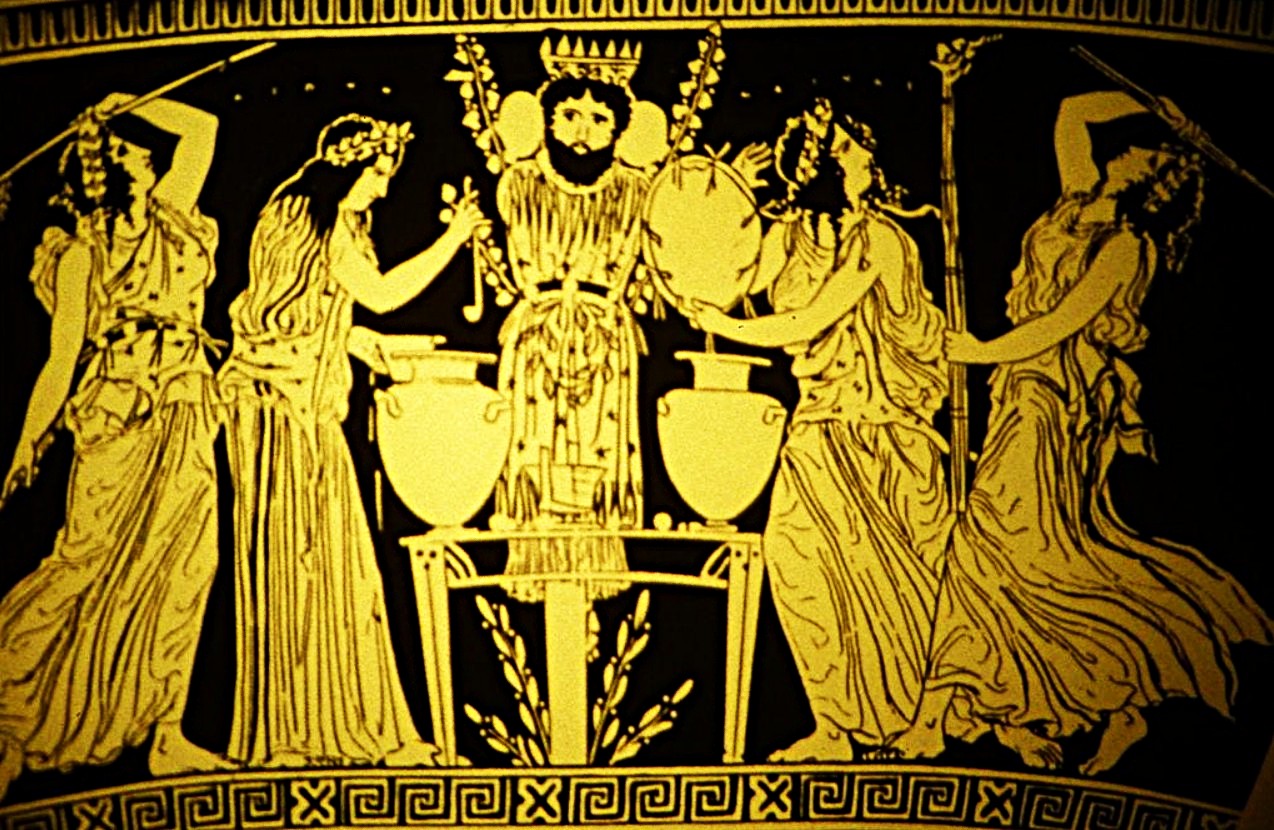
“The rediscovery, at the dawn of the twentieth century, of the happy and peaceful Cretan civilization, and of its religion, so close to Shaivism, which seems to be the deep source of Western civilizations, might be considered a premonition of a return to what [Arnold] Toynbee calls ‘a right religion'”. [4]
“The faithful followers of the god are called bacchoï (bacchants) in Greece and bhaktas (participants) in India.
“For them, it is in the drunkenness of love and ecstasy that can be found real wisdom, where communion with nature and the gods becomes possible”. [5]
John Lamb Lash sees the best source for contemporary nature-friendly spirituality as the gnostic tradition that reached its peak with Hypatia in Alexandria, Egypt.
He writes: “The Gnostic message for humanity may well present the ancient taproot of deep ecology, a social movement that asserts the intrinsic value of the earth, apart from its use for human purposes.
“The religious component of the environmental movement has yet to be defined, but it might now come to expression in a Gnostic perspective, framed by the Sophianic vision of those ancient visionaries”. [6]
“Gnostic cosmology is deeply rooted in indigenous wisdom and reflects a sophisticated version of the native sense for life on earth”. [7]
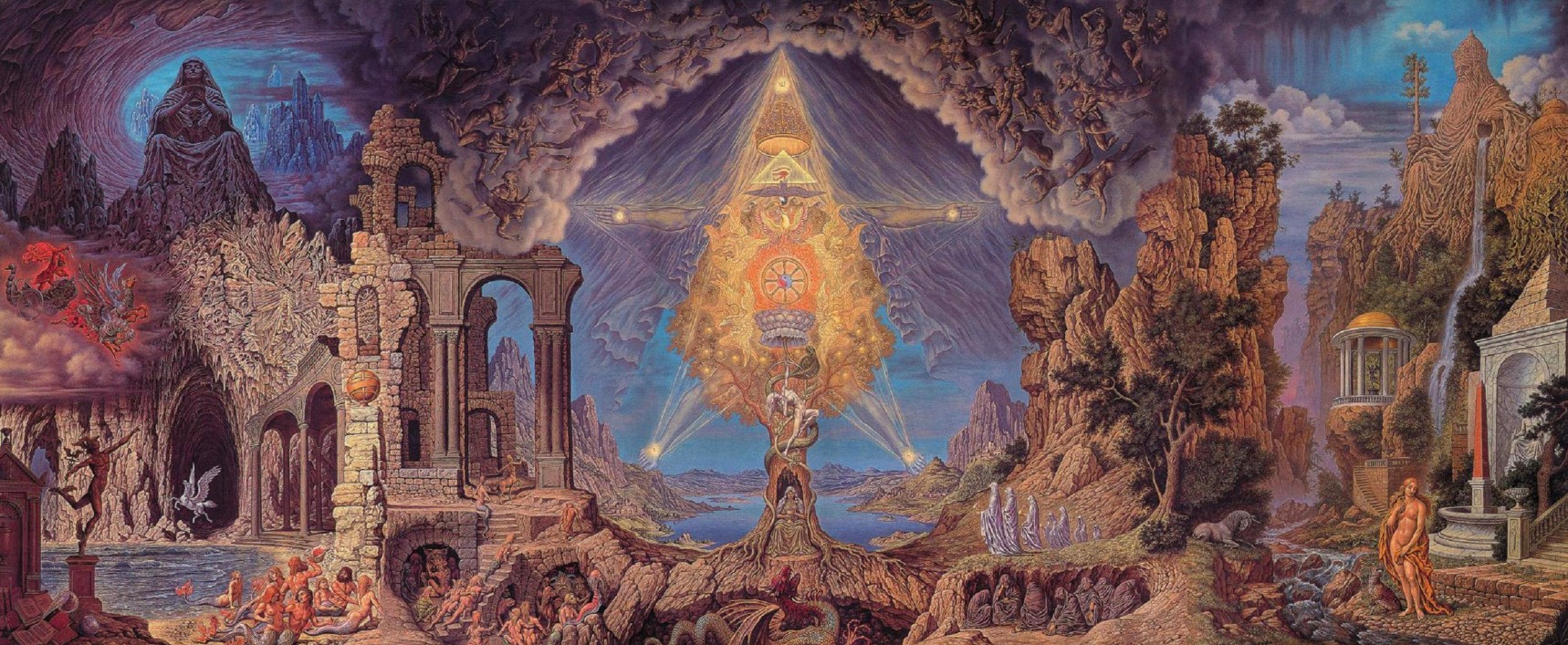
“This is not merely an alternative religion, it is an alternative to religion itself. It is a path of direct knowing, a passage beyond belief”. [8]
“Gnosis is direct contact and communion with Divinity without an intermediary agent of any kind”. [9]
Personally, I think an important element is the emphasis we place on certain aspects of existing religions and philosophies.
Seyyed Hossein Nasr does this, for instance, when he argues that Islam, the “green” religion, is more environmentally oriented than other faiths.
He said in a 2014 radio interview: “The Qur’an addresses not only human beings, but also the cosmos. It is much easier to be able to develop an environmental philosophy”. [10]
In Islam, he has written, “man is the channel of grace for nature; through his active participation in the spiritual world, he casts light into the world of nature. He is the mouth through which nature breathes and lives”. [11]
We see the same thing with Christianity, in which sophiologists stress the concept of divine nature and wisdom that they source from within the teachings of their Church. [12]
They are not inventing a nature-friendly version of Christianity, but bringing out a quality that is already in there somewhere, if not always emphasised by the religious authorities.

Mircea Eliade describes how, although rural European peoples have been Christianised for more than a millennium, “they have managed to integrate into their Christianity a large part of their pre-Christian religious heritage, of an antiquity beyond memory”. [13]
That does not mean that they are not Christians, he stresses.
“But we have to recognise that their religiosity cannot be reduced down to the historical forms of Christianity, that it conserves a cosmic structure almost entirely missing from the experience of Christians in towns.
“One might speak of a primordial and ahistorical Christianity; in becoming Christian, European farming peoples integrated into their new faith the cosmic religion that they had conserved since prehistorical times”. [14]
The fusion of spirituality and love for nature could, and should, take place in a million different ways, according to the cultures, tastes, attitudes and realities of the peoples and individuals concerned.
Most importantly, as I will explain further in the concluding essay in this series, we have to ditch any notion that there is some kind of contradiction between religious spirituality and our physical belonging to nature.
As Eliade writes: “An existence which is ‘open’ to the World is not an unconscious existence, buried in Nature.
“‘Opening’ to the World makes the religious man capable of knowing himself in knowing the World, and this knowledge is precious to him because it is ‘religious’, because it refers to Being”. [15]

[1] Morris Berman, The Reenchantment of the World (Ithaca and London: Cornell University Press, 1981), p. 23.
[2] Ibid.
[3] Alain Daniélou, Shiva et Dionysos: La Religion de la Nature et de l’Eros de la préhistoire à l’avenir (Paris: Fayard, 1979), p. 175. All translations from French here are my own.
[4] Daniélou, p. 12.
[5] Daniélou, p. 21.
[6] John Lamb Lash, Not In His Image: Gnostic Vision, Sacred Ecology, and the Future of Belief (White River Junction, Vermont: Chelsea Green, 2006), pdf version, pp. 32-33.
[7] Lash, p. 179.
[8] Lash, p. 127.
[9] Lash, p. 139.
[10] ‘Islam and the Environment’, CBC Radio,
http://www.cbc.ca/radio/ideas/islam-and-the-environment-1.2914131
https://orgrad.wordpress.com/a-z-of-thinkers/seyyed-hossein-nasr/
[11] Seyyed Hossein Nasr, Man and Nature: The Spiritual Crisis in Modern Man (Chicago: ABC International Group, Inc, 1997), p. 96.
[12] Paul Cudenec, ‘The spirit of Sophia: wild air and wisdom’. https://winteroak.org.uk/2024/09/12/the-spirit-of-sophia-wild-air-and-wisdom/
[13] Mircea Eliade, Le sacré et le profane (Paris: Gallimard, 1987), p. 139.
[14] Ibid.
[15] Eliade, p. 142.
 winter oak