
by Paul Cudenec (who reads the article here)
Because the magic in our lives has been deliberately removed by the industrial slave-system, because our all-round withness has been deliberately stolen from us, we are obliged to take deliberate steps to bring it back.
One such practical initiative with which I have been involved in recent years is to hold evenings of what, in French, is called la culture participative.
Culture, like everything else in modern life, has been turned into a product, a commodity that we have to pay for.
Our experience of it has become commercial and passive – we buy a ticket to sit and watch somebody else sing songs, tell jokes, dance or act out a drama.
The – very enjoyable! – alternative is to do it ourselves, for and with each other without the alienating division between performer and spectator, provider and consumer.
At our events, each person (if they wish) comes with something to share with the others – whether their own creation or not.
During the evening, we all, in turn and when the moment seems right, perform our personal contributions – a song, a poem, an anecdote, a reflection – around the pre-determined theme.
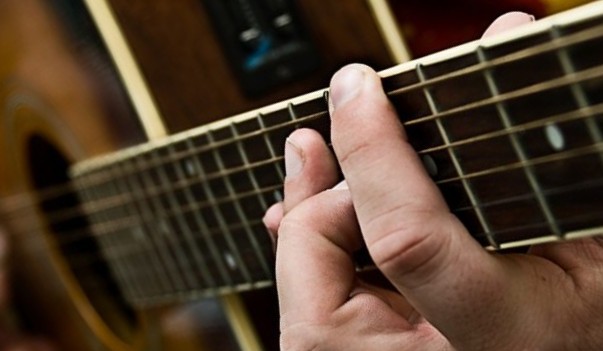
There is no fear of being judged – we all know we are not professionals and have no grand expectations of the others gathered with us.
All of this is washed down with a few drinks and, this being France, nourished with home-made salads, quiches and gateaux that people have brought with them.
Another means of restoring withness which I have been enjoying for several years now is Biodanza – the dance of life. [1]
This practice was developed by Rolando Toro (1924-2010), a Chilean professor who “carried out research concerning expression of the unconscious and states of consciousness expansion”. [2]
He originally called it Psicodanza as it evolved from his treatment of patients at the Psychiatric Hospital of Santiago.
But in this insane modern world, we are all in need of life-affirming therapy, and the broader relevance of the activity quickly became apparent.
Biodanza is, according to its international federation, “a human integration system of organic renewal, of affective re-education, and of re-learning of the life original functions”. [3]
One leading theoretician is Danielle Tavares (pictured), whose father Alberto Tavares was a friend of Toro and one of the early pioneers of the practice in Brazil back in the 1970s. [4]
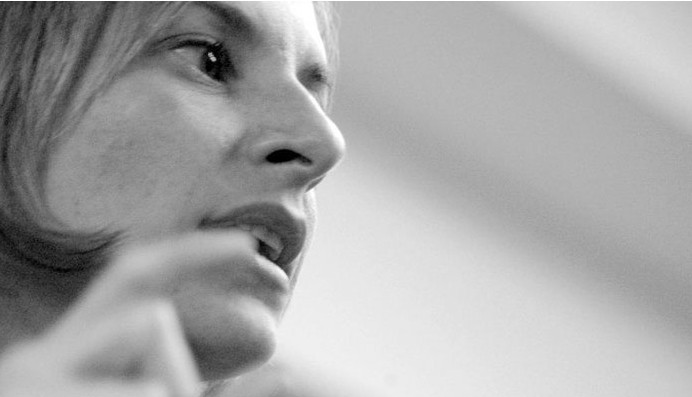
She explains in a booklet: “The vital unconscious is in synchrony with the living essence of the universe. When this synchrony is broken, sickness occurs.
“The act of curing can therefore be understood as a movement which sets out to rediscover this vital synchrony with the universe”. [5]
She adds that a vivencia, that’s to say a Biodanza session, is “the path of direct access to the vital unconscious”. [6]
Before going any further, I should probably explain what a Biodanza event actually involves.
We gather once a week for a couple of hours – in a municipal dance hall in the colder months and in the grounds of a local chateau in the summer.
Before the dancing starts, we have the chance to share our thoughts on the previous session, or anything else, with the rest of the group, who can number anything between 10 and 25.
But there is no talking during the dancing – communication is purely visual.
Our group is pretty balanced on the question of gender, though there are usually a few more women than men.
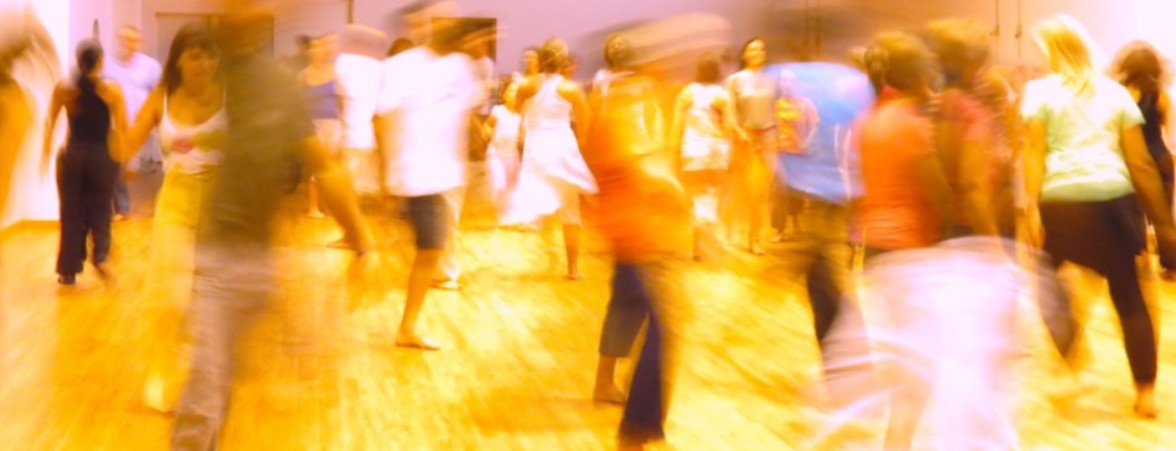
The recorded music often reflects the Latin American origins of Biodanza, and indeed of one of our facilitators. It’s generally to my taste, anyway!
The vivencia always begins with a circle. We hold hands and, as the music begins, revolve in an anti-clockwise direction, establishing eye contact with as many of the other participants as possible.
After that, the session heads off in all sort of directions, depending on the theme chosen by the facilitating duo.
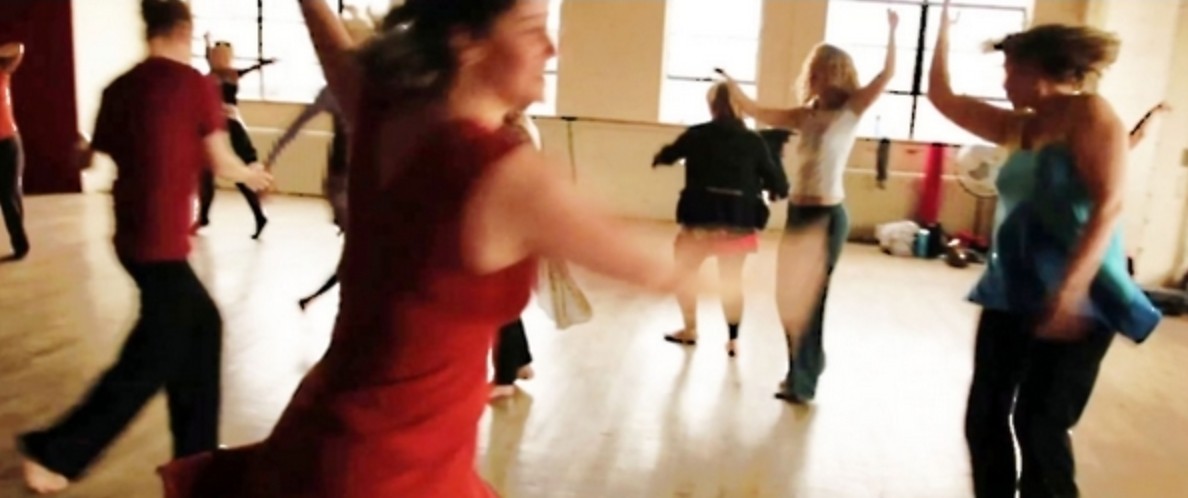
Our movements are always free and unchoreographed.
Sometimes we just stroll in step with the music, acknowledging the presence of others as we pass them.
Sometimes we walk or dance in pairs, finding a common rhythm. At other points, we come together in groups of three, four or five.
There are frequent changes and dance-games of forming and re-forming. A collective dance is followed by an individual one, an energetic exercise by a meditative moment. Lots of hugs are involved.
The emphasis throughout is on presence – in our own bodies, in that place, in that moment, with those people, in this living universe.
Stresses Tavares: “I have not the slightest doubt about the fact that the energy of life is one – common to all living beings, plants, animals and humans. We are all immersed in the same cosmic cauldron of life.
“The energy of life passes through us and through nature as a flow. It is human beings who block this flow with their attempt to separate themselves, isolate themselves from the rest of creation.
“But this attempt is vain and illusory: we are connected by an extraordinary telepathic intelligence whose very nature is love and towards which we have the choice to be either open or closed”. [7]
The Biodanza philosophy strikes me as being part of a contemporary rediscovery of ancient wisdom.
Tavares writes: “Life is not a mere consequence of chemical and atomic processes. It is the expression of an implicit programme guiding the organisation of the universe.
“The evolution of the universe is, in reality, nothing but the evolution of life itself”. [8]
“I don’t think that life arose from matter. I think, rather, that matter takes shape according to the possible structures of life. The cause, even, of the universe is life”. [9]
“We could define the feeling of love as the supreme experience of contact with life. Through Biodanza, we reach the original source of the vital impulse”. [10]
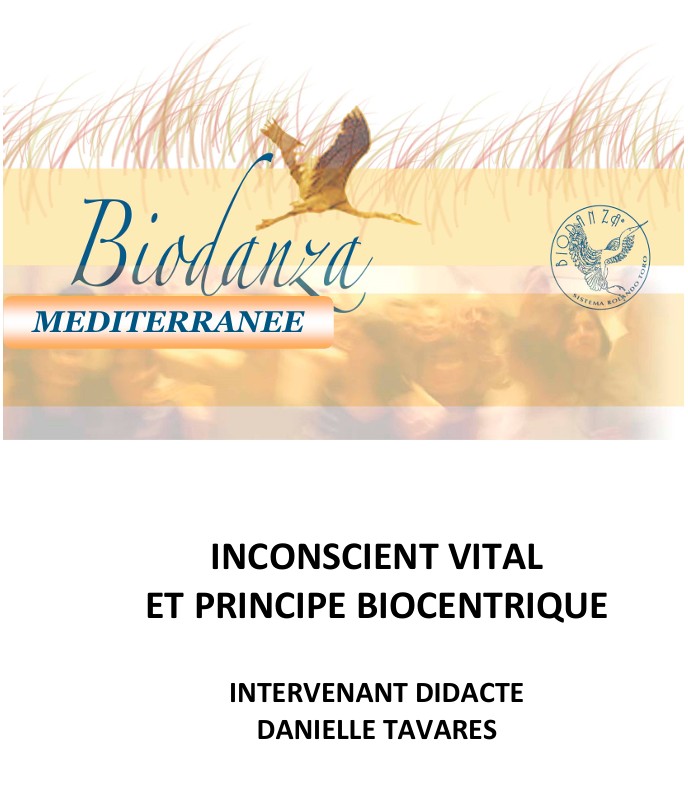
Our other Biodanza facilitator sent me Tavares’ booklet after I was chatting with him about this essay series on the need for a reenchantment of our sacred world – and her vision is, indeed, very close to my own.
She writes: “Dance, love and life are terms which allude to the phenomenon of cosmic unicity. The creative core of the culture of the third millennium will be born from our ability to restore to life its sacred dimension”. [11]
Tavares says that what distinguishes Biodanza from other practices and beliefs is the clarity of its biocentric principle, “which sees life as being the highest expression of the divine mystery”. [12]
She adds: “In Biodanza, people who establish contact in a ‘dance of love’, discover the cosmic meaning which integrates them into a much greater unity.
“The magnetism of the dance generates creative, erotic and biological energy fields which constitute the great ceremony of life, transcendent in its very essence”. [13]
“The sacred is not confined to a ritual space (mandala or temple), but extends to all the circumstances in which life is manifest. Everywhere, the whole of life is sacred”. [14]

Biodanza founder Toro (pictured) wrote about accessing the ecstatic feeling of belonging to the universe, “the supreme sensation of something great and eternal within yourself”. [15]
I would say that this gnosis is the necessary accompaniment to our long-overdue exit from the global industrial prison.
Reclaiming our withness, on every level, is an act of rebellion against a system built on separation and control.
Our belonging is our resistance and that resistance, in turn, amplifies our sense of belonging – we can set in motion a magical spiral of individual and collective spiritual self-empowerment.
There is nothing more threatening to our overlords than a way of thinking and being which is based on joie de vivre, love and connection, insists Taveres.
“This recognises no external authority, whether government and institutional violence or political, religious or discriminatory ideology. The biocentric principle is pure revolt”. [16]
And this revolt must of course involve an explicit rejection of the fraudulent “scientific” worldview artfully sold to the world by the Invisible College in the 1600s. [17]
Anne Marie Riel, a Biodanza facilitator in Quebec, writes: “Has a big cultural lie succeeded in desacralizing life? For it is only when life is deprived of its sacred quality that it loses its intrinsic value and can then be mistreated, exploited, even destroyed”. [18]
Says Tavares: “People’s separation from the cosmic matrix of life has triggered, throughout history, essentially destructive forms of culture. The dissociation between soul and body has led to the profound cultural crisis facing humanity…
“We have to free ourselves, with absolute determination, from all kinds of cultural argument based on profit and destruction”. [19]

[1] https://www.youtube.com/watch?v=jRu_yAasreo
[2] https://www.biodanzarolandotoro.com/en/rolando-toro/
[3] https://www.biodanza.org/en/definition-of-biodanza/
[4] https://biodanzarj.org/danielle-tavares/
[5] Danielle Tavares, Inconscient vital et principe biocentrique, École de Biodanza Rolando Toro Méditerranée, p. 4. All subsequent page references are to that work and all translations from French are my own.
[6] p. 6.
[7] Tavares, p. 16.
[8] p. 26.
[9] p. 27.
[10] p. 28.
[11] Ibid.
[12] p. 29.
[13] Ibid.
[14] p. 30.
[15] Rolando Toro, ‘L’inconscient numineux’,
https://www.ecoledebiodanzalyon.com/post/l-inconscient-numineux-par-rolando-toro-araneda-1
[16] p. 30.
[17] https://winteroak.org.uk/2025/08/11/the-invisible-college-and-the-plan-for-our-enslavement/
[18] Anne Marie Riel, ‘Célébrer le sacré de la vie’,
https://www.cheminement.com/rubriques/expression-et-creativite/celebrer-le-sacre-de-la-vie/
[19] p. 27.
 winter oak