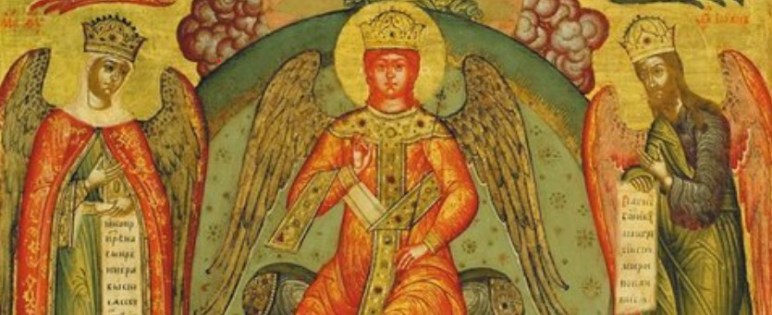
Following our publication of Paul Cudenec’s series of essays on “The Spirit of Sophia” in September, long-time UK reader Wayne John sent us a well-informed essay he wrote around the same subject, which we are delighted to be able to share here.
The central Christian confession of faith is the proclamation that ‘God is Love’ (1 John 4.8). Far from any hint of modernist sentimentalism in this Creedal witness is the basic understanding that the ‘Godhead’ is relational. That is to say, God is more than a Unitarian being of one ‘person’ but rather, a form of communality.
God is a community in communion, which is to say that he must be defined as being in relationship. The basic Christian experience of God is to know God as a Trinity: the Father is the unbegotten, the Son is the begotten, the Holy Spirit is he who proceeds. All three are one and are uncreated, but the mutual love that they share is the created logos that is the ‘divine wisdom’, otherwise known in esoteric Christianity as the ‘Divine Sophia’, the soul of the world both in creation, redemption and the consummation at the end of time.
The Hebrew Old Testament speaks of the ‘Shekinah’, a theme very much developed in the wisdom tradition such as that portrayed in the Book of Proverbs (Pro 8.22.35). As Old Testament biblical exegesis, the interpretation is understood in Christian tradition as representing a ‘veiled prophecy’ – it is important to understand how the New Testament is latent within the Hebraic scriptures awaiting fulfilment and transcendent ‘orthopraxy’ through the Greek scriptures of witness to Christ Jesus, the uncreated Logos.

In the central mystery of the incarnation, there was a replay of the manner in which the Holy Spirit existed from all eternity in the bosom of the Father. In a celestial prototype of marriage, developed in the creation account of the Book of Genesis, the Son leaves the Father to seek a bride. The bride becomes a wife and is ‘lost’ in her husband to become ‘one flesh’ in the body of her bridegroom, forsaking her maiden nature. Therefore, as Eve ‘the Mother of all Living’ (Gen 2.21-25, 3.20), the Divine Sophia was created from within the ‘rib’ of the Triune Godhead/Holy Trinity as a manifestation of its common life and love in relationship, both understood as the beginning, process and goal to be realized in all creation. As the Russian writer Fyodor Dostoyevsky once wrote, “Beauty will save the world”.
The Divine Sophia, or wisdom, is the first created being – and while older than the rest of creation, is yet younger than God although not co-eternal with God. C.S. Lewis, the famous Anglican theologian, Christian apologist and fantasy writer, once remarked that towards God, “all of creation is feminine” in that, while God acts and initiates, creation is thus receptive and responds. This receptiveness is an image of the church as the bride of Christ, destined to ‘disappear’ into the body of Christ in consummation, as echoed in the words of the Virgin Mary when, in reply to the Angel Gabriel, she says in willing submission, “Behold the maidservant of the Lord! Let it be to me according to your word.” (Luke 1.38).
Thus, as well as consenting to be the Mother of God (theotokos) in co-operation with the Holy Spirit (synergy), the Virgin Mary actually becomes ‘the new Eve’, according to biblical typology, just as Jesus becomes ‘the new Adam’ by way of his incarnation, and together through their union they undo the sin of the original Adam and Eve. In his love for Eve, Adam – in actually following her in transgression – identifies himself with her sin, and in doing so actually prefigures Christ in his crucifixion. Equally, while Eve brings forth children in sorrow (Gen 3.17), Mary as a type and personification of the church brings forth her children through the waters of baptism and the bread and blood/wine of the Eucharist.

This is developed further in the Book of Revelation (Rev 12 1–16) where the great sign in heaven of a ‘woman clothed with the sun’ reveals the theotokos further as partaking of, and manifesting, the divine wisdom; ‘the moon being under her feet’ proclaims her pre-eminent role over the creation, again typifying the Divine Sophia as being created before the foundation of the world. Thus the ‘woman’, or Mary/Sophia, being symbolic of the hope and mission of ‘Israel’, finds her consummation and is lost in the body of her bridegroom: the Church as Bride of Christ. She also fulfils the proto-evangel of Gen 3.15.
We therefore find the theotokos in Catholic and Orthodox theology, embracing all three of the ‘pagan goddess’ aspects. She is virgin, mother and crone, personified in there also being three Marys at the Cross (John 19.25). As both man and woman equally share in the divine image, the creator must therefore embrace a duality of feminine and masculine attributes while at the same time transcending both of them, being also progressively revealed as both immanent in creation while also transcending it, in a manner akin to the richness inherent in the Taoist concept of yin and yang. Sometimes, theologians have described this relation with the term ‘panentheism’ (God is in all things and all things are in God). Some mystics of the ‘apothatic’ way describe God as therefore both ‘personal’ and yet completely beyond ‘personality’, embracing both light and darkness (i.e. the ‘via negativa’ way as contrasted with the ‘via positiva’ way).
In eastern orthodoxy, particularly of the Hesychast tradition (which is normative for the eastern Greek and Russian traditions), one should always distinguish between God as manifested in his ‘essence’ and God as experienced in his ‘energies’. While we will never know God in his ‘essence’, being creatures, we can know God in his energies, which can lead to actual deification, ‘being partakers of the divine nature’ (2 Pet 1.2-5).
In his Epistle to the Ephesians, St. Paul further develops this whole theme when addressing the union of a man and woman as being symbolic of that between Christ and the church, calling it a ‘great mystery’ (Eph 5.22-32). This ‘great mystery’ hints at a form of ‘sexual eschatology’, mystically realized in marriage and prefigured in the Hebraic Song of Songs, which Christians have always interpreted as being an allegory of Christ’s love for his bride, or ‘Israel universalised’, in the church. This allegorical exegesis of ‘The Song of Songs’ suggests that, at its highest expression, human sexual love is a gateway to – and revelation of – the divine purpose in creation. The early church father, Origen, speculated that even in heaven, ‘exclusive’ relationships might be manifested, although these would not be expressed through physical sexuality.

As the Divine Sophia in the esoteric Christian tradition is not ‘fallen’, as she is portrayed in Gnosticism, her manifestation in the theotokos has already anticipated and experienced the full resurrection of the body as understood in the Orthodox teaching relating to The Dormition (or falling asleep) of the Holy Theotokos, where it is believed she has already been received into heaven in a perfect unity of body, soul and spirit before the day of resurrection, thus also personifying a ‘realized eschatology’ within the creation.
This is also expressed in the iconography of the Orthodox church by the iconostasis, or iron screens, which separate the altar from the congregation in the layout of the church, and manifest scenes from the life of Mary, along with those from the life of Christ, starting with the Nativity of the Virgin and her presentation in the temple, and ending with The Dormition. In the Roman Catholic tradition, this is a dogma called The Assumption of the Virgin Mary.
Carl Jung was very highly sympathetic to the event of this papal dogmatic proclamation. He was much influenced by alchemical and Gnostic traditions, suggesting that this was the most outstanding theological development since the Reformation, as it implied a veneration of the earthly principle of the feminine. This aspect of humanity had now been taken into the very Godhead, and transfigured in light. Thus, it bridged the gap between the separation of spirit from nature to embrace a holistic, theocentric conception of divine humanity, alien to any hint of a reductionist dualism. As the prophet Isaiah says, “Behold a woman shall encompass a man” (Jeremiah 31:22).
Therefore if humanity is called to be both a co-creator with God, being made in his image, and then to be fashioned later into his likeness, what of the final consummation of the redemptive purpose in creation?
Some mystics of all religious traditions have suggested that divinity wished to reflect itself in creation as in a mirror, similar to the Hindu concept of ‘thou art that’. In this sense, perhaps the Divine Sophia is that mirror, ‘the morning dream of eternity past’, which prophetically reveals as a prototype the blueprint for the whole creational process that all are called to realize in themselves, through grace in the Holy Spirit. The Divine Sophia is therefore the Spiritus Mundi or world soul and matrix of all life, and God creates Sophia as the mirror in which to behold God’s idea of creation. Latent within this perception and discernment are the contemplative ingredients for a revived and renewed ‘nature mysticism’ that could even provide the basis for a prophetic Christian re-engagement with ecology and sexuality.
For wisdom is more mobile than any motion because of her pureness she pervades and penetrates all things. For she is a breath of the power of God and a pure emanation of the glory of the Almighty, therefore nothing defiled gains entrance into her. For she is a reflection of eternal light, a spotless mirror of the workings of God and an image of his goodness. Although she is but one, she can do all things and while remaining in herself she renews all things, in every generation she passes into holy souls and makes them friends of God and prophets for God loves nothing more so much as the person who lives with wisdom. She is more beautiful than the sun and excels every constellation of the stars. Compared with the light she is found to be superior for it is succeeded by the night but against wisdom evil does not prevail. She reaches mightily from one end of the earth to the other and she orders all things well.
(Wisdom of Solomon 7.24-8.1)

 winter oak
This is all very nice but seems to have little basis in historical reality or genuine mystical vision, and is rather naive, no offence meant!
The essence of Abrahamic religion in practice is a full-on assault on the Goddess in her every form, and the removal of women from priesthood or any position of power, and the removal of indigenous “sprituality” (inadequate word) and healing modalities.. without those the people are cripples and easily enslaved.
Abrahamic religion is irredeemable. I chose that word deliberately. There is no genuinely benevolent essence in the Abrahamic creed.
It does not derive from Hindusim or Buddhism but rather is a malignant distortion of these. The originators were the Zaddikim, and the Nazarenes and Essenes were offshoots. None of them were peace loving hippies but deranged, sexually deprived ascetics completely under the influence of the Archons. The conduit for this hijacking was the entity named Melchizedek and only mentioned in passing in the Bible.
Genesis is profoundly anti-human and anti-woman and the Bible as well as the Talmud are the creation of the Archons.
“Gnosticism” was coined by the early Judaic church fathers to refer to a diverse demographic of people they were setting off to exterminate. Which they mostly accomplished hence the Nag Hammadi books being hidden in an obscure goat cave! The people who dictated some of those books were likely murdered for declaring that Yahweh was Satan.
The pagan “gnostics” did not describe Sophia as “fallen from grace” but as literally descending from the Pleroma to transform into the planet Earth. The english translations of the “gnostic” texts are mostly done with the wrong assumption that they are early Christian texts.
With the above context you can really read the Hypostasis of the Archons and other pagan “gnostic” texts.
The Archons are psychic parasites produced as a side effect of Sophia’s “fall” to become the living planet. They are even shown in the Kabbalistic Tree of Life as the “qliphoth” which means “shell” , but of course kabbalists are far from any gnosis and the true significance of this is lost to them.
The Archons are mortally jealous of human beings for having a soul and are desperately trying to use human beings so as to get back to the source, the Goddess, but they never can. They can only be dissolved in the light of consciousness.
There is no unification or reconciliation possible with the Abrahamic creed. It is an aberration produced by the Archons so as to create the situation we find ourselves in now with transhumanist parasites feeding off a spiritually lobotomised population.
LikeLike