by Paul Cudenec, who reads the article here
It is not normally a risky cloak-and-dagger endeavour to head out with some friends on a Saturday night to see a show by a well-known 60-year comedian.
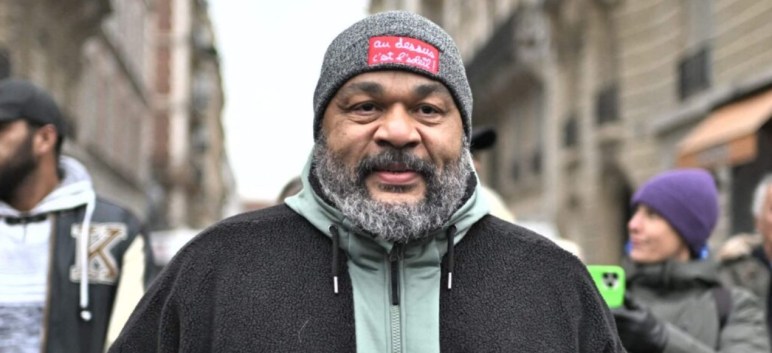
But, here in France, this is indeed the case if the comedian in question is M’bala M’bala Dieudonné (pictured), who became a big name in the 1990s and was also once known for his political campaigning against racism and the far right.
For the last 12 years he has been relentlessly legally persecuted – he is currently forced to wear an electronic tracking bracelet – and treated as a social pariah by politicians and corporate media.
Mainstream venues have refused to host him, local authorities have repeatedly banned him from performing on their patch and he has been arrested on stage while trying to do his act.
Even his audiences have been criminalised – being fined merely for having attended wildcat shows.
Dieudonné’s terrible crime? To have criticised those we are never allowed to criticise, by poking fun at Israelis and Zionists.
And we now know specifically who is behind this ongoing vicious cancelling campaign.
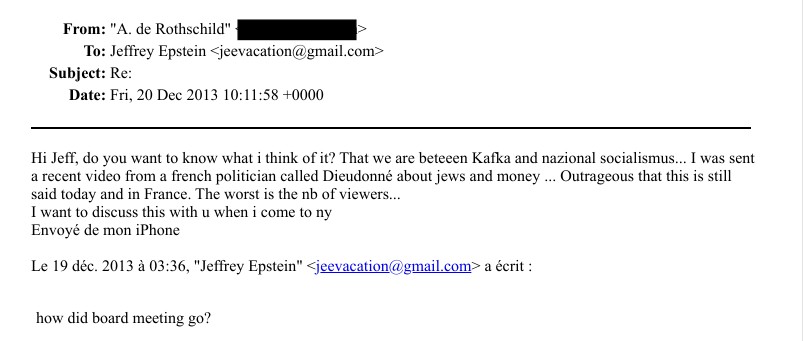
The information came from the famous files recently released in the USA, from which, among much else, it emerged that paedocriminal Jeffrey Epstein worked for the Rothschilds.
As I wrote in ‘Epstein, the Rothschilds and the global cabal‘: “In 2013 when Ariane de Rothschild was irritated by the popularity of French comedian Dieudonné – and his critique of the bankster clique to which she belongs – she asked Epstein to do something about it.
“A few weeks later the French authorities started banning Dieudonné’s shows and trying to silence him – a totalitarian assault on free speech that continues to this day“.
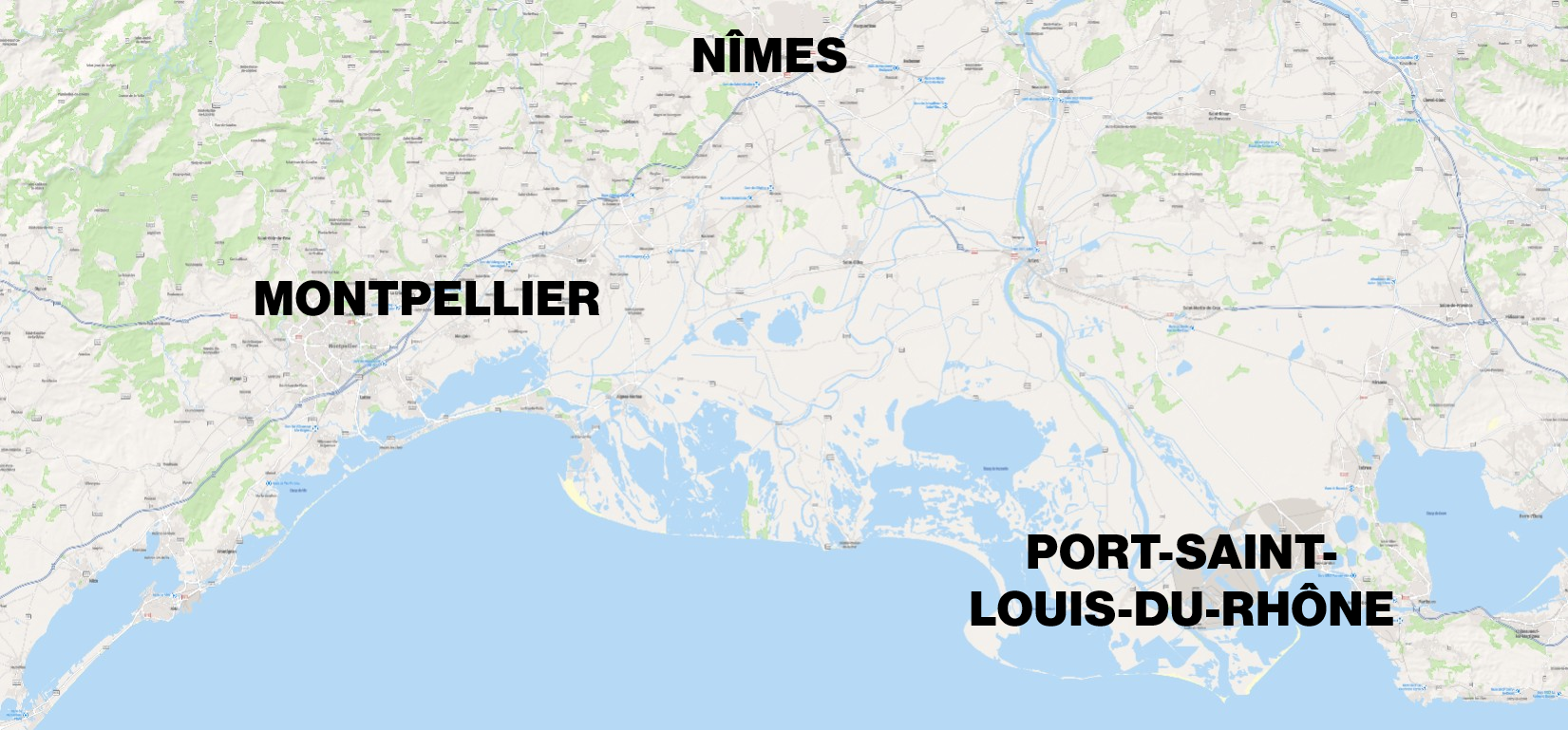
My friends and I booked our tickets for his planned March 28 tour date in Montpellier, in the Hérault département, weeks ago and soon found ourselves wondering if we would actually manage to see his act.*
Dieudonné has described online how one combination of local bans in the south-west of France ended with him heading across the Spanish border, followed by his audience in their cars, to hold the event beyond the limits of the French state.
Sure enough, on the evening of Friday March 27 he announced that la Préfète de l’Hérault, Chantal Mauchet, had banned the event in her area, on what looks to me like very spurious grounds of a threat of public disorder.
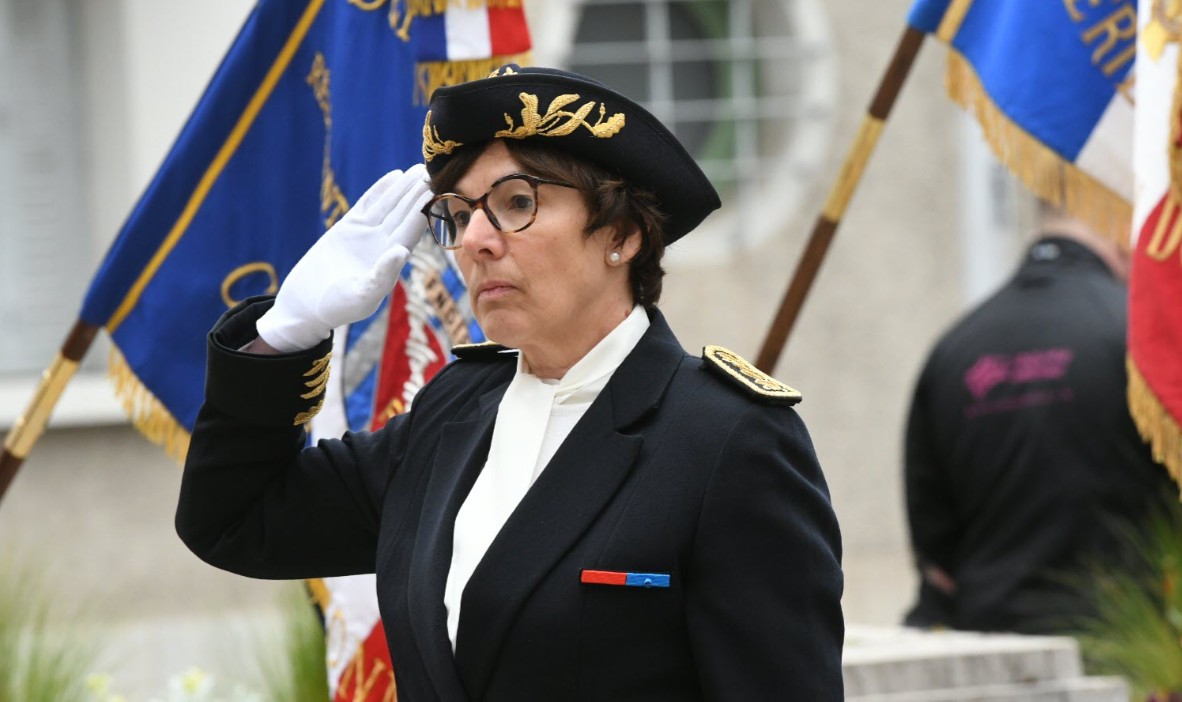
Mauchet (pictured) is a faithful servant of the French Establishment, having previously been appointed prefect of three other départements and rewarded with the Légion d’Honneur and Ordre National du Mérite.
On Saturday afternoon we received text messages from Dieudonné’s team to head instead to the outskirts of Nîmes in the adjoining Gard département, which was good news for us because it is a bit closer. We were also told to bring our own chairs with us.
When we arrived there, we received a further message telling us that the show would be taking place an hour’s drive away at Port-Saint-Louis-du-Rhône in the département of Bouches-du-Rhône in Provence.
None of us had ever been to this place before, which lies at the eastern limits of the Camargue, where the river Rhône enters the Mediterranean. It turned out the venue was a warehouse in a maritime industrial zone filled with boats.
French Wikipedia says that while Dieudonné insists he is anti-Zionist and anti-System, some “see him as a representative of the new anti-semitism”.
The powers-that-be in France try to portray him as some kind of “Nazi”, despite his skin colour – his mixed origins are from Brittany and Cameroon in central Africa and he literally wears the flags of those two places on his sleeves.
But the atmosphere at this venue could hardly have been further from that of a Nazi rally!
It was more like a cross between a squat party and an illegal rave, except that the audience, filing in carrying their folding chairs, were not from any particular cultural scene or age group.
They looked to me simply like a cross-section of the local French population, the sort of people you pass in the street every day.
However, of course, these individuals’ mere presence at this extraordinary event meant they were far from being “normies” – someone next said to us said that we were among the “awake”.
By the time Dieudonné took to the podium, to a rapturous standing ovation, the warehouse was full – there must have been 500 or 600 of us there.
The first half of his act involved him playing some of the characters for which he has become known and loved by so many.
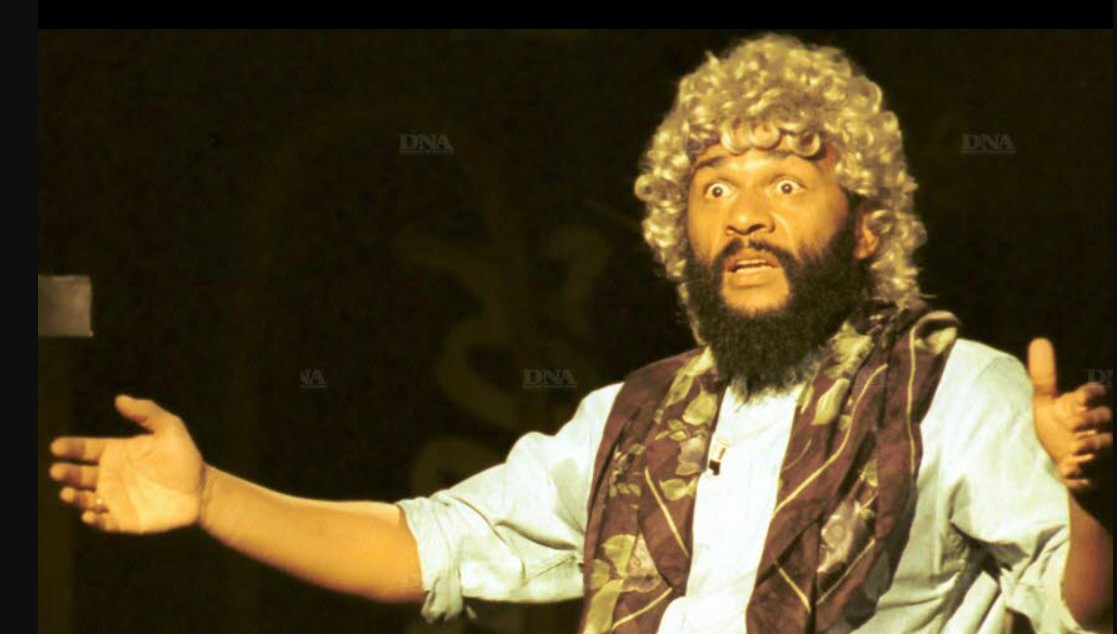
He really is a talented actor as well as comedian – not just his voice but his whole face changes as he switches, in quick-fire “dialogues”, from one personality to another.
The second half focused on the title of this new show – ‘Le fil d’Ariane‘ (‘Ariadné’s thread’), which obviously refers to the message concerning him from Ariane de Rothschild to Epstein.
Dieudonné explained his utter disbelief when he learned about this email, in which Rothschild described him as a “politician” who spoke about evidently forbidden connections between Jews and money.
She complained that his audiences were too big and proposed she should meet Epstein in New York to discuss what to do about him.
The effects were immediate and the subsequent legal warfare against him for “hate speech” and defamation was all-out and ruthless, he explained, and led to his name being attached to a well-known legal precedent in France, the Ordonnance Dieudonné du Conseil d’État du 9 janvier 2014 restricting the previous right to free expression.
His latest conviction, he explained, had – quite absurdly! – been for anti-black racism, in a prosecution launched at the behest of Jewish organisations: he had referred to a fellow black person, a woman, as a “House Negro”, meaning a traitor to her own.
Now he understands that behind all this were the Rothschilds, who he said were “the mafia of the mafia”, with well-known mobsters like Al Capone fading into insignificance in comparison.

Having explained the history of these Enemies of the People to the audience, and how they came to have such a stranglehold on France and the world, he presented an imagined dialogue between two long-dead men.
The first character he incarnated – indeed seemed to become – was Mayer Amschel Rothschild (1743-1812), the founder of the notorious money-power dynasty.
The second was one of his own African ancestors who would have been living a very different existence at the same time.
The serious moral question posed by this comic sketch was which of these two men’s 21st century descendants had met with real “success” – those who had sought money and power by any means and with zero scruples, or a man with the gift to make people laugh, even when forced to do so in a warehouse in a far-flung corner of France.**
As the wind from the sea battered relentlessly at the roof and doors, and it became evident that my extra jumper had not been enough to keep the cold at bay, I suddenly became sharply aware of the context of the surreal scene in which I was participating.
A talented comedian, and his fans, had been criminalised for mocking, and standing up to, a depraved and powerful mafia which steals, cheats, lies, intimidates and bans, which starts wars, destroys cultures and desecrates nature, which rapes, tortures and murders children – all with apparent impunity.
Surely we have now reached a historical tipping point where the vast majority of us simply cannot take this insanity any more?

* The venue was not announced but was to be revealed on the day.
** The police did not show up at all, I am happy to report.
 winter oak
Poor little Ariane has lost her soul – all that is left is a little girl.
Her clan of inbreds have the monopoly over Usury -[the root of all evil] which is dedicated to establishing and then maintaining dominance over others.
Afraid of what people will say about her behind her back, and laugh about it – Ariane lives in fear of being being ridiculed – then so it mote be.
LikeLike
Yes. More mockery is required!
LikeLike